I know you’re all dying to read the first chapter of this book, and I will get to it. I have a couple things to say first.
One, I have to add something to my objective list of why Twilight is bad. I forgot all about (or blocked from my memory) the scene in the fourth book that occurs after Bella and Edward have sex for the first time. Because she’s a human and he’s a super strong sexy sparkly ssss…svampire, Edward can’t help hurting Bella during sex. But of course she doesn’t remember it. Whatever. I don’t care about their sex life. What I do care about is Bella’s reaction when she wakes up the next morning and finds herself covered in bruises. Edward has his first ever justifiable session of self-loathing, but Bella brushes aside the signs of abuse. She even has a moment in the bathroom where she thinks about how best to hide the bruises from other people’s sight. Since I feel like this kind of thing needs evidence to support it, I actually delved back into the world of Twilight and found the passage. Just for you guys.
I concentrated on the bruises that would be the hardest to hide – my arms and shoulders. They weren’t so bad. My skin marked up easily. – Breaking Dawn, page 95
I do not care what arguments there are in favor of these books and this author, the previous excerpt is absolutely unacceptable. If I have to tell you why, then…well, I just pray that nobody reading this has to be told why it’s bad.
Moving on from that, I feel like I should explain my inspiration for Grotesque before I put the excerpt in because I know if I don’t, somebody is going to call me out on it and there will be a huge scandal and I’ll never be able to show my face in public again.
To start with, I was not actually inspired by Beauty and the Beast. However, I do acknowledge that many aspects of the book can be seen as Beauty and the Beast – esque. And I’m okay with that, because I love that story. But I thought I’d make it known that none of it was intentional. No, my true inspiration came from a different source.
There was this cartoon show that I used to love called Gargoyles. It ran in the early 90s, and I have no idea what made me think of it, so don’t ask. The thing is, since I was only three or four when I watched it, I don’t really remember much of the show. Here’s what I do remember:
- There was a group of creatures – Gargoyles – that turned to stone in the morning and came back to life as soon as the sun set in the evening.
- There was a human woman who was their friend.
- The leader of the group was this big guy named Goliath.
- Goliath often found himself fighting robots that looked just like him. (Aside: The English major in me loves the juxtaposition of the ancient, magical creature and the epitome of modern, scientific technology.)
- They had a Gargoyle dog, which is not really relevant, but it is still badass. Can you say that you have a Gargoyle dog? No? Didn’t think so. (If you can, I would very much like to go over to your house right now please.)
So, curious about this show, I looked up and watched the first few episodes. And I was fascinated. Not just because it featured blood and guns, despite being a children’s cartoon show on the Disney Channel, but because it really made me think.
The Gargoyles’ story begins in Scotland, some 1,000 years ago, where they act as guards of this castle where they must have been carved or something. At first I thought, How interesting. I wonder how they got wrangled into that deal. Are they enslaved? Or is it some sort of agreement? Like, “Sure you can live here. No, you don’t need to pay rent. But could you protect us from Vikings? K, thanks.” But it wasn’t like that at all. The Gargoyles simply saw protecting the castle as their duty, their purpose in life. They lived for nothing else. And that got me thinking about how different this story would have been had they been forced into protecting the castle instead of doing it willingly.
From their very first encounter, there is a romantic tension between Goliath and his human friend, Elisa. I say “romantic” and not “sexual” because this was a kids’ show, so any sexual tension I saw came from the adult point of view that I brought to the show, not something that was already there. Although it might have been, since the writers and animators were adults. But that’s not important. It just made me think of more things, and it is probably where most of the similarities to Beauty and the Beast come from. Of all the Gargoyles, Goliath looks the most human, but he still isn’t. Being a kids show, Gargoyles would never have to address this issue. But as an adult viewer, I wondered how a relationship like that would work out. I wanted to know how their love would be reconciled with their difference in species, so to speak.
From those two thought processes, I formed the idea behind Grotesque. First I looked up gargoyles on Wikipedia and found out that the show’s title was a misnomer. A gargoyle was actually just a glorified waterspout with an animal face. Grotesques are the scary statues. But I see why “gargoyle” became the more popular of the two words because it does sound way cooler. Still, I chose to call the statue a grotesque for accuracy’s sake, and because the word’s various connotations were rich with literary promise, as I hope you’ll see.
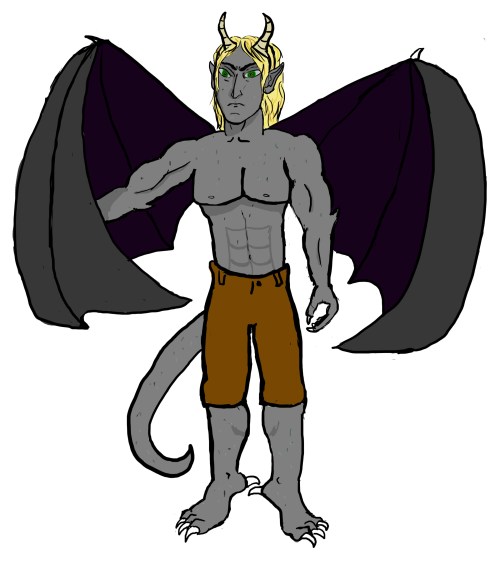
Finally, before we move on to the actual story, I wanted to let you know that I did some concept art for the book. I’m going to put it at the bottom of this post, so you can get an idea of what I think Serrafiel looks like. Now, without further ado, here is chapter one of Grotesque:
Part 1
Enslaved
Chapter 1
I awaken for the first time on the ledge of a tall building, the ground too far below for comfort. Above me is an inky black sky full of bright stars, a large moon, and a few wisps of gray cloud. The words for these things come easily to me, in a language that floods my mind, though I don’t know where it came from.
Truth, be told, I don’t know where I came from, either. Or how I got up here. I look to my left and see a stone statue, its mouth open in a snarl, horns protruding from its head, and clawed hands keeping it secured to the ledge. On my right is a similar carving.
I look down at my own hands and see claws, feel a strange twitching sensation around my shoulder blades and turn to see two large, leathery wings protruding from my back. Swallowing, I reach up to touch my face – careful of the claws – and run my fingers up my forehead, feeling my heart plummet when I reach a pair of horns. I look back at the statue on my left. Apparently I belong with it, am one of its kind. But then…why am I awake when it isn’t?
Reaching out tentatively, I tap the statue on the shoulder. It still feels like hard stone, and I notice that my skin almost matches it in color. I tap again, a little harder.
“Um…hello?”
So I can speak. My lips form the words around pointed teeth. My stone brother makes no response. I sigh. I’m definitely alone up here. Looking around, I try to decide my next course of action. I suppose I should try to get inside; I’d really rather not be on this ledge anymore. My wings fold shut with just a thought, and I’m able to reach out and feel along the wall behind me. The ledge is too narrow for me to turn around, so I can only scoot along and hope to find a window. That or…can I fly? I’m not so confident I could manage it, since I don’t have the faintest clue how it’s done. I look down at the ground again and decide against trying; I don’t really want to risk my life when I’ve only just gained it. That decision made, I continue to feel along the wall, my clawed toes giving me a secure hold on the ledge.
I’m in luck. There’s a window just beyond the statue to my left, the one I tried to wake up.
“Sorry, friend,” I say as I climb over him.
Seconds later, I’ve slipped inside the window, and the chill of the outside is lessened somewhat. I take stock of myself again. My legs are a bit cramped, but that’s to be expected since I’ve been kneeling for…however long I was a statue. I bend my legs up and down to try and get the kinks worked out, and that’s when I notice the thing that’s dangling between them. I raise my eyebrows at it, and then the word for it, as well as what it’s typically used for, comes to mind. Heat rushes to my face as I look away from that part of my anatomy. I definitely won’t be using that anytime soon. Maybe I should find something to cover up with. The word “clothes” comes to mind, and with it the knowledge of what they are and what they’re used for. Yes, clothes are used to keep warm and to cover up private things like the one between my legs. I look around the room I’m in, trying to find something to pass for clothing.
The room is dark. Several sconces are on the wall, but none of the candles within them are lit. I do see that the wicks are black, so someone has used this room at least once in the past. Aside from the sconces, there is a table with a dusty cloth covering, and a fireplace that contains a couple of fresh logs. The tablecloth will have to do for clothes, then. I pull it off the table, give it a shake, and wrap it around my waist. It’s far too long, so I use my claws to shorten it, and then fashion a clumsy knot so it stays put. That done, I try to decide what to do next. I’ve been able to ignore it for the past few minutes, but now I’m aware of an insistent tugging deep within my gut. Someone or something is definitely pulling me toward them, and I really don’t know if it’s a good idea to resist or not. So I follow the tugging sensation and leave the room.
A long staircase leads me deeper into the heart of the building, and I feel when it starts to get warmer – someone has a fire going.
I push my way through another door and into a room that is…buzzing. That’s all I can do to describe it. I feel something crackling in the air, a force of some sort. It’s not quite alive but it has a life to it. And at the center of it all is a man in a long, brown cloak. He is bent over a table that is covered in books, and in front of him is a small wooden bowl that is issuing a stream of bluish smoke.
This is the first human I’ve ever seen, and he’s rather unremarkable. He has gray hair and a slight build that is swallowed up by his cloak. Though he’s bending over the smoking bowl on the table, I can tell that he wouldn’t be that tall if he were standing up straight. Still, he is human, and that is apparently a desirable trait, or so the helpful reservoir of information in my mind tells me. Being human is normal, so whatever I am is not. I find myself resenting my abnormality, especially when I step further into the room and glimpse my reflection in a dusty mirror on the wall.
My hair is long and…the word for it is “blonde.” It falls down my back in waves, resting between my wings. My horns sit right at my hairline, two yellowy-white bones that rise a few inches above my head. I have very angled features, but they are not as fearsome as those of my brothers on the ledge, at least. My eyes are bright green, and I think they might be glowing a little. I can see that the parts of my body that aren’t covered by the tablecloth are tight with muscle, and my feet appear more like a bird’s talons than anything else. Then there’s the tail. How did I not notice it before? It is long and reptilian, and it drags along the floor behind me.
“What do you think?”
I jump and look at the man in the cloak. I’d forgotten he was there, but as I look at him, I realize he was the thing that had been pulling me. Now that I am here, the feeling in my stomach has pretty much dissipated.
“I think…I’m confused,” I say.
“Yes, that’s to be expected,” the man replies conversationally. “I’m just so glad you’re here. I wasn’t sure it would work. Creating life isn’t easy, you know.”
“Um…no, I don’t really.”
“Anyway, I brought life to you because I need some help.”
“Doing what?”
He shrugs.
“This and that. I have rather ambitious plans for my future, and I knew I wouldn’t be able to accomplish my goals without help. So I risked weakening my powers some in order to give you life.”
“What if I don’t want to help you?”
“Oh, you can’t refuse. You’re enslaved to my will. You will have to obey any and every command I issue to you.”
He is so matter-of-fact about it, but I feel anger and frustration rising in my gut as the meaning of his words sinks in.
“So you brought me to life just to use me as a slave?”
“Yes.”
“I think I’d prefer to be free.”
The man snorts out a laugh.
“And what would you do with your freedom? Do you really think people would accept you into their homes? Into their lives? You’d be hunted down and slaughtered on sight.”
I feel my throat tighten, cutting off further words. He is right, of course. This had all been part of his plan to keep me under his control.
“Besides,” he continues. “You can’t be free. Not until I’m dead. And don’t get any ideas. You cannot disobey me.”
Well, this is a solution to one problem at least. I raise my hand and slash my claws across the man’s throat. His blood spills quickly, and he collapses to the floor. The bastard hadn’t ordered me not to kill him, so I wasn’t disobeying anything by doing so.
I congratulate myself on a job well done, and am already planning what I am going to do next when the man’s body begins to dissolve. That isn’t normal for human bodies to do, is it?
“I thought so.”
The voice comes from behind me and I turn to see the very same man stepping out of the air, parting it like a curtain in order to become visible.
“First of all, I order you not to kill me,” he says.
“But didn’t I…just do that?” I ask.
“You killed my double. A mere fabrication. Nothing more.”
“Damn.”
He smiles.
“I can see this relationship is going to be fun. Things might have been easier for you if you had chosen not to kill me. Now that I know you’re capable of it, I’m going to have to keep you on a much shorter leash. Pity.”
I clench my hands into fists, my claws pricking at my skin, but not drawing blood. Apparently I am made of tougher stuff than a human, in order to prevent accidentally hurting myself. That would explain why my mouth isn’t full of blood, though my pointed teeth have been scratching at the insides of my lips.
“Let’s see now,” the man muses, finger tapping against his chin. “I order you to never speak of me to anyone else, to never ask for help from anyone, to never explain your situation to anyone. I also order you not to hurt me, poison me, or attempt to make me sick in any way. There, I think that will do for now. Oh, yes. One more thing.”
He raises his hand and I see bright, white sparks flying from his fingers. Then he closes those fingers around my upper arm, and I feel pain for the first time. A scream is wrenched from my throat as I fall to the floor, writhing as I try to get away from that hand.
“This is the price of disobedience,” the man tells me calmly. “If you should ever start to wonder if there is a way to go against my wishes, to fight me, remember this moment.”
He removes his hand, and I slump against the cool, stone floor, panting.
“You will call me ‘Master.’ You will not leave this church unless I order you to do so. You will not attempt to run away.”
With each new order, a weight inside my chest grows heavier and heavier. He does not chain me, but I feel as if I am shackled anyway.
“Go to the room upstairs and stay there. That is to be your room from now on.”
I am in so much pain that I am unsure if I can move, but my body seems to lurch forward of its own accord. Compelled by the magic that forces me to obey, I manage to drag myself back up the stairs to the cold room I arrived in earlier. As soon as I am there, I collapse back to the floor, shivering. In an attempt to get warm, I wrap my wings around myself. My body craves sleep, but it will not come.
I hear footsteps on the stairs, and a moment later, Master steps into the room with a plate of food. He sets it down by me and then points a finger at the fireplace. The wood within it ignites into a large, crackling fire, and the room instantly floods with heat and light.
“You won’t be able to sleep until the sun rises, at which point you will turn back to stone,” Master explains. “Those were the terms of giving you life. You will wake again once the sun sets.”
He leaves me after that, and I don’t make any move towards the food he’s left for me – a plate of bread and meat. I wish I could return to being stone and leave this life behind me forever. And as I lie on the floor, ignoring the food and waiting for the sun to rise, I begin to cry my first tears.
END CHAPTER ONE <— not really in book, just needed a way to signal that I’m going to start the blogging thing again.
I hope you liked it! See below my picture of Serrafiel (he doesn’t have a name yet, but he will later).
That’s all! I have a bit to say about that common expression or platitude or whatever it is, “Write what you know,” so that’ll probably be my next post.
Word of the Day: Grotesque (adj) – odd or unnatural in shape, appearance, or character; fantastically ugly or absurd; bizarre
P.S. – You might notice that I’m starting to make the Words of the Day pertain to the posts. Just look at how this blog has evolved since I started it! Truly this is astounding!


 Potato Lady Blogs