Monthly Archives: November 2012

Taylor Swift, Mary Sue

The long awaited post by Liz is here!  I want you to know that everything from here on is going to be her material, with the exception of the one drawing I did.  Be nice, as this is her first post here.  Any comments you leave will be directed to her, and responded to by her if she deems them worthy.  Without further ado, Liz’s post!

Half of my preposterously superfluous degree is in literary theory. So, today, I thought I’d share two brief examples of the various readings an academic might apply to your writings, should you produce an insanely good book, or an insanely popular waste of arboreal destruction. As an example, I am going to use a poorly written character with whom you are probably familiar:


Taylor “Bubbles” Swift

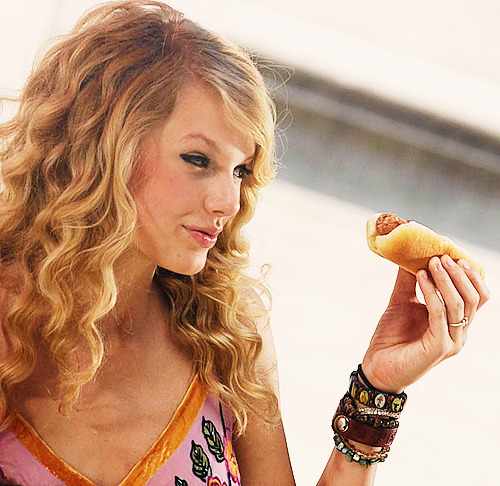
For those of you unaware, Taylor Swift is the above wooden plank. Critics have called her “charming,” “sweet,” “the girl next door,” just a shrug, and “inoffensive.”* She’s meant to be some sort of musician, but the writer that penned her into existence failed to specify a genre. (Although, from her lyrics we might discern that she sings the sort of Pop that lulls her audience into a false sense of security while she steals their money.) The fact that she’s a musician, however, is an insignificant detail of the character. Now that you’re acquainted with Bubbles, let’s get knee deep in theory!

*Bex said that.

A Feminist Reading:

This would probably be the most troubling analysis. From her dialogue (“I love Karlie Kloss. I want to bake cookies with her!”), to her lyrics (“Abigail gave everything she had to a boy / Who changed his mind and we both cried”), Taylor hardly seems a paragon of gender enlightenment. Her primary preoccupations appear to be boys, the fact that she won’t wear the same dress twice, boys, and hoping that a ghost doesn’t sneak up on her to undo her nose job.

Also: boys. She never refers to her temporary male obsessions as “men.” Unless the 22 year old has a dark secret to share, this implies that the reader is meant to see her as considerably younger than the grown woman she is supposed to be. “But her songs are from the perspective of a teenager!” says nobody whose taste is good enough to be reading this blog. Shut up. I’ll get to that in four seconds.

This infantilization is common in badly written female characters and it sends the message that she is inexperienced, only fulfilled by men (sorry, “boys”), and virginal, to the detriment of virtually any other characterization. In other words, some asshole has written the Christian Right’s perfect woman into existence. It doesn’t matter what age or what level of experience she’s meant to possess; her carefully constructed image and not-so-carefully constructed musical drivel exude a coy yet artificial innocence that is devoid of any relatable personality.

This is not to say that the women you write shouldn’t enjoy baking cookies for boys. Or that they can’t be relationship-obsessed, offensively inoffensively good looking, sexually innocent or void of any complexity. But to do so without any awareness of the  feminist implications makes your character – and the rest of your work – pretty easy to attack from this perspective.

A Freudian Reading:

As you may recall from two paragraphs ago, Taylor is a one-dimensional character with virtually no human fears, aspirations, or anus. This would make it somewhat difficult for a Freudian scholar to reduce the entirety of her mental and emotional existence to her childhood (yes) sexuality.

I kid, of course. Freudian scholars never have trouble with that.


Freud was surprisingly prolific for one so addicted to cocaine and incest, making it impossible to sum up his writings here. For simplicity’s sake, a good place to start this type of analysis is with a simple question: “Why is this character so super depressed about sex?” While the answer may seem obvious (humans sometimes have to do things that are not sex, and that is super depressing), it is
actually quite complex. “But my characters aren’t depressed!” you might shout to nobody who cares or can hear you. Well you are wrong, and probably deeply (subconsciously) concerned about the feelings you exhibit towards breadsticks and your sister.

The root of Taylor Swift’s sexy depression is that she’s made a living by being repressed. And extolling the virtues of said repression. See, the central conflict in her life is murky and variegated, and her lyrics plumb the depths of human existence. Sometimes boys don’t notice her, and she really wants them to notice her. And sometimes, terrible women steal the boys who don’t notice her, or boys
notice her and then stop noticing her.

The point is, her incessant yearning for a four-year-old musical theater fan’s idea of romance is almost disquietingly chaste, and that can only mean that she is repressing her baser urges. To bone, is what I’m saying. I could provide some evidence here in the form of any one of her extremely boring quotes, but I won’t. You get it. She’s a terrible character and you can do better.

Word of the Day: Repression (n) – the ego’s ridding itself of unacceptable desires and ideas by dumping them into unconsciousness.

So that was Liz’s post you guys!  I have nothing to add except that you should read this comic by The Oatmeal.  It’s long but it’s worth it.  It describes my thoughts and my life really well.  I’ve got two comics lined up for my next couple posts, so be sure to check back!  And really don’t forget to thank Liz!  She worked really hard on this.
1 Comment

Filed under books, Humor, writing

Ending the Ending

After a great deal of confusion and me wanting to pull my hair out…

…it looks like the poll is working.  (I was wearing purple pants and a gray shirt that day, so I decided to roll with it)  The problem seemed to be that it was showing up for everyone but me.  But the results are in and the winner by a landslide is Danya.  So that’s the character’s new name!  The poll is now closed.

On to the topic at hand: The Ending.

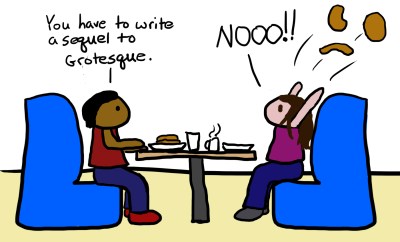
A lot of my books are going to have sequels, so I’m going to start with that – Ending a book that is going to have at least one sequel.  Surprisingly enough, I don’t ever try to write a book with the intent of giving it a sequel.  I sat down to write The Dreamcatchers, Hellbound, and Grotesque with the intention of making them single, one-shot novels.  In fact, I don’t like writing sequels, because I don’t think I’m very good at it.  For The Dreamcatchers, I just came up with some cool new ideas, so I started sequels for it.  For the other two, I was so upset when I realized I had already gone through an entire story, written over 60,000 words, and still had a lot more material to cover.  In both books, there was this central villain that I thought was going to be killed off and taken care of by the end, and both times I found other obstacles had to be tackled first.  And by the time I got through those, the book was over!  Which led to conversations like the one I had with my friend, Micah (M), in an IHOP.

The main reason I balk at sequels is I have so many writing projects going on at one time that I am always angered in a way when I end up with a new one.  That’s why when I had the dream that led to the writing of Hellbound, my first reaction was something like, “Fuck!”

Oh my, I have gotten off topic.  Alright, so when you write a book that’s going to have a sequel, you need to do two things when you write the ending: 1) Wrap up with the main conflict that was covered in the book 2) Set up the conflict that is going to be in the next book.  You can read examples of this in Harry Potter, A Great and Terrible Beauty, Trickster’s Choice, or any other book that has a sequel.  The main point is that you get the feeling when you’re done reading it that you get when someone starts saying something but doesn’t finish the thought.  You’re waiting for more.  You know there should be more.

And there are still a million ways to do this.  You can leave your characters in utter turmoil, or you can make it seem like everything’s going to be fine, until the next book starts and that new conflict arises.  My biggest piece of advice would be to go with your gut, as I’ve said before.  After you’ve managed to write a full book, the ending should come naturally.  If it doesn’t, ask for help from family and friends.  This advice doesn’t change if you’re writing a stand-alone book.  The ending doesn’t have to wrap everything up with a neat little bow.  Graveminder didn’t end that way.  That book ended with the central conflict wrapped up, and a sort of consensus that the changes that had occurred in the main characters’ lives were permanent, and that they were okay with that.

This is pretty much the only advice I can give you.  But here’s something else: I love helping people with their writing.  So if you want to post a comment with a question about something you’re working on, or go to my Contact page and send me an email, I’d be happy to give you a few tips.  Just don’t sue me for offering the advice if it ends up not working for you, because then I’ll be sad.

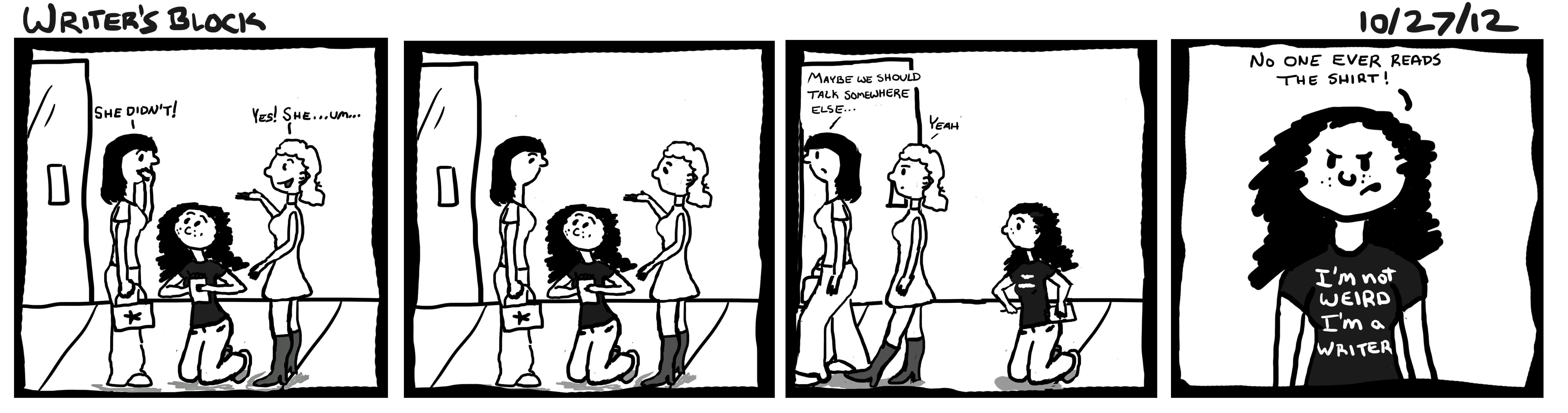
COMIC!! Please note that I tried to make my writing more legible.  Operative word is “tried.”  (Click to Enlarge)

Finally, for those who don’t know, George Takei has written a book and it is available for pre-order.  To anyone who is not a fan of George Takei, you actually are a fan of George Takei, you just don’t know it yet.  Try watching this video if you are unconvinced.

So don’t forget to buy his book!

Word of the Day: Ingenuity (n) – The quality of being cleverly inventive or resourceful; inventiveness.

P.S. Keep an eye out for my next post, because that will be the guest post by Liz that I hinted at before!  You don’t want to miss it.

Also this.  Can you guess what book she’s reading?

2 Comments

Filed under books, Comic, Humor, writing

Starting the Ending

My dad asked me the other day how I come up with endings for my books, and my response was, “Uhhhh…well…um…yeah…I…I don’t know.  I mean…I just do.”

So yeah, that’s not very helpful.  But it did make me realize that while I have talked extensively about how to begin a book, I haven’t really touched on the ending at all.  I think the reason for that is that it never seemed like something I’d need to talk about.  See, I hate to brag, but the endings for my books usually just come to me.  About halfway through the book, I’ll have a small revelation while I’m writing that will clearly detail how my book is going to end.  And then I go, “Ohhh, so that’s how it’ll end!” and then I keep writing.  And when I get to the end of the book, I write the ending pretty much how I imagined it, and that’s that.  I might just have assumed that it happens for everyone that way, and I might just have been wrong.

So we’re going to talk a bit about conclusions today.  But first!  There is a character in Grotesque named Dinah.  She is a six-year-old girl, and I don’t like her name.  So I’m going to change it (God I’m starting a lot of sentences with “So” today), and for the first time ever, YOU are going to get to help decide.  I figure you just got done voting for president, so you’re in the voting spirit.  I’ve created a nice little poll here for you to use.  Go ahead and vote.  Please only do it once.  I disabled the thing that uses Cookies to prevent you from voting multiple times because I don’t really like Cookies (of the computational variety).  Yes there are only two choices, but that is because the others (I use www.babynames.com to find names that have appropriate meanings) were unappealing to me.  E.g. Chipo, Donatella, Matias, etc.  The name meaning I was going for was “Gift.”  So here’s the poll:

UPDATE: The poll doesn’t appear to be showing up, so if you can’t see it, just vote using the comments.  The two names are Nita and Danya.

I’ve already talked too long, and there aren’t even pictures, so I’ll probably split this into two posts so you don’t get bored.  I’ll just do a brief introduction to Ending the Novel.

The ending for your book is largely up to you, and it is honestly very hard to pin down any universal rules for writing it.  Here’s why: If you want to make your ending vague, that’s up to you.  If you are planning on writing one or more sequels to your book, that changes how the ending is going to be.  If your favorite color is blue, then you might write an ending entirely differently from a person whose favorite color is puce.  Here’s my opinion on endings: I once wrote a Facebook status after reading the series that begins with Blue is for Nightmares, by Laurie Faria Stolarz.  I finished reading the last book in the series, and then I said, “How can you even think to contrive a happily ever after that is more like a mildly happy present with a fairly good chance of a felicitous outcome? The ending to a book shouldn’t read like a weather forecast!”

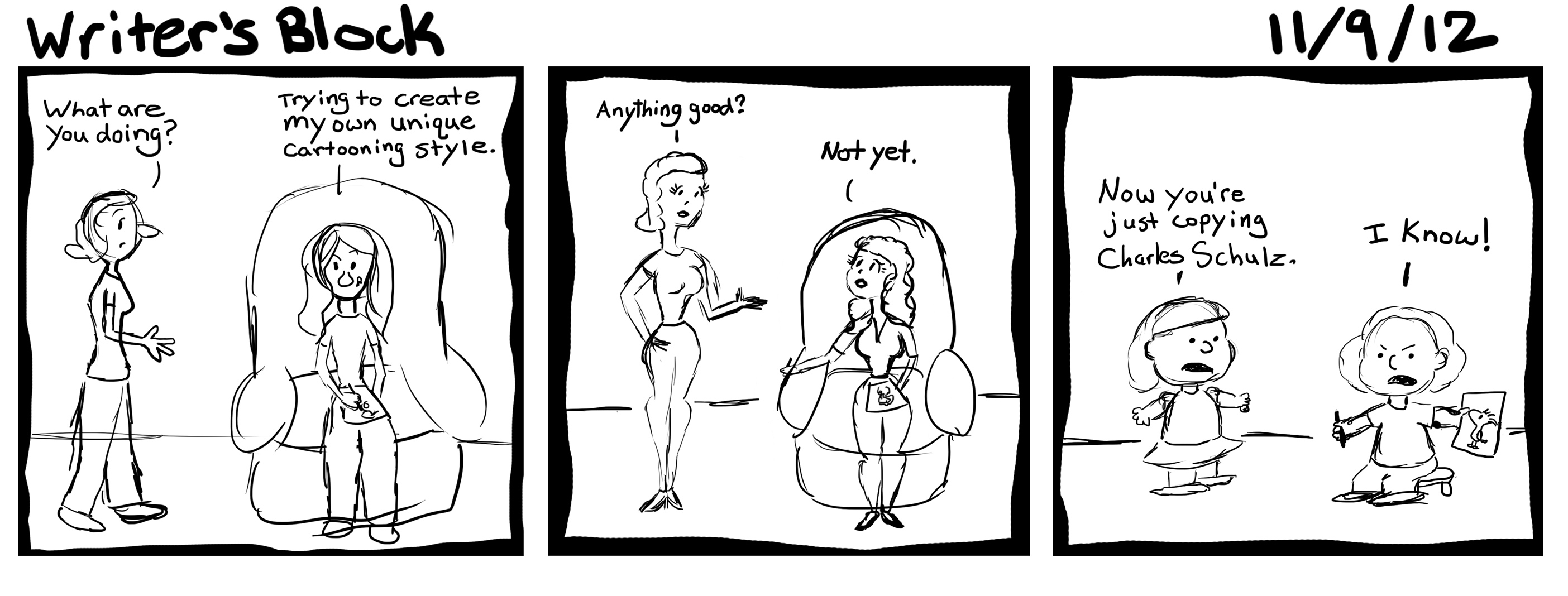
That’s my opinion.  I’ve read a lot of books for work recently that have had really inconclusive and frustrating endings.  If you’re going to write an ending for your book, then write it with conviction.  Even if it’s vague, or purposefully inconclusive, write it like you mean it.  Trust me, it shows.  Your book shouldn’t just peter out once the story’s wound down.  Okay, I’ll talk more about this with more pictures in another post.  For now, enjoy strip #2 of Writer’s Block!

(Click to enlarge)

Word of the Day: Contrive (v) – To plan with ingenuity; devise; invent.

P.S. Results for the Poll will be posted next week sometime, or whenever I get around to writing the next post.

8 Comments

Filed under books, Comic, Humor, writing