Category Archives: Comic

The Character You Can Be

So I got a quill a while back as a gift, and I recently started practicing writing with it.
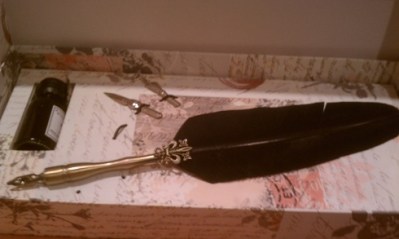
(Also, I’ll give you three guesses who bought the quill for me that’s right it was Liz)

So obviously I’m still a little shaky but check this out:

Nifty, no?

Anyway, on to the post…no, one more thing.  Watch this and laugh with me (Thanks to BuzzFeed for this gem):

Ok, now we can do the real post.

So I wanted to talk to you today about the things that make us human.  I’ve talked before about the little things your characters do to make them seem real, but now I want to talk about the things you do that make you real.  And these are the teeniest tiniest nuances.  Do I think these teeny tiny nuances need to go in your writing?  No probably not.  I mean, that can get boring fast.

John tried to turn the page but that thing happened where two pages stick together, so he took the two pages between his thumb and index finger and rubbed them together until they came apart.

The above situation has happened to most people.  It probably doesn’t need to happen to your characters, because it probably doesn’t add anything to the story.  You probably don’t even need to include “John turned the page.”  “John read a book,” is good enough most of the time, right?

So what’s the whole point of this ramble?  To get you to observe life.  Because that’s what we authors are (or what I believe we should be).  We are observers.  We wonder about things.  We unload the dishwasher with little care for the dishes’ well-being and narrate it as we’re doing it (I grabbed two plates together and they clanked loudly as I dropped them on the stack in the cabinet).  And the more you narrate in your head, and pay attention to minor details, and think about which ones would translate well in writing, the better you will become at conveying a story.

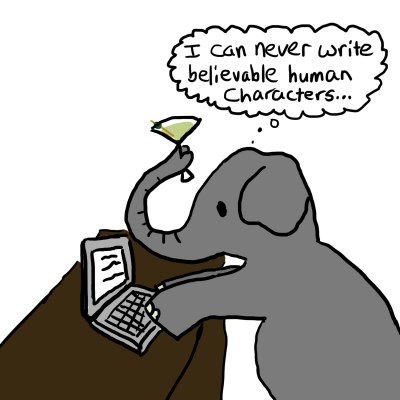
I am eating pita chips and hummus (homemade hummus!) as I write this.  But I’m not dipping the chips in the hummus because all the chips that were left in the bag were broken and tiny.  So what did I do?  I dumped the chip pieces into the hummus, stirred, and began eating with a fork.  Every now and then, I stop typing to take another couple bites and become very aware of the ensuing silence.  I type very loudly.  Almost everyone who has ever shared a room with me while I’m typing has told me so.  Elephants could type quieter than I do.
What do you do when you go to bed at night?  Do you crawl under the covers and pull them up to your neck?  Do you toss and turn?  Do you lie on your side or your stomach?  When you’re showering, do you read the label on your shampoo bottle?  Or do you contemplate the meaning of life?  Do you sing?  These are important things.  You are a character in your own story, as is everyone else in your life.  You are living a story right now.  Be aware of what you’re doing.  Because you are doing more than reading.  You are scrolling down with your right hand (or is it your left?), you are breathing, you are thinking about what I’m saying (hopefully).  Have I made a point?  I don’t know.  But I’m out of hummus chips so I’m going to stop writing.

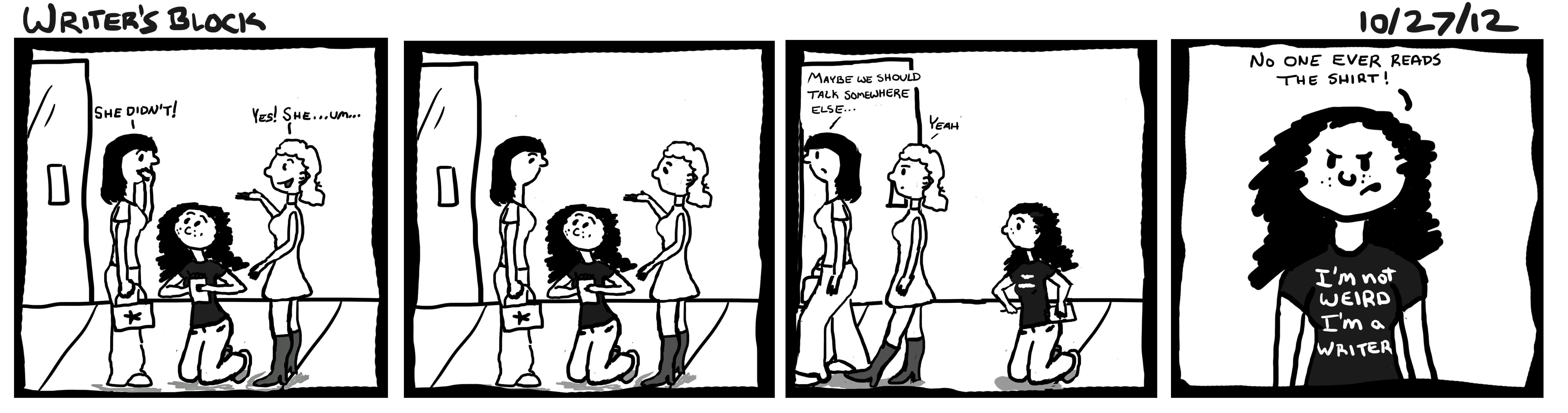
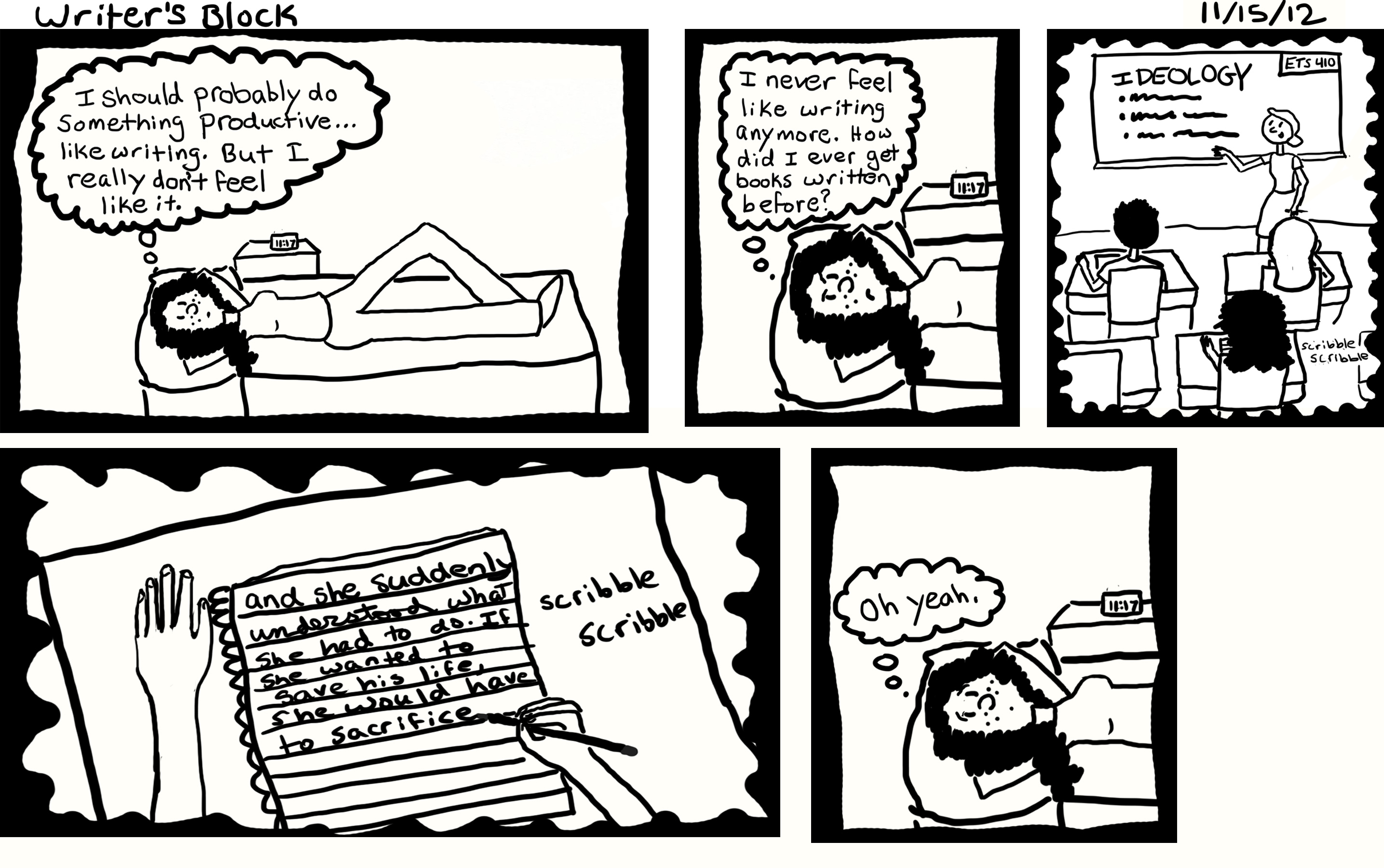
Comic! (Click to Enlarge)
Word of the Day: Contemplate (v) – to look at or view with continued attention; observe or study thoughtfully.
1 Comment

Filed under books, Comic, Humor, writing

Ending the Ending

After a great deal of confusion and me wanting to pull my hair out…

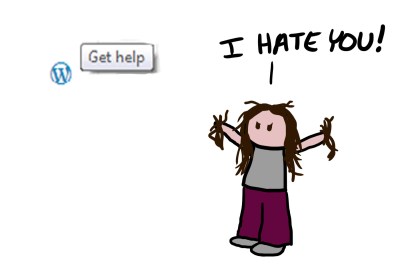
…it looks like the poll is working.  (I was wearing purple pants and a gray shirt that day, so I decided to roll with it)  The problem seemed to be that it was showing up for everyone but me.  But the results are in and the winner by a landslide is Danya.  So that’s the character’s new name!  The poll is now closed.

On to the topic at hand: The Ending.

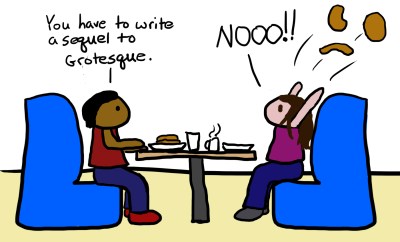
A lot of my books are going to have sequels, so I’m going to start with that – Ending a book that is going to have at least one sequel.  Surprisingly enough, I don’t ever try to write a book with the intent of giving it a sequel.  I sat down to write The Dreamcatchers, Hellbound, and Grotesque with the intention of making them single, one-shot novels.  In fact, I don’t like writing sequels, because I don’t think I’m very good at it.  For The Dreamcatchers, I just came up with some cool new ideas, so I started sequels for it.  For the other two, I was so upset when I realized I had already gone through an entire story, written over 60,000 words, and still had a lot more material to cover.  In both books, there was this central villain that I thought was going to be killed off and taken care of by the end, and both times I found other obstacles had to be tackled first.  And by the time I got through those, the book was over!  Which led to conversations like the one I had with my friend, Micah (M), in an IHOP.

The main reason I balk at sequels is I have so many writing projects going on at one time that I am always angered in a way when I end up with a new one.  That’s why when I had the dream that led to the writing of Hellbound, my first reaction was something like, “Fuck!”

Oh my, I have gotten off topic.  Alright, so when you write a book that’s going to have a sequel, you need to do two things when you write the ending: 1) Wrap up with the main conflict that was covered in the book 2) Set up the conflict that is going to be in the next book.  You can read examples of this in Harry Potter, A Great and Terrible Beauty, Trickster’s Choice, or any other book that has a sequel.  The main point is that you get the feeling when you’re done reading it that you get when someone starts saying something but doesn’t finish the thought.  You’re waiting for more.  You know there should be more.

And there are still a million ways to do this.  You can leave your characters in utter turmoil, or you can make it seem like everything’s going to be fine, until the next book starts and that new conflict arises.  My biggest piece of advice would be to go with your gut, as I’ve said before.  After you’ve managed to write a full book, the ending should come naturally.  If it doesn’t, ask for help from family and friends.  This advice doesn’t change if you’re writing a stand-alone book.  The ending doesn’t have to wrap everything up with a neat little bow.  Graveminder didn’t end that way.  That book ended with the central conflict wrapped up, and a sort of consensus that the changes that had occurred in the main characters’ lives were permanent, and that they were okay with that.

This is pretty much the only advice I can give you.  But here’s something else: I love helping people with their writing.  So if you want to post a comment with a question about something you’re working on, or go to my Contact page and send me an email, I’d be happy to give you a few tips.  Just don’t sue me for offering the advice if it ends up not working for you, because then I’ll be sad.

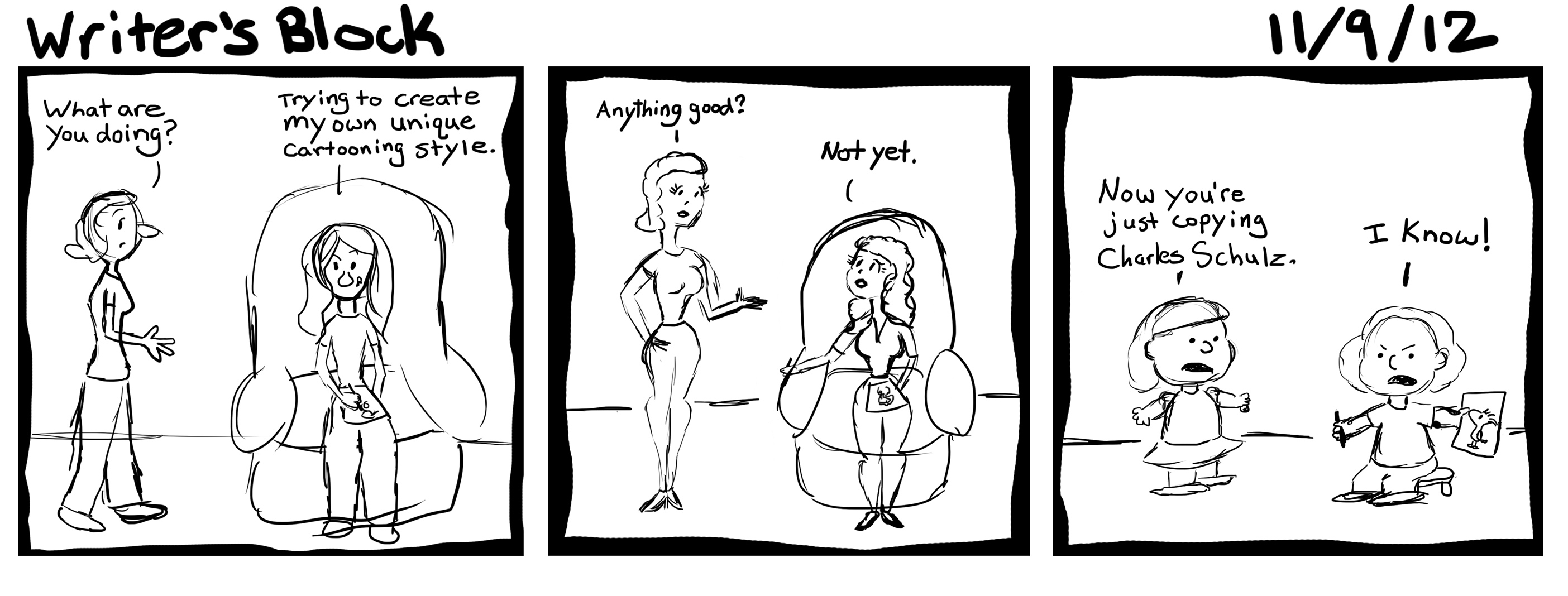
COMIC!! Please note that I tried to make my writing more legible.  Operative word is “tried.”  (Click to Enlarge)

Finally, for those who don’t know, George Takei has written a book and it is available for pre-order.  To anyone who is not a fan of George Takei, you actually are a fan of George Takei, you just don’t know it yet.  Try watching this video if you are unconvinced.

So don’t forget to buy his book!

Word of the Day: Ingenuity (n) – The quality of being cleverly inventive or resourceful; inventiveness.

P.S. Keep an eye out for my next post, because that will be the guest post by Liz that I hinted at before!  You don’t want to miss it.

Also this.  Can you guess what book she’s reading?

2 Comments

Filed under books, Comic, Humor, writing

Starting the Ending

My dad asked me the other day how I come up with endings for my books, and my response was, “Uhhhh…well…um…yeah…I…I don’t know.  I mean…I just do.”

So yeah, that’s not very helpful.  But it did make me realize that while I have talked extensively about how to begin a book, I haven’t really touched on the ending at all.  I think the reason for that is that it never seemed like something I’d need to talk about.  See, I hate to brag, but the endings for my books usually just come to me.  About halfway through the book, I’ll have a small revelation while I’m writing that will clearly detail how my book is going to end.  And then I go, “Ohhh, so that’s how it’ll end!” and then I keep writing.  And when I get to the end of the book, I write the ending pretty much how I imagined it, and that’s that.  I might just have assumed that it happens for everyone that way, and I might just have been wrong.

So we’re going to talk a bit about conclusions today.  But first!  There is a character in Grotesque named Dinah.  She is a six-year-old girl, and I don’t like her name.  So I’m going to change it (God I’m starting a lot of sentences with “So” today), and for the first time ever, YOU are going to get to help decide.  I figure you just got done voting for president, so you’re in the voting spirit.  I’ve created a nice little poll here for you to use.  Go ahead and vote.  Please only do it once.  I disabled the thing that uses Cookies to prevent you from voting multiple times because I don’t really like Cookies (of the computational variety).  Yes there are only two choices, but that is because the others (I use www.babynames.com to find names that have appropriate meanings) were unappealing to me.  E.g. Chipo, Donatella, Matias, etc.  The name meaning I was going for was “Gift.”  So here’s the poll:

UPDATE: The poll doesn’t appear to be showing up, so if you can’t see it, just vote using the comments.  The two names are Nita and Danya.

I’ve already talked too long, and there aren’t even pictures, so I’ll probably split this into two posts so you don’t get bored.  I’ll just do a brief introduction to Ending the Novel.

The ending for your book is largely up to you, and it is honestly very hard to pin down any universal rules for writing it.  Here’s why: If you want to make your ending vague, that’s up to you.  If you are planning on writing one or more sequels to your book, that changes how the ending is going to be.  If your favorite color is blue, then you might write an ending entirely differently from a person whose favorite color is puce.  Here’s my opinion on endings: I once wrote a Facebook status after reading the series that begins with Blue is for Nightmares, by Laurie Faria Stolarz.  I finished reading the last book in the series, and then I said, “How can you even think to contrive a happily ever after that is more like a mildly happy present with a fairly good chance of a felicitous outcome? The ending to a book shouldn’t read like a weather forecast!”

That’s my opinion.  I’ve read a lot of books for work recently that have had really inconclusive and frustrating endings.  If you’re going to write an ending for your book, then write it with conviction.  Even if it’s vague, or purposefully inconclusive, write it like you mean it.  Trust me, it shows.  Your book shouldn’t just peter out once the story’s wound down.  Okay, I’ll talk more about this with more pictures in another post.  For now, enjoy strip #2 of Writer’s Block!

(Click to enlarge)

Word of the Day: Contrive (v) – To plan with ingenuity; devise; invent.

P.S. Results for the Poll will be posted next week sometime, or whenever I get around to writing the next post.

8 Comments

Filed under books, Comic, Humor, writing