Category Archives: Grammar

Mistaken Word Identity

Hello.  How has your life been these days?  Mine has been hectic.  On top of trying to find work to pay for my career as an author, moving to a new state, and writing, my computer is still pretty broken.  It won’t even open Firefox anymore, which sucks because I am used to using it as my browser.  I even tried uninstalling and reinstalling it.  No luck.  Can you even break a web browser?  Apparently I can.  I am that kind of special snowflake.

Anyway, I was on a plane for reasons, and I was reading a book.  The book was called Supernaturally.  It is the sequel to the book, Paranormalcy, by Kiersten White.  The first book had a unique enough premise, so I thought I’d read the second.  That’s usually how things go.  The problem is, the second book left me with kind of a bad taste in my mouth.  Don’t get me wrong, it’s not terrible.  It’s pretty standard for the new Young Adult Paranormal Romance genre that is all the rage these days, and that I, myself, write for.  The thing is…I don’t know.  It just wasn’t for me.  One of the big problems, the one I wanted to talk quickly about, was that I think the author used a word incorrectly.  I know this shouldn’t be a big deal, but it really pulls me out of the book when I see a word used to mean its exact opposite.

So we’re going to do the Words of the Day a little early here.

Nonplussed (adj) DOES mean: utterly perplexed; completely puzzled.

It DOES NOT mean: Unfazed.  Cool.  Calm.  Unaffected.

That one gets misused a lot, because it sounds like it should mean what it doesn’t.  I will add the disclaimer that White might have been using it correctly.  The character could have either been confused or nonchalant, but I got the impression he fell into the latter category, in which case “nonplussed” was the wrong word to use.

This happened to me one other time, a while back when I tried to read a book called Tithe by Holly Black.  She used the word “enervate” to mean its exact opposite and I just kinda lost a few respect points for the author.  “Enervate” is another word that sounds like it should mean its opposite.

Enervate (v) DOES mean: to deprive of force or strength; destroy the vigor of; weaken.

It DOES NOT mean: To energize.  Give energy to.  Fill with life.

It just sounds like it’s supposed to mean that.

Watch out for those words, and others like it.  Just a helpful hint.  I’ve got another post for you about my recent editing process for Hellbound, so look out for that soon!  Hopefully with pictures.  (Dare I risk plugging in my tablet?)

Word of the Day (even though I already gave you two): Lugubrious (adj) – mournful, dismal, or gloomy, especially in an affected, exaggerated, or unrelieved manner.

3 Comments

Filed under books, Grammar, Humor, writing

Random Advice and Stuff

As the title of this post suggests, I just have a few random things to throw at you today.

The first is the difference between the words “compliment” and “complement.”  This is important, I feel, because even I have trouble remembering the difference.  “Compliment” (with an I) refers to praise.  I complimented her on her taste in Jello.  She complimented her boss in the hopes that he would give her a raise.  You get it.  “Complement” (with an E) refers to things that go well together.  This wine complements this chicken dish.  Or the drapes complement the carpet.  That kind of thing.

Next is something my sister emailed me.  It’s pretty self-explanatory, so I’ll just paste it here for your amusement.  My comments are in red, and my cartoons are in…cartoon.

Kurt Vonnegut’s Eight Rules for Writing Fiction:

1. Use the time of a total stranger in such a way that he or she will not feel the time was wasted.  In other words, when someone picks up the book you’ve written, make sure they know fairly quickly that it was worth it.

2. Give the reader at least one character he or she can root for.  This does not have to be the main character, but it helps to achieve point #1 if you have point #2.

3. Every character should want something, even if it is only a glass of water.  Motivation.  Your characters should have motivation.  If they do not feel motivated to do anything, then your reader will pick up on that, and then they will cease to be motivated to read your book.  Again, see point #1.

4. Every sentence must do one of two things — reveal character or advance the action.  This you’re allowed to disagree with, though I feel these two definitions can be given a very broad spectrum.  For instance, describing your main character’s workplace may not be either of those two things, unless you consider that the way the character views their workplace provides insight into their…well, character.

5. Start as close to the end as possible.  I believe he’s referring to starting in Medias Res, or the middle of the action.  This is your choice, but do remember that if starting at the beginning is as close to the end as you feel you can start, then technically you are following the rule properly.  After all, he did say “as possible.”  It’s up to your judgment where and when to start your story.

6. Be a sadist. No matter how sweet and innocent your leading characters, make awful things happen to them — in order that the reader may see what they are made of.  Yes.  If you’re having trouble with this, it may be necessary to write “They aren’t real” on the back of your hand in Sharpie.  The fact of the matter is that your characters are at their best when all aspects of their strengths, weaknesses, and personalities (that is, each character’s personality, not each character’s multiple personalities) show through.  And this can only happen if you put them in situations that are all over the spectrum of “Good” and “Bad.”

7. Write to please just one person. If you open a window and make love to the world, so to speak, your story will get pneumonia.  You can’t please everyone.  But if you can make just one person read your story and say that it made them think, or changed their life forever, then you’ve accomplished something big.  Never forget that.

8. Give your readers as much information as possible as soon as possible. To heck with suspense. Readers should have such complete understanding of what is going on, where and why, that they could finish the story themselves, should cockroaches eat the last few pages.  This is hilarious, but not entirely true, depending on who you talk to.  I do agree that you can’t leave your readers totally lost.  Readers, for the most part, don’t want to have to fight to keep up with your story.  They should be safely strapped into the rollercoaster, not running on the track behind it hoping to keep up.  However, some suspense and mystery is good, if that’s the type of book you’re writing.  It is okay to keep some things secret, but it is not necessary.  If your readers know something that your characters don’t, that’s called Dramatic Irony.  It’s a thing.  Work with it.  Or don’t.

— Vonnegut, Kurt Vonnegut, Bagombo Snuff Box: Uncollected Short Fiction (New York: G.P. Putnam’s Sons 1999), 9-10.
Kurt Vonnegut: How to Write with Style

Vonnegut was a fantastic writer, may he rest in peace, and I think his advice is great.  But, as this is my blog, I do believe I should start working on my own comprehensive list of this sort.  So maybe I’ll whip one up and make that my next post.

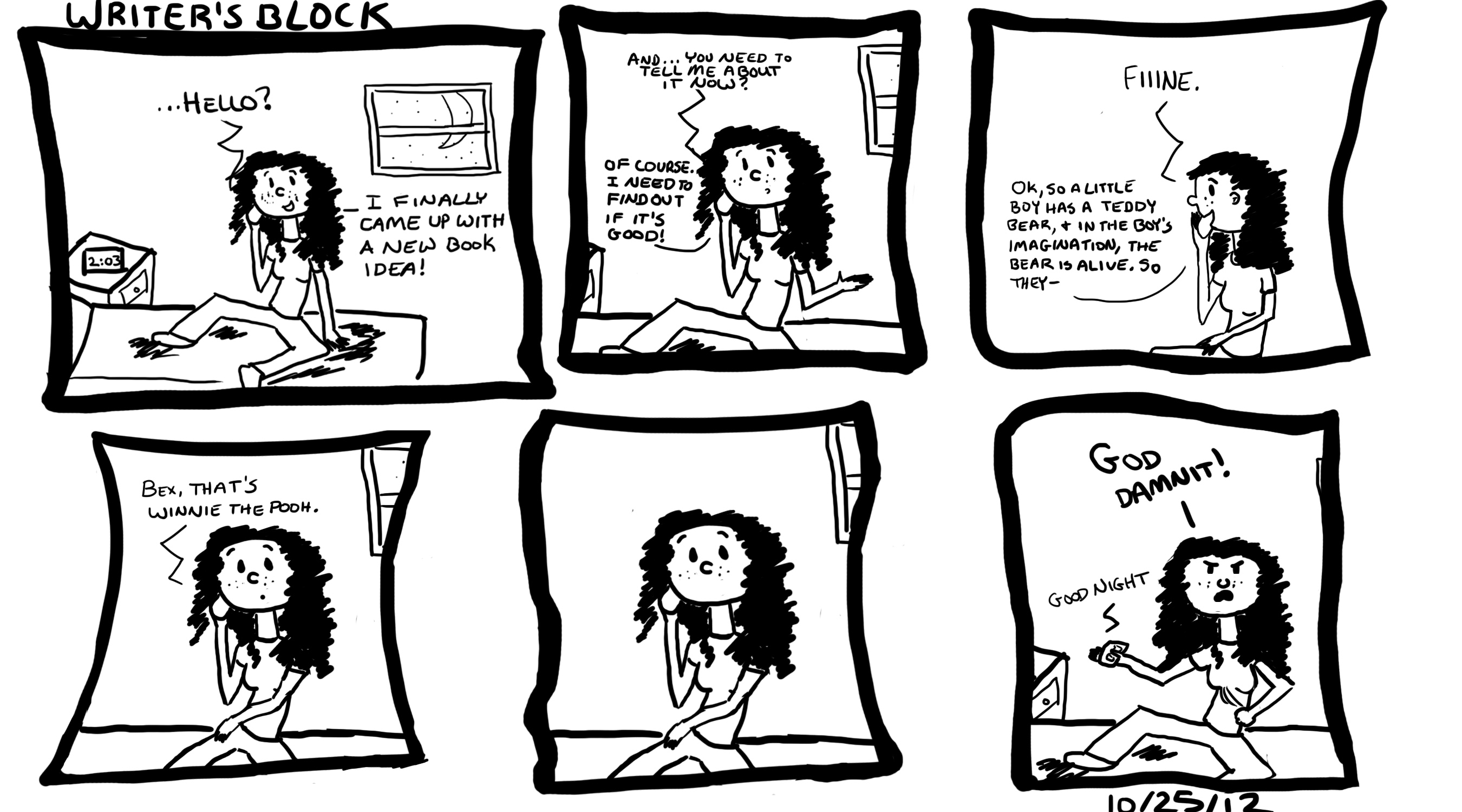
Lastly, I think, was just a new comic.  So here you go.  Click to enlarge.

[Edit: I remembered what the last thing actually was!  I made a meme.  Ever heard of First World Problems?  Check it out.  I knew there was something I was forgetting.]

Word of the Day: Complement (v) – something that completes or makes perfect.

4 Comments

Filed under books, Comic, Grammar, Humor, writing

Writer’s Block, the Comic

A few notes.  One, another grammatical pet peeve of mine.  It’s short, so don’t worry.

It is amazing how the simple addition of an extra letter can change the meaning of a word so drastically.  I talked before about every day and everyday, and those don’t even have any difference in their lettering – only in the addition or deletion of a space.  Today, for your benefit and my sanity, I am going to quickly illuminate the difference between the words “Lightning” and “Lightening.”

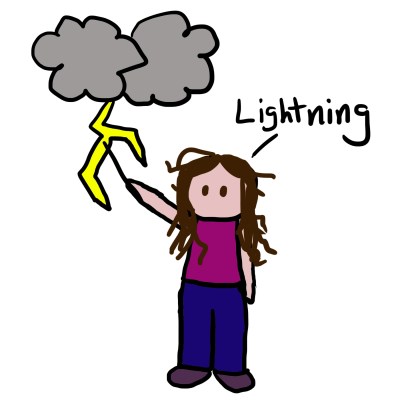
LIGHTNING, no E, is the weather.  Here is Lightning illustrated:


Recently, in I think two different sample manuscripts I was reading, the word “Lightening” was used to refer to the weather pattern illustrated above.  I haven’t illustrated “Lightening” for you, namely because the first definition that came up on Dictionary.com was this one:

Lightening (n) – the descent of the uterus into the pelvic cavity, occurring toward the end of pregnancy, changing the contour of the abdomen and facilitating breathing by lessening pressure under the diaphragm.
So you can see why I didn’t want to draw that.  The word can also describe a progression from dark to light, or from heavy to light.  In any case, it is NOT used to describe the flashy electricity that comes from the sky when the weather gods have been angered.  Please don’t throw an E in where it doesn’t belonge!
Next, a quick note.  In drawing my best friend in my previous post, I realized that I had put her in a stance that I always draw her in – arms crossed, glaring out at the world as if she’s daring someone to cross her.  In thinking about this, I had to wonder why I always give my drawings of her that particular position, when I know her to be a very kind, witty person.  I felt the need to explain myself here because I don’t want anyone to get the wrong impression.  So I’ll say this: Liz does not suffer fools gladly.  But she is still a wonderful person to get to know.  The reason I draw her that way is that, in my mind, she has always been the stalwart warrior.  Someone who does not easily bend or break.  Someone who is assured of her own convictions, but still very open to new possibilities – studies, research, discoveries, whatever you may call it.  For that reason, I draw her in a warrior’s pose.  Just thought I’d let you know.
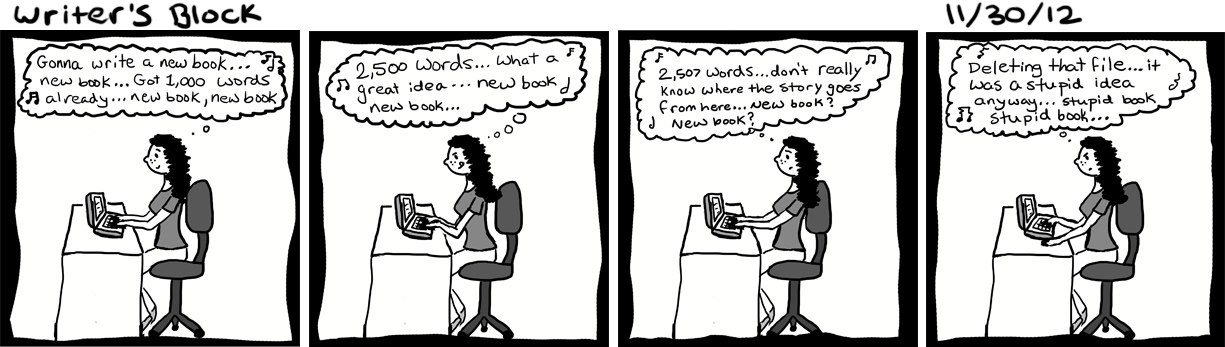
Finally, I’ve decided to take on a more serious cartooning endeavor in the form of a semi-regular comic strip entitled Writer’s Block.  And, before you ask, no this does not mean you’ll be seeing less of Mini Bex.  The strip will be included at the bottoms of blog posts, not on a separate page or website or another blog.  It will just be for fun, something you can glance at like you would a strip in the morning paper.  I’ll include the first strip I’ve drawn here in this post (Click to enlarge).  I hope you like it.
That’s all for now!

Word of the Day: Stalwart (adj) – strong and brave; valiant.

1 Comment

Filed under books, Comic, Grammar, Humor, Language, writing