Category Archives: Grammar

Some Things to Keep in Mind BEFORE Querying an Agent (Part 1)

Working at a literary agency has really given me some new perspective on how dense authors can be (myself included).  While I am in no position to share any specific examples to back up what I am about to say, for the sake of the authors’ privacy, I believe I have learned quite a few things that can help aspiring authors (and screenwriters I suppose) to present the best possible query.  The result will be this blog post, and probably one other, if not more.  It depends how well I stem my urge to ramble.  Spoiler alert: I probably won’t do so well.  I’m already failing, and I haven’t even started yet.  So…without further ado, we begin the list!

#1 – Your book is not your baby!
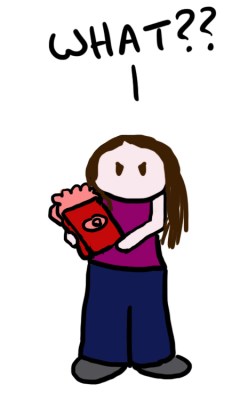
This bit of advice is something that will help you not only in the querying stage, but also beyond that, when editors start to take a look at your work.  The fact of the matter is, if you want your book to get published (or your screenplay to be taken seriously), you are going to have to accept the fact that many people are going to read it, and they are all going to have their own opinions.  Those opinions will largely affect how your finished book looks when it’s finally there, in all its hard-covered glory, on the shelves in the store.  And if you want to see that happen, you have to remember that these people’s opinions aren’t things to be taken lightly or ignored – these people are professionals.  They know what they’re doing, and – just in case you don’t believe me yet – their paycheck also depends on your book being bought by more than two people who only bought it by accident because their grandmother recommended The Setting Sun and your book is titled The Setting Son.  So you better believe they’re going to do their damndest to make it the best, most marketable thing out there.  Hence Twilight.  And if you’re sitting there kvetching and whining, saying things like, “But I can’t change that part!  Jill’s encounter with the Yeti is a crucial subplot that plays a vital role in the development of the Yeti’s character!”  then say goodbye to that book deal, and the shelf space at the Barnes & Noble.
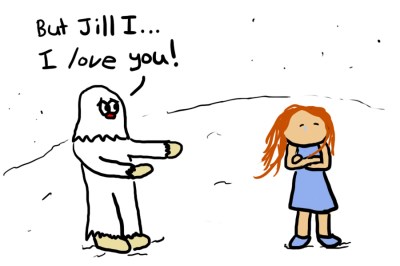
In conclusion, yes, it’s your book.  You created it.  But don’t be like the one guy who queried us and then, upon receiving a request for the first fifty pages of his manuscript, sent in the entire self-published book because he “couldn’t bear to cut up his work.”  That there is a warning sign right off the bat.

#2 – Proofread your query letter and your manuscript before submitting them.  This includes having someone else read them.  Someone who doesn’t fear incurring your wrath should they offer a suggestion for revision.

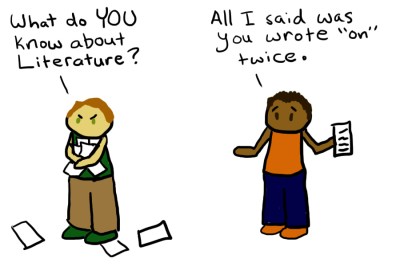
This one seems like it should be obvious.  It isn’t, apparently.  I have had people write in with missing punctuation and misspelled words and proper nouns.  Even my boss’ name has been misspelled a couple times, and you’d think that’d be the one thing people would make sure to get right.  Nope.  Proofread your work, people.  Then have someone else read it.  Someone who knows what they’re talking about would be best.  And, just a side note, if they start laughing from reading your query – and it’s not supposed to be funny – maybe go back to the drawing board.  I have to admit that I have encountered quite a few queries that – for one reason or another – have brought a chuckle out of me.  Either because the writing is poor, the plot is shaky, or the grammatical errors are so egregious.  So really, really look at your query and your manuscript before submitting it, and if someone else reads it and offers you their thoughts, don’t get defensive.  They could be on to something.
Which leads me to…

#3 – Learn to take constructive criticism 

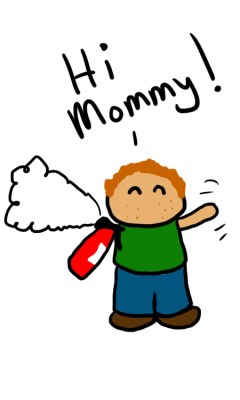
I won’t spend too long on this, because I pretty much already said what I need to say for this in item #1.  If someone gives you a suggestion for how to revise, or how something might be improved, don’t get haughty.  If it’s good advice, take it.  Sure, that’s up to your discretion, but also take into account whom you receive the advice from.   As I said above, literary agents and editors want your work to sell just as much as you do, so if they send you back some form of a critique, pay attention to it.  Even if it hurts your pride.  Because, again, your book is not your baby.  If someone tells you your son can be improved by removing his right arm and replacing it with a fire extinguisher, feel free to ignore them.  If someone tells you that your main character seems a little one-dimensional, roll with it.  Maybe they have a point, and you should try to fix it.

That’s all for today!  Tune in next time for more  of my expert advice!
Word of the Day: Haughty (adj) – disdainfully proud; snobbish; scornfully arrogant; supercilious

And, for your edification (and mine, since I didn’t know this): Supercilious (adj) – haughtily disdainful or contemptuous, as a person or facial expression.

Oh all right, this one too: Egregious (adj) – extraordinary in some bad way; glaring; flagrant
5 Comments

Filed under books, Grammar, Humor, writing

If Your Ad is Grammatically Incorrect, I’m Not Using Your Product

I was on the Facebook just now, and I glimpsed an ad in the sidebar.  Facebook has a lot of trouble advertising to me, since I recently went through my profile and deleted every single bit of information I’d previously provided.  So now it has very little to work with.  Here are two things it knows: I play a horseback riding game, and I am currently in Syracuse, NY.  So my ads are pretty much all geared to that now – either horses or “fun” stuff to do in Syracuse – except for some random ones for FASHION.  I don’t know where that came from.  Oh…yes I do.  I’m female.  Therefore I must love buying hideous dresses from websites I’ve never heard of.

So I glimpsed the sidebar, as I said, and I saw an ad that said, “Five things to do in Syracuse everyday.”  I promptly clicked the little X in the upper right corner of the advertisement to make it go away.  And Facebook does this thing where it gives you a list of reasons to choose from when you dismiss an ad.  The reasons are:

– Uninteresting

– Misleading

– Sexually explicit

– Against my views

– Offensive

– Repetitive

– Other

(I used to get ads that said stuff like, “DO YOU LOVE TWILIGHT???  DO YOUUUU??” and I’m pretty sure I clicked the “Offensive” and “Against my views” buttons a couple times.)

For this ad, I clicked “Other.”  And when you do that, it gives you a little box to type in your reason.  I typed in, “This ad is grammatically incorrect.  They used “everyday” and not “every day.”  And that inspired me to tell this story on my blog, and also give a short grammar lesson, since this concept seems to be hard for some people to grasp.

“Everyday” is an adjective.  You have everyday activities, like eating, sleeping, swimming, killing people’s dogs, and reading the newspaper.  These everyday activities are things you do every day.  See what I did there?  “Everyday” is an adjective, and “every day” is an adjective describing a noun.

Every day, I stare out my window and make faces at passersby.

This ad is not seen every day.

I have many everyday routines.

This isn’t some kind of everyday threat.

Are we starting to see the difference?  “Every day” is talking about the day.  It’s a noun.  You don’t see people writing, “Onceaday, I kick my bedroom wall.”  No, they write, “Once a day.”  Same thing with “Every day.”  I think I’m getting a little repetitive here, but I really want to make sure I’m understood, because between you and me, I get a little annoyed when people blatantly disregard basic grammatical rules.  And it’s not an uncommon occurrence either!  It happens every day!

Word of the Day: Miffed (adj) – put into an irritable mood, especially by an offending incident.

Leave a comment

Filed under books, Grammar, Humor, Language, writing

My Language Right Is!

I hope you’ll forgive me for going off on a slight tangent today.  It has nothing to do with books, but everything to do with language, which is another topic that I am immensely interested in.  Currently I’m taking a Linguistics course called “Teaching English as a Foreign Language,” and it got me to thinking about a lot of things.

Now, there’s no way to say this without sounding like I’m bragging, but I’m honestly not trying to do that.  For one thing, this is information that is relevant to this post.  Secondly, let’s face it, my family reads this blog, so I think they’ll probably be quite happy to read that my Linguistics professor called me a “Language Genius” the other day.  Her words, my capitalization.  Apparently my Japanese teacher reported that she’d never had a student like me before.  The fact of the matter is that my Japanese teacher was fascinated that I had picked up as much of the language as I did, and the reason she is fascinated is because there is a critical period (many Linguists would say) for learning languages, and it is much younger than 18-20.  So it’s rare to see an adult pick up a new language that they weren’t exposed to as a child.  This is all relevant, I promise.  It’s all leading up to this observation I’ve made about language learning, and I feel that it is worth thinking about, and worth sharing.  So what better place to share it than here?  Seriously, I have no other options.

Anyway, here’s what I’ve observed: People (in this case native English speakers) tend to fall into two traps when learning a new language that inhibits their acquisition of that language.

Trap 1: They assume that their native language is “right” (with reference to grammatical structure) and that the language they’re learning is somehow “wrong” if it does not follow the same structures as the native language.  Which leads to…

Trap 2: They assume that their native language is related in any way to the new language they’re learning, when really the two are almost completely unrelated.

Allow me to explain.

I think that language teachers should emphasize a difference between translating one language into another, and expressing the same or similar meanings in two different languages.  Take the following two sentences, for example.  (The Japanese will be written out phonetically in English as well, so you can read it)

  • 私はスーパーに緑りんごを買いに行きました。

Watashi-wa soopa-ni midori ringo-oh kaii-ni ikimashita.

  • Yo fui al mercado para comprar unas manzanas verdes.

If you take these two sentences and translate them into English, you get:

  • Japanese: I supermarket to green apple(s) buy to went.
  • Spanish: I went t’the market in order to buy some apples greens.

Now, it is important to recognize that the above translations do not make sense in English, but that they do make perfect sense in their own languages.  Both of those sentences mean the exact same thing as “I went to the market to buy green apples.”  And I feel like people do fall into these traps where they try to directly translate from English to the language they’re learning, which is where you get problems with false cognates, for one.  (“Embarazada” is not Spanish for “Embarrassed.”  It means “Pregnant.”)  And then another problem is that of direct translation, where you assume that every language will follow the same rules as your native tongue, so you say “Yo quiero a comprar una manzana” because you know that “a” in Spanish means “to” and “comprar” means “buy.”  What you wanted to say was, “I want to buy an apple.”  What you said was, “I want to to buy an apple.”  Why?  Because Spanish has one word for the infinitive of verbs where English has two.

To Buy – Comprar

To Eat – Comer

And so on.  But we (English speakers) are used to seeing two words there, so we assume that Spanish has to have two words there, too, in order to make sense.  It doesn’t.  Because languages that aren’t English don’t have to make sense in English.  They only have to make sense in accordance with their own rules and structures.  I feel like I’m making a mess of this.  It was all so clear in my head, and now I feel like it’s very muddled.  Maybe I should quit while I’m ahead.

I’ll finish with this: The title of my post is incorrect English, but if that were Japanese, then it would be A-Okay.  So, in conclusion, your language is no more or less correct than any other.  Languages all express the same meanings, just in very different ways.  So when you’re learning a language, you have to approach it as an infant would – as if you have no previous exposure to anything like it.  Because learning a new language really should be like starting fresh, learning to talk all over again, not learning how to say good English in something that’s not English.

Word of the Day: Cognate (n) –

Hmm…None of these dictionaries are saying what I want them to say.  “Cognate” apparently has a lot of possible meanings, but the one I’m referring to is this: Words that sound similar across two or more different languages and have the same (or similar) meanings.  e.g. Telephone and Teléfono (Spanish).  And “false cognates” are two words that sound really similar but have different meanings.  These usually throw people off when learning new languages because drawing associations between words like that is a pretty common tool for memorizing new vocabulary.  An example of a false cognate is the embarrassed/embarazada thing or “pan” and パン(pan), which is the Japanese word for “bread,” not a pan.  Interestingly enough, that was taken from Portuguese, I think, so the Portuguese word for “bread” and 「パン」 are probably cognates.  Ok, that was officially the longest Word of the Day ever.  Sorry I couldn’t find an official dictionary definition.  You can look it up if you’re still confused.

1 Comment

Filed under Grammar, Humor, Language