
I’ve been meaning to write this post for a while, ever since my mom told me she’d once written a similar article about things she’d learned from her own mother. I don’t normally “observe” Mother’s Day. You know all the things that everyone in the world has already said criticizing “commercial holidays” and/or “Hallmark holidays”? Yeah? Well, pretend I just typed all that out. Because I believe all that stuff.
That being said, it seemed unbelievably petty and unnecessarily contrarian to avoid posting this on Mother’s Day just because I think one should attempt to make their loved ones feel appreciated all the time, even if their calendar doesn’t tell them to.
It’s Mother’s Day. I have a post I’ve been meaning to write about my mother. Let’s do this.
In true Listicle fashion, I’m going to start from number 5 and move to number 1. This doesn’t matter in the slightest. I’m not ranking the useful things I’ve learned from my mom. This isn’t Buzzfeed.
5. Organize the Cart and the Conveyor
When in the grocery store, organize items as you put them in your cart; don’t just dump them in. Be neither willy nor nilly with your additions. Then, when you have reached the checkout, place the items on the conveyor belt in an organized fashion. Boxed items go together. As do refrigerated items, frozen items, etc. Put produce on last (or second-to-last if you are purchasing eggs) because these things often require inputting a code and/or weight. Instead of having to stop at random to do this, the checkout clerk will do them all at once at the end. Eggs go on last because that makes them easier to keep track of, and the bagger can make the best choice about where to put them to avoid breakage.
At this point, you are probably wondering if you should call some sort of hotline to report my mother and me for being worryingly anal-retentive. First of all, there is no such hotline. Second, if there were such a hotline, we’d definitely already have been reported, so you wouldn’t have to do it anyway.
And third…
Have you considered that no one wants to be in the supermarket longer than they have to?
Yes, organizing the cart and conveyor makes the checkout person’s life easier. You should endeavor to make this person’s life easier whenever possible because other people endeavor to make their lives harder on a regular basis.
Setting that aside, organizing your cart from the very beginning means you spend less time unloading. Organizing as you go on the conveyor belt means all your items will be bagged quickly and according to your preferences. Efficient scanning and bagging means a quicker exit from the store for you. Then, when you get home, putting groceries away will go more smoothly as well. So… are my mom and I nit-picky and obsessive? Yes. But we never forget where our eggs are, and that’s important.
Also, one time, a checkout person thanked me for my careful conveyor choreography.
Worth it.
4. Threading a Needle
I can thread a needle. You might be wondering why, in this age of apps and electric cars and motion-activated landscape lights and watches that track your heart rate, I would need to use a needle and thread for anything. I must admit, it has come in handy on more than one occasion in recent memory. Knowing how to do the most rudimentary form of sewing has converted old t-shirts into pillows, repaired toys and clothes, and converted two old blankets into a large beanbag chair/winter clothes storage system.
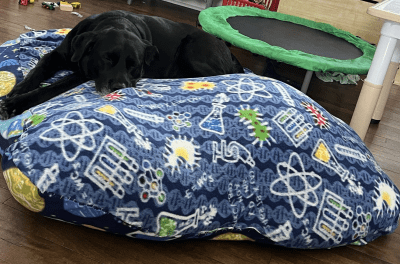
Geordi loves it
I can also knit. Different needles. Yarn instead of thread. Same concept. I like knitting. It relaxes me. I’ve also never had to buy a winter scarf. And sometimes you can knit pillows if old t-shirts aren’t your style.
3. Frosting a Cake
It’s hard to frost a cake. Sure, you can buy them pre-frosted from the grocery store, but then you might get the wrong cake-to-frosting ratio. Or worse… whipped cream frosting. The horror!
I know how to make buttercream frosting (the only frosting worth eating). I know how to bake a nice yellow cake, how to prep it for frosting, how to fill a frosting bag. I’m never going to be called upon to prepare someone’s wedding cake, but I can make little florets and patterns. I know that I should pre-write words on the cake using a toothpick so I can be sure everything will fit correctly and be spaced well. My frosting writing is still only so-so, but that might have something to do with the fact that all my other writing is also so-so.
2. People Have Seven Heads
My mom is a good artist. She taught me to value creativity, and has helped me along the way to… wait… hold on…
2B. Value Creativity
Creative pursuits are valuable. My mother can draw and paint and make a cake that looks like a hamburger. She taught me to hone my own creative brain, and I attribute a lot of my success in writing to her encouragement and guidance.
2C. People Have Seven Heads (Continued)
When sketching a (standing) person, consider that the average person is about seven or eight “heads” tall. Meaning, if you draw a basic head shape at the top, you should be able to draw that about six or seven more times all the way down to the figure’s feet. If you can do that, then you know you’re on your way to having a well-proportioned sketch.
1. There is Always a Solution
I know I said I wasn’t going to rank this list, but it occurs to me that this item does belong at the number 1 spot. This is a truly valuable life lesson that I have taken with me from childhood on into adulthood. When you encounter a problem, never let yourself think, “I can’t fix this.”
There is always a solution.
Sometimes there are multiple solutions.
The creative brain is not just good for making scarves or sketching a well-proportioned person; it can also lead you to address a problem in ways that aren’t immediately apparent at first.
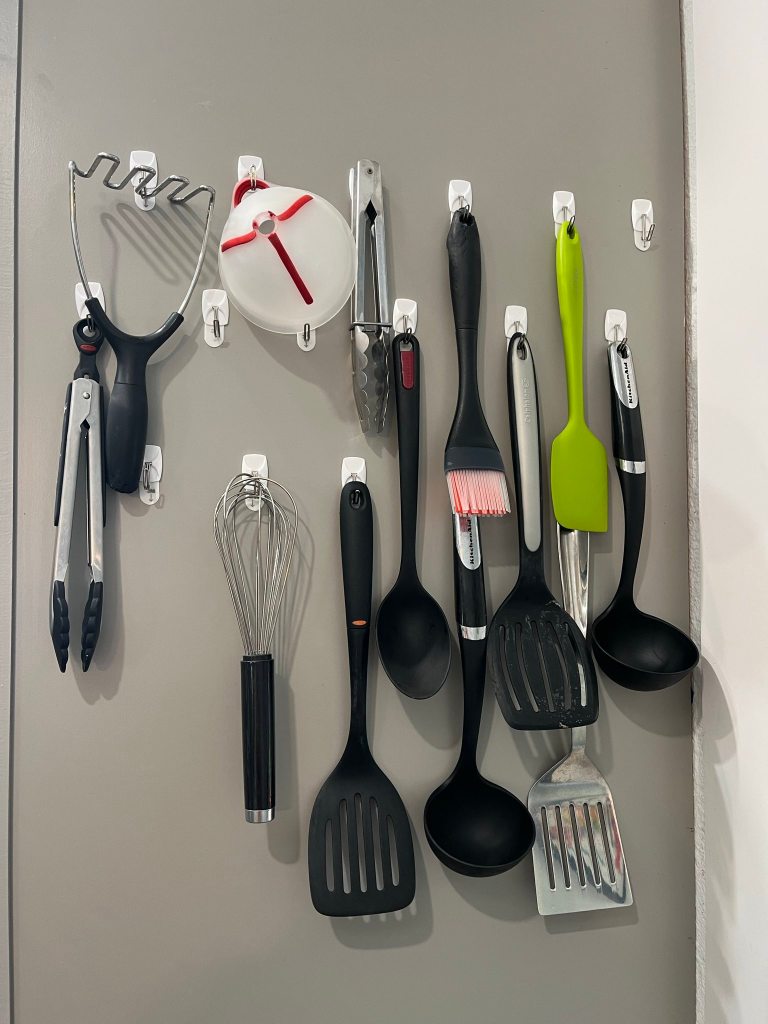
I happen to have an example. My house is lovely, but a bit short on storage space. One of the things I really wanted for my kitchen was one of those utensil hanger things. It would save drawer space and make it easier to grab a ladle or spatula when needed. Emptying the dishwasher would go quicker, too.
The problem: Utensil hangers cost money and often require drilling into a wall or the ceiling.
The solution: I bought a couple packs of those little command strip hooks and put them on the side of my pantry. Then I hung my utensils from them. Saved money. No drilling. Got exactly what I wanted without having to wait until I could budget for it.
My younger son, Ari, loves his kiddie pool. He would live in that pool if he could. With the turn of the weather, we were able to bring it back out for him. Unfortunately, his parents are so white that they are practically translucent. His dad is a redhead, for Gibraltar’s sake! Doubly unfortunately, he does not like it when I put sunscreen on him. I can’t blame him. I don’t like the sensation either. We still put it on him, but I wanted to avoid having to reapply as much.
Once again, the problem had to do with budget. Sure, I could buy some sort of awning or canopy, but they are quite costly. Plus, as mentioned above, we don’t have a lot of spare storage space.
So I built a little canopy for him using a spare sheet, some chip clips, and whatever outdoor furniture I had on hand to prop it up. Did it look pretty? No. Do I care? Also no. My son was able to splash to his heart’s content in the semi-shade of his new kiddie canopy. (Do these things count as life hacks? I couldn’t say. That term has lost all meaning to me.)
That’s it.
Well… no, that’s not it. Like… my mom did teach me other stuff. I remember her teaching me how to read, for example. Honestly, I might make a follow-up to this one day when I remember the other important things I wanted to list.
For now, I’ll just say: I love you, Mom.
and happy mother’s day or whatever



 Potato Lady Blogs