
As always, Bex is late to the party. (Actually, in real life, I’m never late to parties because I’m not invited to them.) I finally watched KPop Demon Hunters and I have some thoughts about the central message of the film. Which is… it was generic and (seemingly deliberately) obtuse when it came to acknowledging very real issues that surround pop stardom.
They ALMOST made a movie about the dark underbelly of, not just KPop, but being a star or idol in general. As someone who is not particularly aware of the KPop scene, I can’t speak to it specifically, but there are articles if you want to read up on it. I do know that we have had plenty of exposés about the darkness lurking beneath the sappy sweet peppy exterior of popular entertainment in America. Just read Jennette McCurdy’s book! Or watch, if you can stomach it, Quiet on Set, the docuseries about Nickelodeon. Listen to former child stars discussing their lives. Read books and AMAs from people who were on certain reality shows like America’s Next Top Model.
If you have not seen KPop Demon Hunters… oh yeah…
SPOILER ALERT FOR KPOP DEMON HUNTERS
Okay, if you have not seen the movie, it follows a pop trio in Korea called HUNTR/X (Huntrix). The three women in the trio—Rumi, Mira, and Zoey—are charged with entertaining the masses and protecting the masses from the demons who push their way out of the underworld to eat human souls. The songs are pretty great if you like pop music (which I unabashedly do), the art style is… unique. Often pretty. With one exception.
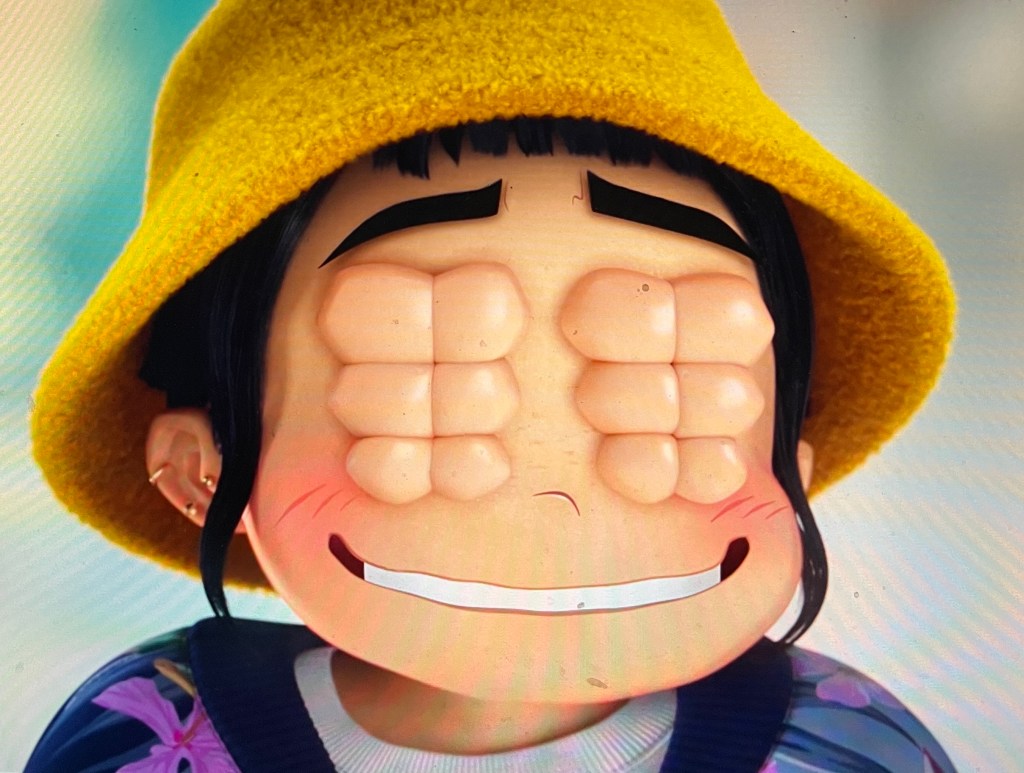
It has decent characters, great acting, and is overall an enjoyable story. That being said… I take issue with the message of the film, otherwise knows as the theme.
I honestly thought for a good chunk of the movie that they were going to go for an incisive and poignant message about the hidden horrors of being a celebrity or idol. The clues were all there!
The constant repetition of “For the fans” and “We need the fans.”
The fact that their mentor lady told them, “Your faults and fears must never be seen” (which I’m trying to generously read as NOT a straight ripoff of Elsa’s emotionally abusive father in Frozen. Conceal it don’t feel it, am I right).
The constant pressure to perform, to the point where Rumi—without her partners’ permission—interrupts the week of vacation they’ve been anticipating in order to put them right back in the spotlight. It particularly bothered me that the other two responded with a bit of upset… for a minute.
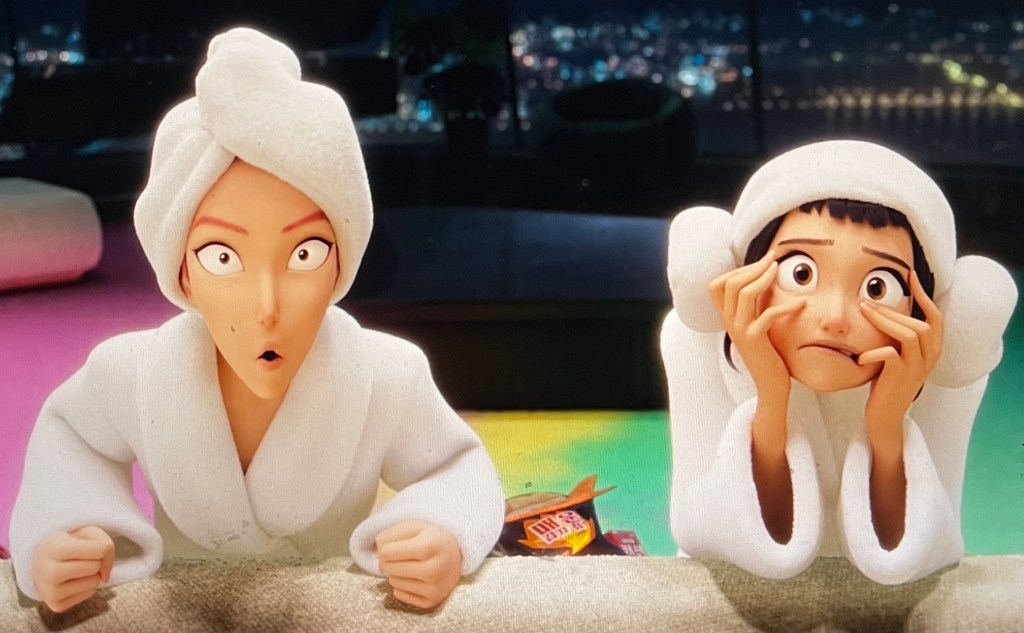
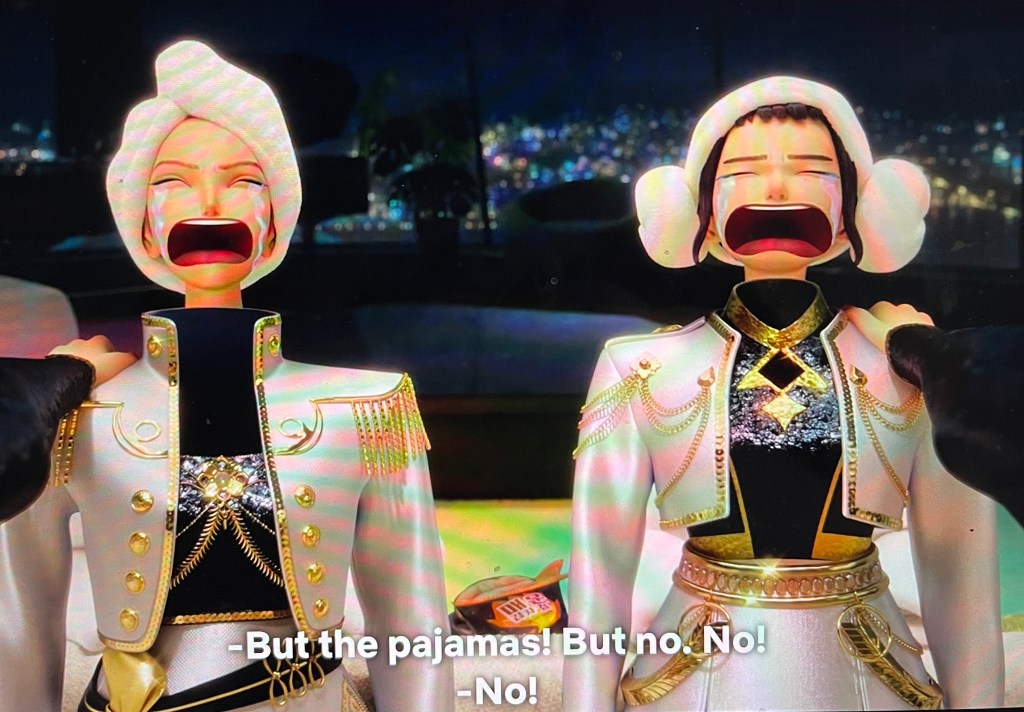
Then their manager, Bobby, busts in to inform them that “Golden,” the single that Rumi dropped WITHOUT THEIR PERMISSION OR KNOWLEDGE, is going viral, and just like that, Mira and Zoey are happy happy happy!
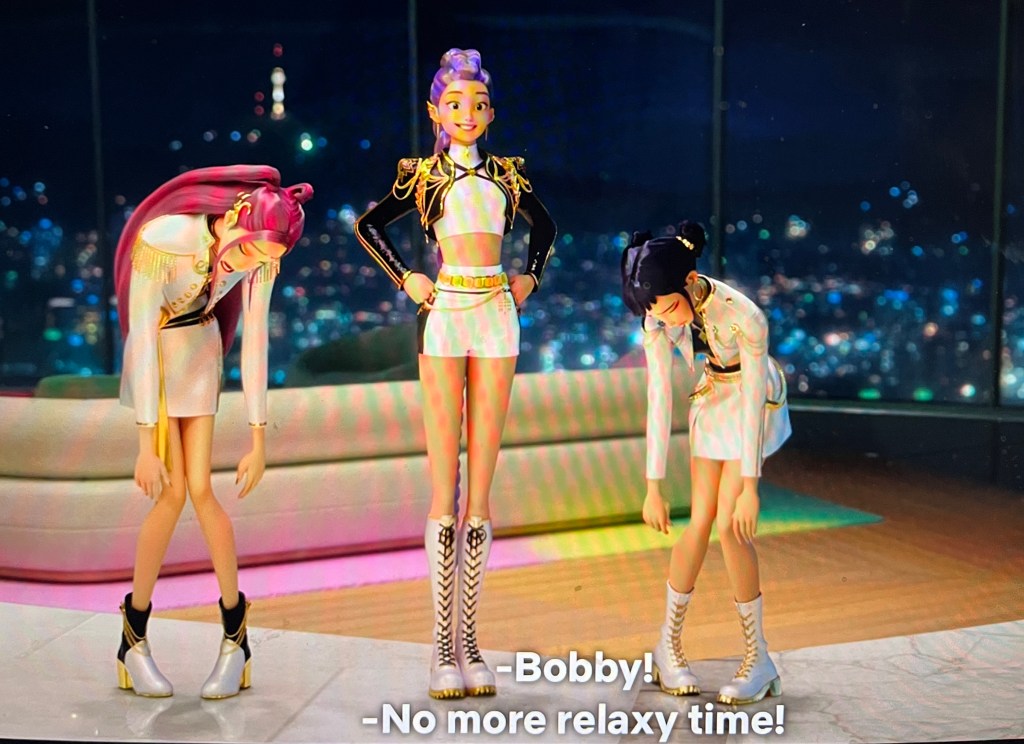
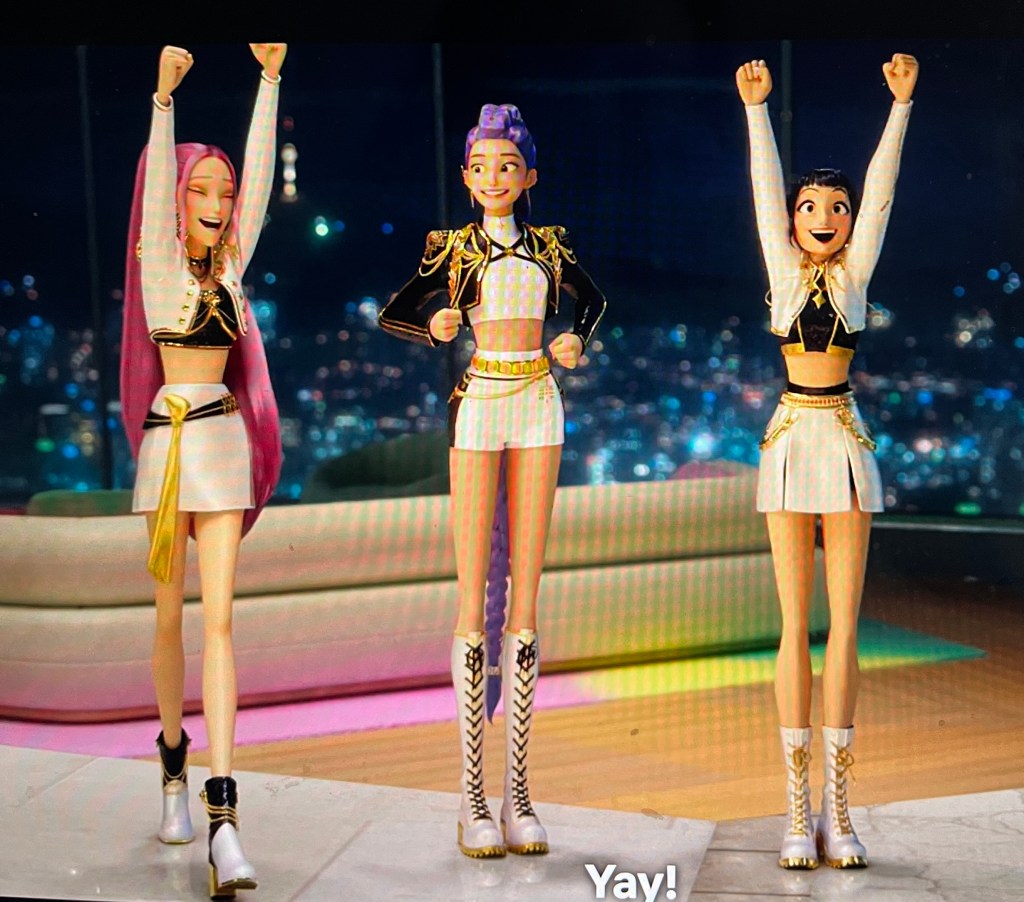
There was an in-film reason for Rumi’s betrayal of her costars, namely that she believes her own demonic traits will be erased once they sing “Golden,” but Zoey and Mira don’t know that! They have every reason to be angry at her. While they do try to confront her later, that arises from other behaviors and warning signs, not from this clear and remorseless betrayal. In this moment, when they discover their vacation has been cut short, all is forgiven and forgotten almost immediately.
Like I said, I feel like they were getting there, except they waaaay boffed it at the end with this generic message of “Oh EVERYONE has their hidden demons and you just need to BE YOURSELF,” and not “These PERFORMERS have their demons and are afraid to be anything other than perfect because of the backlash they’ll face.” Again, this is highlighted by the fact that they’re angry to see a rival band. Why would this make them angry? Because they need the fans! They need to be IT and PERFECT! But again… that didn’t go anywhere. They still just LOVE being pop stars, and the message of the movie ends up being generic: DON’T BE AFRAID TO BE YOURSELF.
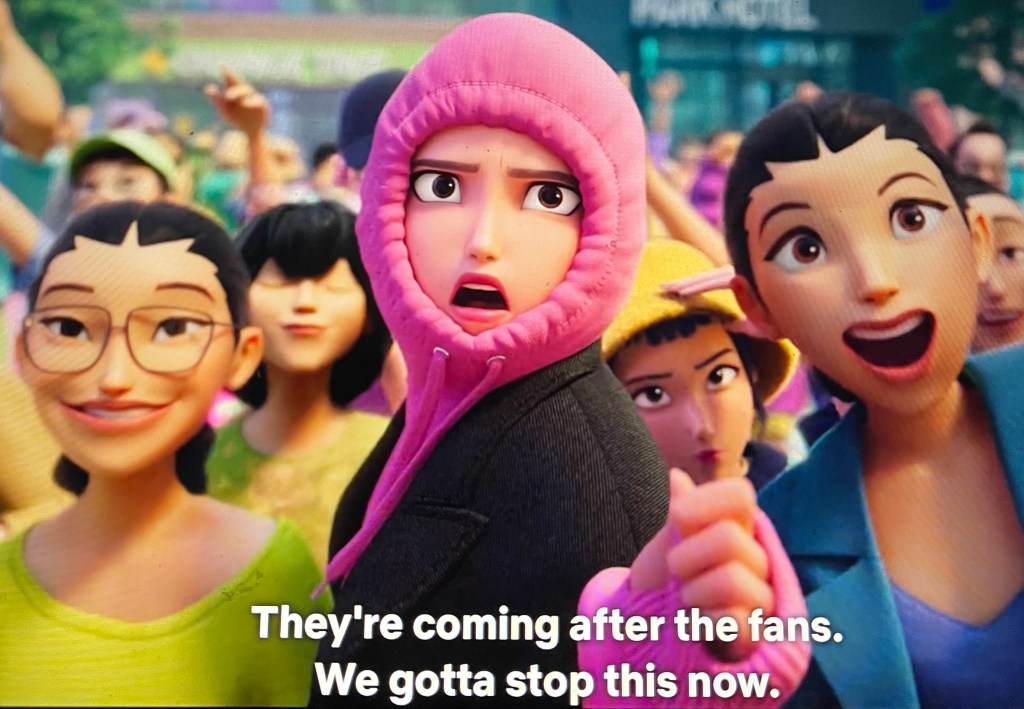
I don’t have anywhere else to put this, so I’ll just say I looked it up and “Saja” 사자 means “Lion.” Hence the band’s logo being a lion and their call to action being, “Join the pride.”
Credit where credit is due, I like the lyrics in “What It Sounds Like,” the final number the trio sings as they defeat the demon lord. Specifically, when they sing “[N]ow we’re seeing all the beauty in the broken glass.” That’s a good line! I like that one. Oh, but speaking of that song, there are other lyrics I want to focus on…
My voice without the lies
Why did I cover up the colors stuck inside my head?
We’re shattering the silence.
It’s all about a “song [they] couldn’t write.” The lyrics are all about uncovering the truth, finally being honest, not being scared to be their real selves, to show that they have flaws. I’m willing to bet there’s another layer of meaning to it, too, considering it’s likely that pop stars aren’t always allowed to perform the songs they want to sing. I’m sure there are some out there who would prefer to go against their established “image,” and either feel they can’t or are explicitly told they can’t. Jesus… I think I just described the plot to Stuck in the Suburbs. Am I really sitting here thinking the Disney Channel Original Movie Stuck in the Suburbs achieved the message I’m looking for where KPop Demon Hunters didn’t??
“What It Sounds Like” could have been the perfect anthem for tired, burnt-out celebrities and pop stars everywhere. “We’re shattering the silence”? Come on! When I think of entertainers shattering the silence, I think of the abuse they endure behind closed doors. The pressure. The paparazzi and fans hounding them. Photoshopped pictures in magazines. Speculation in headlines. Their lives under fucking microscopes. They never have peace! This song could have been about them coming to the realization that it’s better to let the world see them as imperfect than to keep living up to impossible standards at the expense of their own mental health. But, no, in the context of the movie, it’s all rolled into the “Don’t be afraid to be yourself” narrative.
I swear, the bones of this theme are in there. Look at Saja Boys’ final song. The religious imagery in their lyrics, the fact that they are dressed like the Korean version of the Grim Reaper. Describing fans as “down on [their] knees” to worship the band. The sinister nature of the song is ostensibly about how the band of demons is planning to take people’s souls (“You gave me your heart, now I’m here for your soul”), but I see it as yet another cry for help. The obsession of the fans exposed as something dark and unbearably heavy, not a connection, not a tie that binds, but a rope that constrains and imprisons:
I can be the star you rely on
I’m all you need
Your obsession feeds our connection
They’re there for the fans. The fans “rely on” them. But who can these pop stars rely on?
Why wasn’t this theme explored more fully? The concept of idols and stars being beholden to their fans, even if it’s to the celebrities’ own detriment. Is it because it’s a kids’ movie? (I think it is? I’ve heard people talking about their kids loving it, at any rate.) Maybe it wouldn’t be so bad for kids to learn that the celebrities they idolize are human, too. And it wouldn’t have prevented kids from picking up on the more general message of “It’s okay to be yourself”! That message could have still been there! We need to give kids more credit, man.
Or was it because the filmmakers didn’t want to piss off the Powers That Be in the entertainment world? In the KPop world? Maybe. I’m not sure I can blame them for that. It is quite possible that the oppressive nature of the entertainment industry is exactly what… prevented this movie from pointing out the oppressive nature of the entertainment industry. Gotta appease the masses. Gotta appease the bosses. The people who write the checks don’t want to look bad. No no. Stay in line. Funnily enough, in a meta sort of way, this movie does kind of send the message I wanted it to. My awareness that the moviemakers would have had to pull their punches to appease the higher-ups is the message, but only if they had punches to throw and chose to pull them. I can’t speak to the motivations of the people who wrote and produced this movie. Maybe it never occurred to them to send a more poignant message. I’m operating under the assumption that they would have wanted to, but felt they couldn’t. Maybe they didn’t want to at all, which is a problem in and of itself.
Anyway, what I would have done would be to make it so the general public DOES know about the demons and THEY are the ones who turn on Rumi when they discover she is part demon.
(BTW THEY NEVER EXPLAINED THAT. Did her mom have sex with a demon?? What are demons anyway? I love their design, but they appear to be a bunch of otherworldly monsters and then… there is this one dude who was human and sold his soul. So were all demons human once? Some of them? I know Rumi tried to figure that out herself in one scene, but was unable to draw a conclusion, as I am unable to do. Was Jinu a demon at all? Why does he get a pet bird and tiger? Where did they come from? Are they demons? Demon animals?? Maybe I missed something…)
Ahem, so basically it could have been a message about how nice it is to sing and how Rumi can’t get enjoyment out of it when there’s pressure to be an IDOL, and the end of the movie is her realizing she doesn’t need to be this perfect object for her FANS, but rather can sing on her own terms for herself. The woman who does Rumi’s singing voice, EJAE, apparently had her own negative experience with this industry as she was told she was too old and would “never make it,” so I’m simultaneously very happy for her and also upset that they didn’t go more into the “Pop stars don’t shouldn’t exist to be consumed by the masses” message.
I really thought for a small portion of the movie that they were going to go for it, they were going to make a point about what celebrity does to people (both the person who is a celebrity and the people who worship them). The trio really could NOT stop repeating the fans thing. The fans! For the fans! We need the fans! AHHH THE FANS. It’s like… are we supposed to believe this is a healthy mentality?? Because it’s not. Yet, that was never addressed. A charitable reading of this is that they like pleasing the fans and interacting with them, and that is why they are so desperate not to disappoint. But… it still leaves us with these three women making all their decisions for groups of strangers rather than for themselves.
Imagine if a group of the obsessed, screaming fans featured at the beginning of the movie went up to Huntrix at the end of the movie and calmly, politely asked if it was okay to chat, rather than screaming manically and assuming it was okay to mob their idols? What if the fans thanked them for their hard work? This would contrast nicely with the fan behavior throughout the film and show there was a lesson for everyone to learn.
In conclusion, it was a pretty movie and I liked it (though I am concerned all the bright colors and jerky animations were there to continuously grab and regrab viewers’ attention, not unlike someone constantly snapping their fingers in front of your face), but the ending had it falling flat for me. Rumi, Zoey, and Mira want to be golden, but—to paraphrase a famous poem—“Nothing gold[en] can stay.” They strive for perfection that cannot and should not exist.
So yeah, the film was good, but it had no teeth. I like my movies and books to have some teeth. Like Sinners. That was a good movie. It had teeth.
Also I YouTubed again. Check it out below (if I embed it correctly) or follow this link.


 Potato Lady Blogs