Tag Archives: humor

A Look Back – Familiar

Chugging right along, here’s a look at one of my books, Familiar.  (If you’re just joining us, you might want to read this post first)

INSPIRATION – You know that archetypal witch on a broomstick that you usually see silhouetted against the moon, her black cat inexplicably riding behind her without falling off?  Usually as a Halloween decoration?
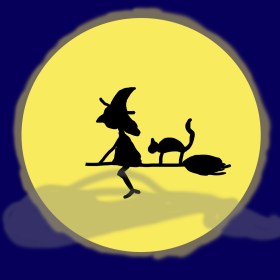
Witch and Cat

I was thinking about that image and decided to write a story from the black cat’s perspective.  But I ended up writing it from both the  cat’s and the witch’s points of view, alternating every chapter.

PLOT – A young woman named Aradia is a modern-day witch who attends college and works a part-time job, and when she’s not doing those things she’s practicing magic with her familiar, a black cat named Kemnebi (Kem for short).  Aradia and Kem soon learn that an evil, immortal shapeshifter has been summoned to do the bidding of an unknown evil mage who has a keen interest in Aradia because of her unusual connection to the elemental spirits – Fire, Water, Air, and Earth.  (Magic, in this book, is created by drawing on the power of the Spirits, which coexist with the real world and are born from strong emotions and feelings and things that cause strong emotions, like Death or a Home.  And also from just…strong things, I guess, since there are elemental spirits.)

PROBLEMS – My biggest problem, I realized after gaining a great deal more experience in the field of writing, is that Aradia is a Mary Sue.  She is beautiful, but doesn’t see herself that way, she acts cute and demure around her friends and her love interest, and she is Special in the way that needs capitalization.  There’s nothing wrong with main characters being Special, of course.  It happens all the time – Harry Potter, Clary Fray, Katniss Everdeen, to name a few – but these Special characters do need to have personalities outside of their Specialness.  Aradia does not.

“Should’ve known better than a surprise party, huh?” I heard Lynn say to Aradia.

“I’m sorry.  I shouldn’t have reacted that way, but thank you.  Now that I’m over the shock, I can acknowledge that it was a nice surprise.”

“You certainly know how to make an entrance,” interjected Nameless-Snake-Man.

“Yes, it’s a gift,” Aradia replied. “Don’t get me wrong, I’m glad that you helped replace the bulbs, but I’m afraid I have no idea who you are.”

“Lynn invited me,” was his reply. “I’m Theo, and this is Samson.”

He pointed to the snake around his neck as he spoke the second name, and it responded by turning its fluttering tongue in Aradia’s direction.

“It’s nice to meet you both,” Aradia said politely. “It looks like you’re not the only one to have brought a pet.  Have you met mine?  Come here, Kem.”

So that was the biggest problem I could think of.  Aradia was a Mary Sue who easily fell in love with Sean – the love interest who has a wolf familiar named Circe – in a matter of days.  And he fell in love with her.  And that led to INCREDIBLY embarrassing dialogue like:

“You’re lying to yourself, Aradia,” Sean stated. “Do you understand that?  You’re so afraid of hurting someone, you won’t even let yourself try and see if you’d actually do it.  Deep down you know you can control it, but you refuse to believe it.”

“Sure I can try to control it, but what if I mess up?  I don’t want to take that chance.  It would be too painful, and I don’t think I would ever be able to recover from it.  Would you please just let me go?”

“Well, I don’t mind taking that chance at all, and I’m not letting you go.  If you leave then you’ll be taking my heart with you and then I’ll never see it again.”
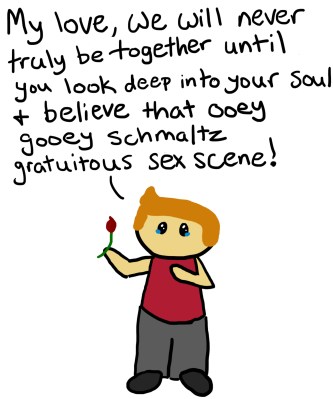
Ooey Gooey Schmaltz

Why did this happen?  Because Familiar, as well as a number of other books, was written in a time when I was trying desperately to live vicariously through my characters.  I wanted a boyfriend and a relationship so badly that many of the books I wrote ended up being about a stupid, sappy, romance-novel-worthy relationship with only a shaky plot that was added in as an afterthought.  I also contributed my own self-consciousness and low self esteem, making a character who thought herself plain but was actually beautiful, since that is what I so wanted to be true of me.  I, like many young men and women of a certain age and awkwardness, wished fervently for some prince to come along and tell me how wrong I was about my looks, how I was a beautiful thing to behold and all my self-consciousness was unfounded.  Since I didn’t see that happening anytime soon, I made it happen again and again in my books.  And my writing suffered for it.  So…

HOW I’D FIX IT – By taking all of the above information into account and changing it.  Aradia would become surly and guarded, foul-mouthed and friendless, except for her faithful familiar.  Kem would continue to be his proper, tightly-wound self, with his own love interest – a calico named Trinka – and his own motivations – get Aradia to open up to other human beings, stop the evil shapeshifter, yadda yadda.  This could work.  I think I could do it.  It would just take a lot of effort.  I didn’t leave myself very much to work with when I wrote this one.  But I’ll try my best, because I like the idea.

Next post will be about Leaves (as if that means anything to you).  See you then!

Word of the Day: Demure (adj) – characterized by shyness and modesty; reserved
Writer's-Block-Strip-32

Leave a comment

Filed under books, Comic, Humor, writing

A Look Back – The Dreamcatchers

I tried to write this post once already, and it ended up longer than my average post before I was even halfway done.  So now I’m going to try to do the super abridged version of it.

The Dreamcatchers

INSPIRATION – I got the idea in 8th grade Lit class after daydreaming and thinking about how weird it would be if all the things I’d just imagined appeared in the classroom.  Then I thought that bringing dreams to life would be a good book idea and it all went from there.

PLOT (as it was then) – Shauna Clay unwittingly buys a magical dreamcatcher from a hippy named Sunny.  The dreamcatcher transports Shauna into her dreams every morning, and she can’t find her way back to the real world without seeing the dream through to its conclusion.  The dreams challenge her stuck-up ways and cause her to rethink her priorities and learn a huge lesson, etc.

PROBLEMS – Shauna’s name has since been changed to Shaina McKay since I realized that “Clay” seemed like I was trying too hard for literary meaning.  Clay being a moldable, changeable substance.  The real problem was that I did mold Shauna to my liking, making her the person I never thought I could be.  As a thirteen-year-old girl who was teased a lot for being “gross” and “ugly,” I immediately attempted to live through my character:

The three girls visited tons of shops, but Shauna still didn’t see anything really amusing.  They began to talk about her upcoming date with Jason. 

“He is so hot.  I can’t believe your mom said yes,” said Paige. 

“Yeah,” said Carrie, “But I’m not surprised that he asked you out.  You’re, like, the prettiest girl in school.” 

There were two things about Shauna Clay that were undoubtedly true.  One was that she was very pretty.  She had shoulder length brown hair, green eyes, a perfect complexion, and she was in good shape.  The other thing was that she’d never broken a sweat.  She wasn’t athletic at all, in fact it was just the opposite.  Shauna was laid back, and had no interest in sports.  Studying was the only thing she was really good at.

The Dreamcatchers, First Edition (2004)

Beyond the bad writing and the attempt to live vicariously through my character, there was also the plot.  There is a word for it that I didn’t know existed at the time – Formulaic.  The book worked like this – Shauna woke up, lived through an exciting dream, did some stuff, went to sleep, had a dream, lived through the dream, did some stuff, repeat, repeat, repeat.

HOW I’M FIXING IT – Well, first off, I became a better writer.  I learned to Show more and Tell less.  But the book was still formulaic.  In my current rewrite, I’m working more on having Shaina’s waking life be just as important and eventful as her dream life.  That way the two can parallel each other instead of her waking life being filler between dreams.

“Yeah,” said Shauna.  She went upstairs to read. 

Later that night, after dinner, Shauna went up to her room.  She lay on her bed and stared at the dreamcatcher.  After a few minutes, she dozed off because she hadn’t gotten much sleep the night before.  She woke up in the morning, apprehensive, because she couldn’t remember her dream and didn’t know what to expect. 

There are a lot of things I changed in the first rewrite, too, like making Shaina a person who sketches all the time.  In the newest rewrite, her drawings literally wallpaper her bedroom, and they relate to the quirky, crazy dreams she has.  In the older versions, Shaina’s real life affected the dreams she had more than the lives of the other two people she meets – Cady and Eric – even though all three of them share the dreams and learn from them.  In the newest version, I will be attempting to work Cady’s and Eric’s lives into the dreams more, so there’s a balance.

We’ll see how it goes!  If you managed to read along this far, then you deserve a comic as a reward.  One that fits into the post without the need for click-to-enlarge technology.

Writer's-Block-Strip-31

Nifty, no?  This new format will allow me to provide you with in-post comics from now on.  Hooray!

Tune in next time for a look back at Familiar.

Word of the Day: Cumbersome (adj) – burdensome; troublesome.

Leave a comment

Filed under books, Comic, Humor, writing

A Quick (Not Really) Book Review

I know in my last post I talked about doing my personal trip down Memory Lane, and I will get to that in the coming weeks.  But first I wanted to do a quick (not really) review of a book called Openly Straight, by Bill Konigsberg.  In this review I will also be expressing my opinions about homosexuality.  I hope that doesn’t become an issue.

Openly Straight follows Rafe, a high school junior who is openly gay.  Rafe’s parents are extremely supportive, his community accepts him, and he even starts to talk at other high schools about being gay.  But through all this he feels that the label of “Gay” is following him around.  So, in an attempt to shake the label, he transfers to an all-boys boarding school and becomes “openly straight” to try and live a “normal” life without his Gay label.  This of course leads to some consequences, especially when he falls for a straight friend.

The book is good.  What’s good about it is that it reads like any other Young Adult fiction.  It has a flawed, but likable main character, a love interest, conflict, motivation, and a resolution.  The only difference is that the protagonist is gay.  Strangely (or ingeniously) enough, this book has the same label on it that Rafe is trying to escape.  It’s about a GAY.  It’s DIFFERENT.  It’s making A POINT.  And it does a fairly good job of making its point, too.  On the one hand, we have Rafe’s love interest, who knows he is straight but is still confused by his feelings for Rafe.  This makes him almost a foil for Rafe.  The Gay boy who is trying very hard to appear straight falls for the straight guy who is trying very hard to remain straight.  The love interest’s (I’m refraining from using his name so as to avoid spoilers) inner conflict is almost a better representation of the struggle that a lot of young, questioning people go through.  It also subtly incorporates the concept of the Kinsey scale, putting the love interest somewhere on a spectrum of sexuality, rather than making him one thing or the other.  (Even “Bi” is a definite label that doesn’t allow any leeway or preference towards one sex over the other.)

Then there are Rafe’s parents, who are supportive of their Gay Son to a fault.  I capitalized those words because the parents were also part of the “labeling” problem that Rafe tries to escape in the book.  Instead of continuing to think of him as their son, they started to think of him as their Gay Son.  And I think this addresses a very poignant issue: Sometime in our history, we as a society decided that Homosexuality (as well as everything else included in the LGBT spectrum) was a Big Deal.  This left individuals and groups with the task of assigning either a positive or a negative to this Big Deal.  People had to decide whether they thought this was a Good or a Bad.  And, as I said earlier, there are problems with both.  Because both schools of thought serve to strengthen this idea that those in the LGBT community should be recognized as “Other.”  Am I saying that there shouldn’t be groups like PFLAG, or Gay Pride marches?  No.  But I am saying that even people with the best intentions can still actively isolate a community by saying “Oh yes, I have NO problem with THOSE people.”

What do I propose instead?  It’s hard to put into words.  Take a simple statement like, “Oh, I can’t do Thanksgiving at your house this year.  I’m going to my sister’s.  She and her husband invited the whole family.”  You know how no one ever responds to a statement like that by trying to slap the person?  People should react just as calmly if the word “husband” were switched with “wife.” We should stop thinking about Gay People and start thinking about people.  When someone says “My sister and her wife baked these orgasmic cookies,” no one should react with anything other than “Can I get the recipe?”  Why?  Because the sooner we start to accept that “the Gays” are just people whose sex lives should be no more or less interesting than anyone else’s, the sooner reality will reflect the change in our actions and thoughts.  The sooner everything will calm down and suddenly there will be less and less need to fight for “Gay rights.”

I shouldn’t say this, but Americans are just awful at learning from their mistakes.  Many, many decades ago, we decided Black people were less than human.  We fought a war over it, and now the majority of people realize that slavery was wrong.  We are still trying to apologize for it with things like Black History Month.  So we know it’s wrong.  Even more recently, Women had to fight to get the right to vote.  Women are still fighting for equal rights, but at least we’ve accepted that maybe they should be treated like equals, too.  Now we’re in the present day, and none of our past mistakes have served as learning experiences.  We are still trying to create Us and Them, still trying to select groups of people and make them Less Than.  When really I thought we were supposed to be better than that.  Land of the Free and all that?  Where exactly are the Free at this point?  How Free are we when we need to restrict other people’s freedoms just to feel that much more in control?  How Free are we when we cringe away from anything that seems Different?  We’re bound by our own prejudices and hatred.  It sounds cheesy; it’s also fucking true.  Stop thinking of LGBT and Gay and Straight and start thinking about People.  We’re all just people.

Anyway, it was a pretty good book.  You should read it if you have the time.

No comic today.

Word of the Day: Prurient (adj) – having, inclined to have, or characterized by lascivious or lustful thoughts, desires, etc.

This post is dedicated to George Takei, who’s just a really cool, inspiring dude.  We should all try to be George Takei when we grow up.

Leave a comment

Filed under books, Humor, writing