Tag Archives: humor

Make with the Wooing Already!

Today’s post is about romance.

There are so many elements to think about when creating a work of fiction that it’s not even funny.  But I want to focus on romance because it does come up a lot, and I think it’s one of the trickiest things to handle.  I’m having trouble putting my thoughts into words for this one, so bear with me.

Romance is an element in a lot of novels. Some people read books specifically to follow characters on their romantic journeys. Heck, there’s an entire genre dedicated to it.

Here’s the problem: Because romance is so prevalent in several genres of literature, it becomes very hard to bring something new to the topic.  In other words, it’s hard to make your characters’ love story unique.  Now, it helps that your story as a whole is unique. (If it isn’t, then see me after class)  With a unique story comes a unique romance.  But you still need to approach it carefully.

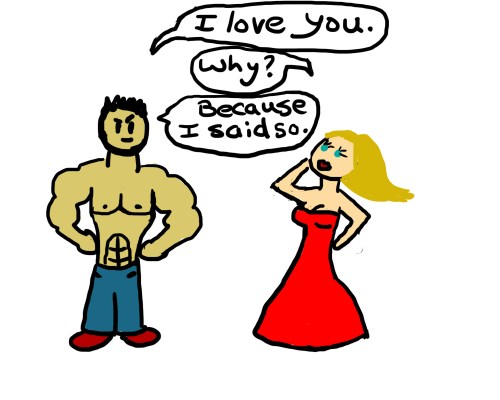
What you don’t want in your story is a muscled-up, ruggedly handsome, personality-less man falling in love with a gorgeous, buxom, personality-less woman whose hair always seems to be blowing in the wind.  Then you get this:

The problem with the above scenario is that they are in love for superficial reasons.  This is, of course, an extreme example.  But my point is that the love should never come from you, the author, telling the reader that these two characters are in love.  No, the love should come directly from the characters.  I hope that makes sense.  Remember how I mentioned following your gut?  If your gut is telling you that this relationship you’ve created isn’t working, then it probably isn’t.

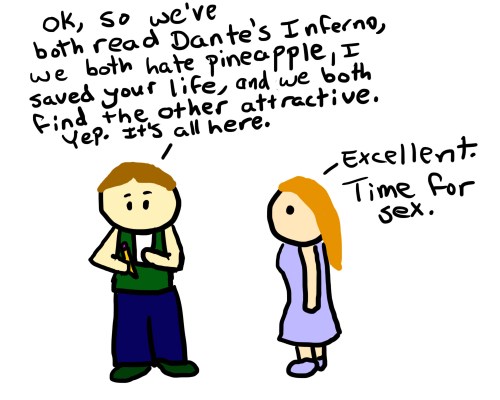
You can’t fix the above problem by fabricating reasons for the two characters to be in love, though.  It’s not as simple as going back through the book and inserting some random things that they have in common.  Then, at the end of the book, it’ll kind of seem like your characters are going through a checklist of things that represent their love.  Like this:

What I’m saying is, it’s not enough that they have some stuff in common.  And it’s definitely not enough that he’s saved her life.  Then you have the whole knight-in-shining-armor scenario where the princess falls in love with her savior because she’s pretty much obligated to.

So what does that leave us with?  Well, my advice is that you develop each character’s personality separately.  I think a lot of the time, the problem stems from that whole “Romance is expected” thing I mentioned earlier. You have this well-developed main character who needs a significant other, so you create that extra character for the sole purpose of having your main character fall in love with him/her.  Instead of doing that, remember to develop your love interest’s character beyond the romance.  Give them a back story and a purpose in the plot besides needing rescuing and/or being hot.

I hope that helps.  I might expand on it later, if I feel like it.

Word of the Day: Amorous (adj) – Inclined or disposed to love, especially sexual love.

2 Comments

Filed under books, writing

They Say

First, an update.  My mother pointed out a continuity error in Chapter 1 of Grotesque that has now been fixed.  What’s great is it actually reinforces an earlier point that I’ve made.

In Fantasy, you make up your own rules, and are at liberty to change them.  The error I made was very small – the fireplace in Serrafiel’s room is described as having no wood in it, but then later his master lights a fire in it, and suddenly there’s wood there.  This happened because I originally decided that magical fire would not need anything to burn.  But as I got farther in the book, those rules no longer worked.  For reasons that I don’t care to go into, it became necessary for magical fire to need wood.  So I went back and changed it so that the fireplace in Serrafiel’s room contained wood.  What I did not realize was that I’d mentioned the lack of wood in two places, but I only changed it once.

Moving on…I mentioned that I was going to talk about this in my last post, and I will stay true to my word.

They say, “Write what you know.”  Well, I don’t know who “they” are, but if I ever meet them, I’m going to punch them right in their collective smugness, which I’m now convinced is a punchable organ.  I shall explain why.

Here is a list of things I know:

–          My name

–          Sarcasm

–          How to talk (usually without stopping)

–          Psychology, via courses in high school and college

–          Horses (How to ride them, and some random facts)

–          English, some Japanese, some Spanish

–          Judaism

–          Literary analysis

–          What it is like to be cis-female/Things associated with being cis-female

–          Video games

–          The capital of California

–          How to drive

–          Baseball

–          The lyrics to Fireflies by Owl City

–          Cooking/baking

–          The names of all the kids from Ms. Frizzle’s class in The Magic School Bus. (Dorothy Ann, Phoebe, Wanda, Keesha, Arnold, Carlos, Ralphie, Tim)

–          I love chocolate

–          I hate broccoli

–          Grammar (Usually)

–          How to make lists of things

–          How to type

–          How to navigate an airport

–          Which fork is for the salad

–          How to stop a list

It could go on.  I promise you that I know many other things.  But long as that list is, it is infinitesimal in comparison to the list of things I don’t know.  Here is a brief sample of the things I don’t know:

–          What it’s like to have magical powers

–          What chocolate-covered crickets taste like

–          What it is like to be cis-male

–          The capital of Wyoming

–          Where I’ll be in twenty years (and the future in general)

–          What I ate for breakfast on March 19th, 1994

–          How to shoot a gun (What a relief, right?)

–          French, German, Arabic, Swahili, Welsh, Sanskrit (among others)

–          What kind of tea George Washington preferred to drink

–          The exact number of stars in the sky

–          The lyrics to Last Friday Night by Katy Perry (although I’m pretty sure the phrase “Last Friday night” makes it in there somewhere)

–          What causes laughter (Looking for a more scientific answer than “Jokes.”)

–          Why people major in Philosophy

–          What it’s like to be a chinchilla

–          What it’s like to be in love

–          How to build a windmill

–          How to pilot an aircraft

–          How old Leonardo da Vinci was when he died

–          The names of all the elements in the Periodic Table (Oxygen, Carbon, Hydrogen, and Iron are in there somewhere)

–          All the species of butterfly that exist in the world

–          Your grandmother’s maiden name

You might have noticed that in the first list, I didn’t mention writing as something I know.  That’s because this blog, and specifically this post, is all about how to “know” writing, so I figured I’d leave it out.

You might also recall that there is another common expression that contradicts the “Write what you know” mantra.  Ever heard someone say, “You could fill a book with what that guy doesn’t know”?  That bears some thinking on, doesn’t it?

My point in listing all of these things is that you can’t possibly limit yourself to writing “what you know.”  I think it’s insulting to even suggest that you should.  The whole point of creative writing is that you get to write about stuff you don’t know, oftentimes stuff you could never know – like what it feels like to break a man’s spine with your mind.  To say that you should stick to what you know is saying that you’re not good enough at being creative to write convincingly about something you don’t know.

That said, it is important to remember that what you know can be very useful, like a supplement to your writing that makes it awesome.  Take emotions for an example.  If your main character is a fairy princess who just saw her entire kingdom fall into ruin, chances are, you’re not writing from experience.  But here’s something you might have experienced – sadness.  Or desperation.  Grief.  You can use those things, find those feelings, and insert them into your writing.  Without the emotion, it’s just description, and you can do that easily enough.  You don’t have to have seen a fairy kingdom falling into ruin to be able to call up an image of it in your head, and then write down a description of that image.  It’s the emotion, the feeling, that makes that image meaningful.  That’s what I think of when I hear someone say “write what you know.”

And yes, if you read through my books, you’d see that I have inserted a lot of myself into them. I do that because it’s fun, and because it does help guide my writing if I have little things like that thrown in there that I have some personal connection to.  So that’s what I’ve got to say about that.

Word of the Day: Platitude (n) – a flat, dull, or trite remark, especially one uttered as if fresh or profound.

1 Comment

Filed under books, writing

Urban Fantasy with Harry and Harry

Today I asked myself, “Rebecca, do you want to be productive?  Or do you want to draw ridiculous cartoons and then put them up on your blog?”  And myself replied, “How did you get this number?  I told you never to call me again.”  So I took that as a sign to do the cartoons and blogging thing.  But there will be a point to it, too.  Maybe.  This post is going to lead up to that writing sample I promised you guys, so you can expect another update very soon after this one.

But first!  I drew Hamlet.  I just saw Michael Sheen play Hamlet at the Young Vic theatre here in London, and it was awesome, in case you were wondering why I drew this.

Right, so that’s done.  Now the current novel I’m working on is called Grotesque, and it is just my luck that I came up with the idea for it just as NaNoWriMo was coming to a close.  But I’m not bitter.  Even though I wrote 25,000 words in a single weekend, and could have easily reached the 50,000 word goal if I’d had the idea sooner, I’m really okay.

Anyway, Grotesque is a fantasy, even though my forte is really Urban Fantasy.  Now I realize that many people don’t actually know what Urban Fantasy is, so I have illustrated definitions for you.

Urban Fantasy is when you take the real world – cars, iPhones, email, Starbucks – and insert some element of Fantasy into it, like magic or super powers.  Observe:

A good example of this is Harry Potter. [EDIT 3/13/21: I know JK Rowling sucks, but unfortunately Harry Potter is still a good example of this that many people recognize] It’s the real world, but there are people who can do magic.  Another example is The Dresden Files.  If you have not encountered this series yet, you haven’t lived, in my professional opinion.  Jim Butcher is a genius.  Honestly.  His writing flows in a way that I rarely see, even from authors that I truly love.  He is also so funny that it should be illegal.  His main character, Harry Dresden (Now the title of this post is starting to make sense, yes?), is sarcastic, witty, and lovable.  Here’s a picture I drew to illustrate all these qualities:

The skull’s name is Bob.  No I am not kidding.  I will say that reading The Dresden Files is kind of like being in a boxing match, only your hands are tied behind your back and your opponent (That would be the book, in this analogy) gets to wail on you for as long as he wants.  It really is a very rapid-fire, out-of-the-frying-pan-and-into-the-fire type deal.  But it’s worth every bruise, metaphorically speaking.  I’ve got more to say on Harry Potter, the character, but first I want to finish up my definitions.

Fantasy is when you create an entirely new world from scratch, and that world involves things like magic, fairies, elves, and/or wizards.  Think Lord of the Rings.  Also keep in mind that these are the simplest definitions I can come up with, and that you should probably go to some form of dictionary if you want a more complex explanation.  Here’s Fantasy (Yes, I’m aware I look like a sarcastic Powerpuff Girl):

So Grotesque is a Fantasy, and I’m going to tell you, Fantasy is both a blessing and a curse.  Here’s why it’s a blessing: If you’re making up your own world from scratch, then you get to make up the rules as you go along.  The only boundaries that constrain your writing are the ones that you set up, and you can mold and change them as you see fit.

Here’s the curse: Creating everything from scratch means that everything, absolutely everything must be explained.  And you leave yourself vulnerable to criticism and plot holes if you forget to explain something.  It’s not like Urban Fantasy, because people are already familiar with the real world, so all you have to explain is whatever fantastical element you’ve added.  In Fantasy, the existence of magic brings up all sorts of questions that you have to answer.  For example, you might have a magical farming community.  And then you have to address the question of why they bother to grow food if they’re magic.  Can’t they just pull food out of thin air?  Or at the very least plant, harvest, etc. using magic?  Those are things you have to think about.  But then you run into another problem: Everything needs explaining, but nobody wants to read a book that is 50% exposition, where the story is constantly being interrupted by paragraphs of explanation.  This leads nicely into what I wanted to talk about with Harry Potter.

I’ve noticed that there is a very convenient way to get around this explanation problem if you introduce a certain type of character into your writing.  I call this character the Neophyte, with a capital N.  Harry Potter is my favorite example of the Neophyte.  See, if you have a book in which every character already knows the rules of their world, then the reader is left out.  They either have to figure out the rules for themselves, or they’re just plain left in the dark.  Letting the reader figure things out, by the way, is not a bad option, if you do it right.  Also here’s an analogy: The aforementioned divide between characters and reader is like having all the characters in a big, fancy yacht while the reader is in a little dinghy that’s attached to the back of the yacht by a rope.  But what happens if you put a character into that dinghy with the reader?  Then, suddenly, your reader isn’t alone.  They have someone to help them row and catch up to the yacht so they can get on board and party with everyone else.  Okay, enough of this convoluted metaphor.  What I’m saying is, that’s exactly what Harry Potter does.  Because he’s new to the wizarding world, he has to have everything explained to him, which means that the reader is informed vicariously through him.  It has the added bonus of inserting explanation without having to stop the story.

In Grotesque, my main character is, well… a grotesque.  [EDIT 3/13/21: Grotesque was terrible. So I rewrote it. It’s still terrible. I will never let it see the light of day. I suck at Fantasy. What’re ya gonna do?] You know, those scary statues that were put on churches and castles and stuff to fend off evil spirits and peasants?  Right.  The book begins with the grotesque – Serrafiel – being brought to life.  So one minute he’s a statue, and the next, he’s a living, breathing… monstrosity.  Serrafiel is the ultimate Neophyte, because literally everything, right down to breathing and speaking, is new to him.  Which is why I chose to narrate the book from the first person, in the present tense.  Because then the reader gets to see everything through his eyes, exactly as it’s happening.

So now that that super duper long post is out of the way, you can look forward to seeing the first chapter of Grotesque, coming soon to a computer near you.

Word of the Day: Neophyte (n) – a beginner or novice.

P.S. You get extra points if you got the Legend of Zelda reference.

2 Comments

Filed under books, writing