Tag Archives: novel

Am I Being Right or Stubborn: A Guide for Writers

I got my editorial letter! This is the second editorial letter I have received in my life, but I don’t remember if I talked about it or explained it back when Hellbound was almost close to almost being considered for publication. That version of events is too depressing to talk about anyway, so I thought I’d do a post about editorial letters that is positive and happy! But then I remembered John Green already did a great explanation of editorial letters about thirteen years ago on his YouTube channel.

(Speaking of YouTube, I have released two new videos since my last post.)

Everyone can help me thank John Green for saving me time by watching this video (don’t worry it’s short):

That being said, I wanted to explain the editorial process in broad terms real quick. You see, editing a book is an upside-down pyramid. It starts with broad strokes, big sweeping changes, and generalized feedback. Then it moves on (when your editor is satisfied that it can move on) to narrower, more focused changes.
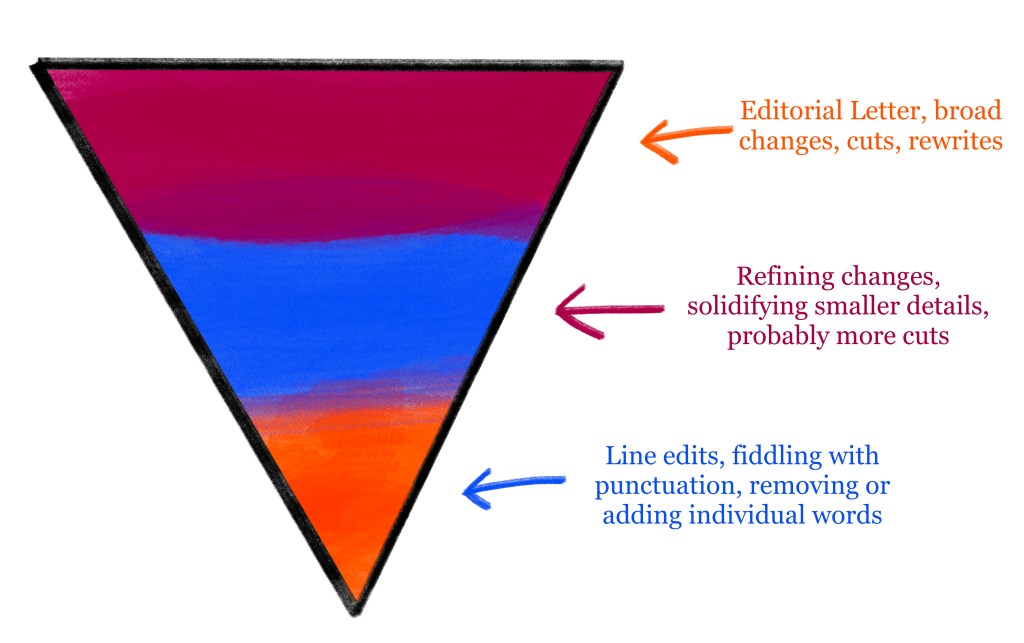
A lot of people imagine book editing as the editor getting out their red pen (or writing utensil of choice) and marking up the manuscript. But you can’t do that for the first edit because the markup would literally coat the text of the book itself. This would inevitably lead to a mental breakdown on the part of the author, and while we authors are quite familiar with the art of the mental breakdown, healthcare professionals do discourage having more than two or three a year. It takes a while to get down to the nitty-gritty of line edits down there at the point of the pyramid.

What’s really exciting for me is that I am only familiar with the top sections of the pyramid! I can’t express how much I am looking forward to discovering parts of the publishing process that I have not been through before. The thrill of the unknown! I just know that this thing is going to start feeling 1,000% more real once we start talking cover design, and I’ll be sure to update when I can so that you, dear reader, can follow along with me.

What I want to touch on real quick is an issue I’ve run into regarding the plot of my book. Falling for the Protagonist is a satirical novel, and therefore I felt that there was a certain amount of leeway I had vis-a-vis “explaining” the supernatural elements. In my mind, because it was satire, part of the point was that the magical stuff and the [REDADCTED TO AVOID SPOILERS] were not practically explained or reasonable at all. For me, that was funny. It fit the theme of the book, which is that romance novels typically bend over backwards to accomodate their happy and just worlds. The previous statement is not said with any kind of censure on my part; I read romance novels because they provide the comforting certainty of a happy and just ending.

But then literary agents started rejecting the manuscript because “there wasn’t enough explanation” of how/why the supernatural stuff happened. At first, I scoffed in an authoritative and haughty way. (I didn’t want you to miss that great pun back there, so I went ahead and emphasized it for you. You’re welcome!)
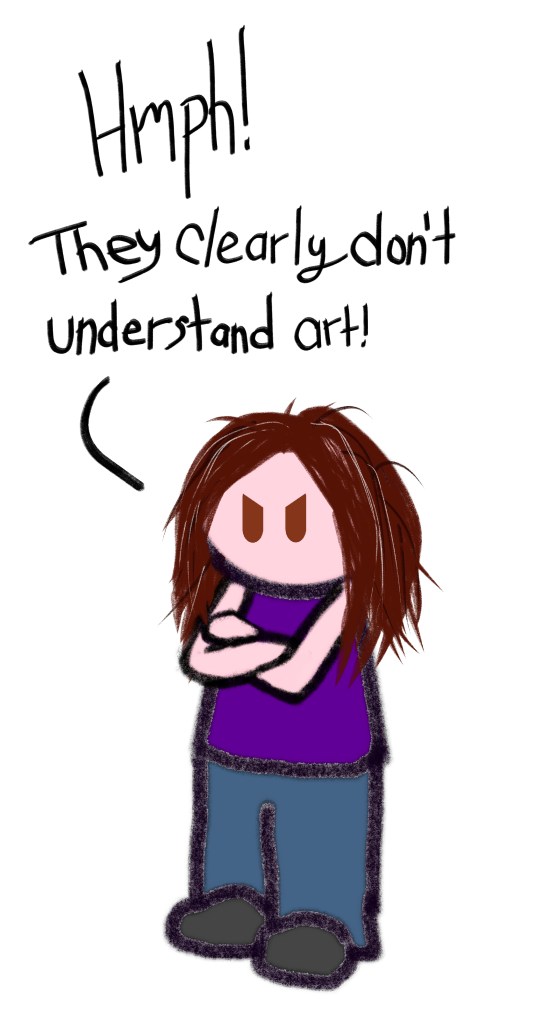
I changed my tune recently, however, when my lovely editor mentioned that we needed to work on better explaining the “rules,” and I was finally confronted with the fact that maybe it was time to kill my darling. In this case, I had to accept that what I thought of as a perfectly acceptable and on-brand element of the novel was clearly not hitting right when other people read it. A good rule of thumb: If some part of your vision isn’t translating well to readers (Even if it makes perfect sense to you!), it shouldn’t make it to the final draft.

The problem many writers run into when encountering other people’s suggestions is that it’s sometimes hard to know when to stand your ground, and when to accept that you need to make changes. Sometimes you get a lot of feedback, and some of it is contradictory. Which do you listen to, if any? If you push back, are you doing so because you are confident in your writing and your concept? Or are you accidentally (or purposefully; no judgement) being a stubborn artiste who refuses to back down?

As with all things creative, there is no single right answer. It’s one of the most frustrating things about being creative sometimes. Other times, it’s a gift. (For example, the fact that good art can be achieved in any number of different ways is freeing for those who want to explore unusual or unexpected artistic avenues.) For me, I have recently discovered that I should probably sit up and pay attention when multiple professionals in the industry are saying the same thing. It’s hard to keep claiming I’m in the right when literally no one agrees with me. Not even my inner goddess!
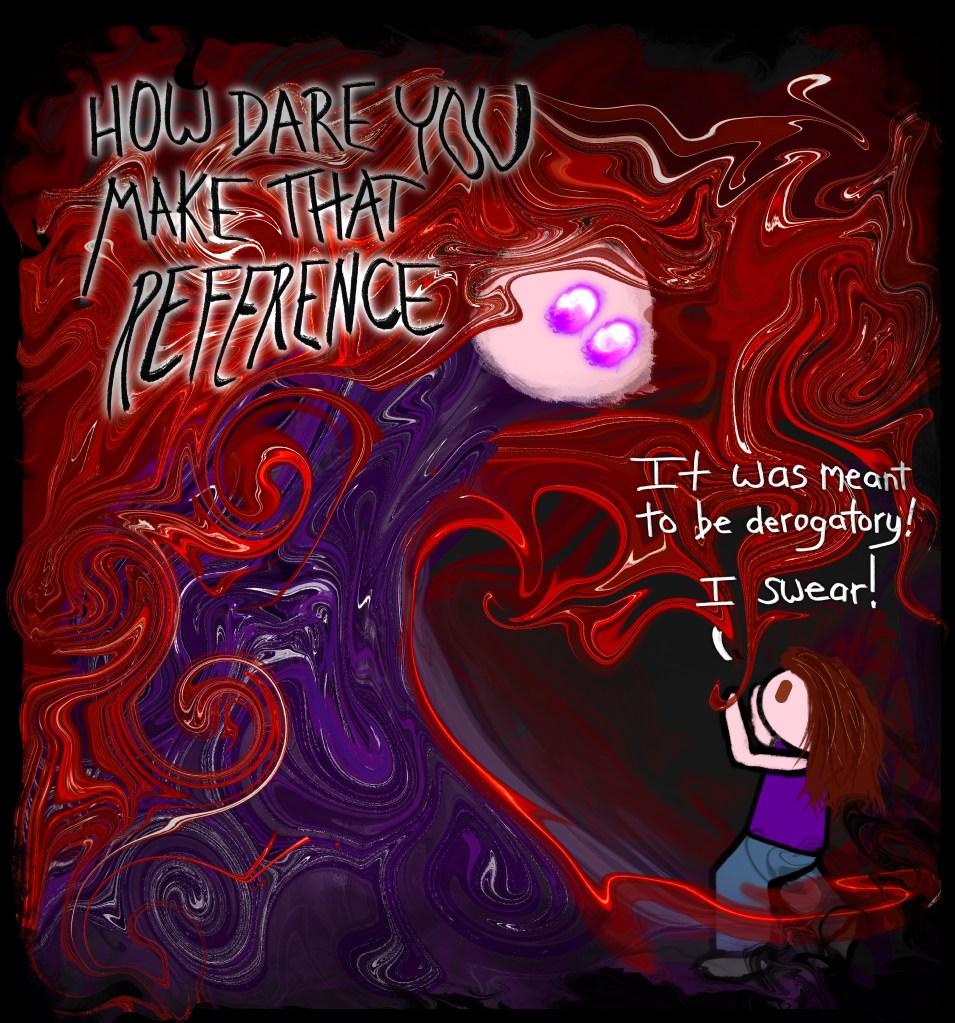
I typically go through some variation of the stages of grief when I have to change something that I was willing to defend for so long, but I have trained myself to get to the Acceptance stage pretty quickly.

In short (too late, I know), you don’t have to listen to everyone’s opinion, but if you get the same advice consistently from people with the credentials to back it up, it may be time to throw in the towel.

I will conclude on an optimistic note, which is unusual for me, but apt in this moment. If you are an aspiring writer, I want you to remember this: Many literary agents rejected my book because of this issue. They didn’t see the manuscript as worth representing because they couldn’t get past this obstacle. I sure did get discouraged! Looking back on it, I’m glad those rejections happened. Because the agent who decided that this plot issue wasn’t a deal-breaker for her is clearly the person I was meant to be working with. Same goes for my editor. My manuscript wound its way through the agencies and publishing companies until it found the right people for its needs. A lot of boilerplate rejections contain language along the lines of “it wasn’t a good fit.” It’s a trite phrase, but I’d like you to consider that it is also 100% truthful. You do not want someone representing you and your work if they didn’t feel that “click” when they read your manuscript.

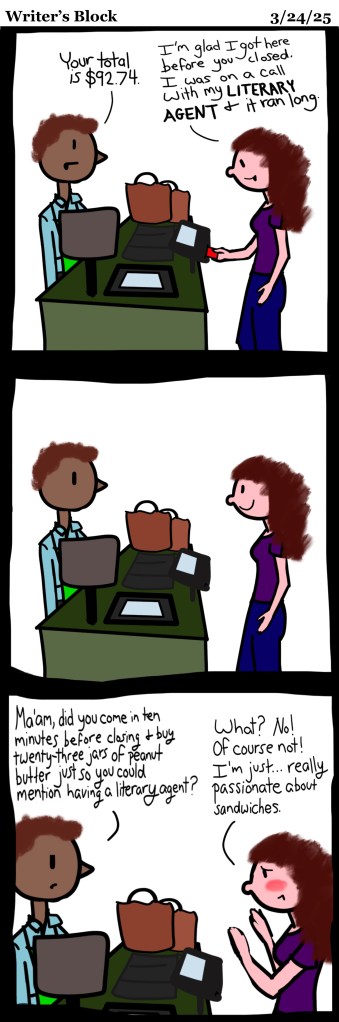
And, yes, I have been finding ways to work “I have an agent and/or editor” into everyday conversation as much as possible. I imagine I’ve become absolutely insufferable, but I just can’t help myself.
Leave a comment

Filed under books, publishing, writing

Strong Concepts

I’ve been thinking a lot lately about the term “strong concept.” It is at once easily definable and as inscrutable as Big Foot’s daily schedule. What makes an idea a strong concept? I hope everyone will agree with me when I say: Every strong concept is an idea; not every idea is a strong concept.

Lately, due to developments that I can’t talk about yet (but OH BOY get ready!), I have been mentally poring through my seemingly unending list of book ideas and trying to figure out which ones can actually be made into a solid story with a beginning, a middle, and even an end.

Something I’ve come to understand is that I often have ideas for scenes that really rock my socks, but just because I have a good scene in mind does not mean that there is a world outside of that moment. It doesn’t mean the characters in the scene are three-dimensional. One good scene certainly can’t carry an entire book. (Unless, I guess, that book was written by Stephenie Meyer. Even then, if I had been given the chance to edit Twilight, it would have turned out differently.)

For example, I have this one scene in my head. A woman walks into a PI’s office and enlists his help to find the man who is going to kill her… at some point in the future.

The backstory for the scene is in my head, too, so I guess it’s really two scenes. See, the woman has a very specific psychic ability–the first time (and only the first time) she touches someone, she gets a brief glimpse into that person’s future. She can’t control what she sees, how long the vision is, or even how far into the future she sees (could be a day, a year, ten years, or any other length of time). One day, she bumps into someone at a coffee shop and the glimpse she gets of his future is terrifying because she sees herself from his perspective as he’s about to stab her. By the time she recovers from this vision, the guy is long gone, and she only has a vague idea of what he looks like. Even worse, she can’t help but shake the feeling that he’d orchestrated that contact, like he’d known exactly what would happen to her and exactly what she’d see. Hence, hiring a PI to help her find him before he finds her.

But… then what? Who is this woman? Who is the PI? Do I even know how PIs work? I mean… I watched Jessica Jones and read The Dresden Files as well as Nora Roberts’ Hidden Star. So… no. No, I don’t know how PIs work. Do I know how to write a competent mystery? I mean… Hellbound has one. But I can’t say I went about constructing that particular mystery in a structured and logical way. Plus, the building blocks of that one were relatively simple. A mystery for adults? One that has to carry an entire novel and involves psychic phenomena? That might be out of my wheelhouse.

Is this a Strong Concept? Hmm… no. I don’t think so. Could it be? Okay, yes. It certainly could be. With some real work put into the setting, the characters (including the villain!), and the plot, I think it could transform into a Strong Concept. But right now, it’s an idea. And I’m not sure it’s an idea that merits the work it would take to make it into a Strong Concept.

Here are some questions I ask myself when I’m trying to determine if I have an Idea or a Good Idea:

  • Why do I want to tell this story? Is there a message the events and characters I’m toying around with will send? Is there something that a stranger could gain from reading about these people and events? Some sort of anchor in the real world and the Human Condition? Along similar lines…
  • Whom am I telling this story for? (It’s tempting to write an entire book just for myself that speaks to my own needs and grievances and hopes and dreams. But my biggest goal is to write for an audience, so if I find myself saying, “I want to write this for me”, I shelve the idea.)
  • What are the characters’ personalities like? Are they more than just cardboard cutouts that I’m moving around from scene to scene?
  • Can I write this book? Do I have enough knowledge and experience to make this story believable? Or will I come off as ignorant and incompetent as I attempt to play in a space I’m completely unfamiliar with?

Feel free to weigh in. What makes an idea a Strong Concept? And what makes you hit Pause and go back to the drawing board?

Leave a comment

Filed under books, Humor, reading, writing

It’s Alive!

A few weeks back I met with my agent and her interns to discuss my book, Grotesque.  One of those interns told me that the manuscript reminded her of Mary Shelley’s Frankenstein, and suggested I read it for inspiration.

So I did.

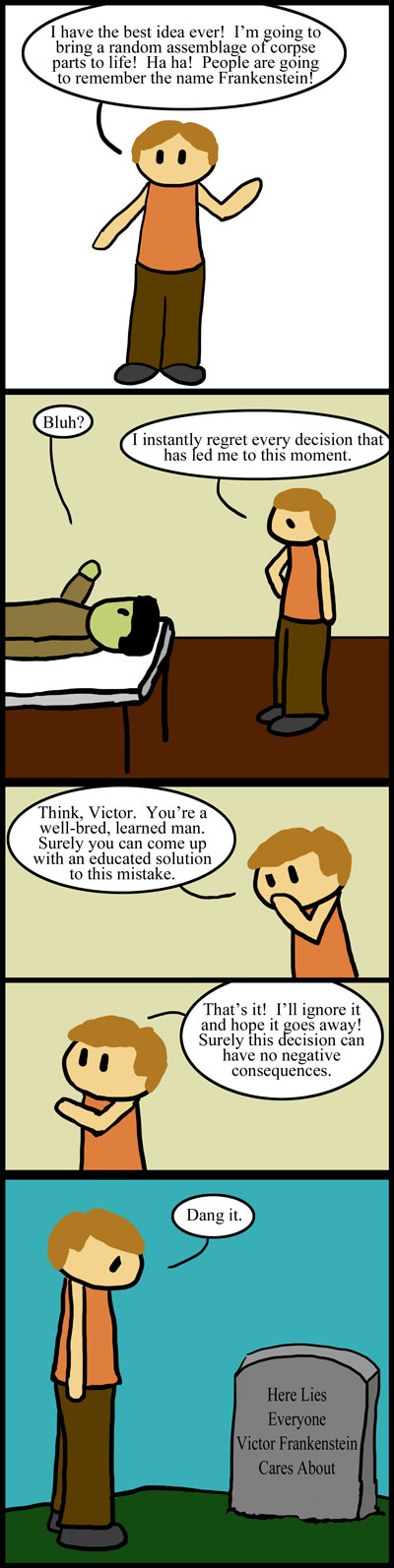
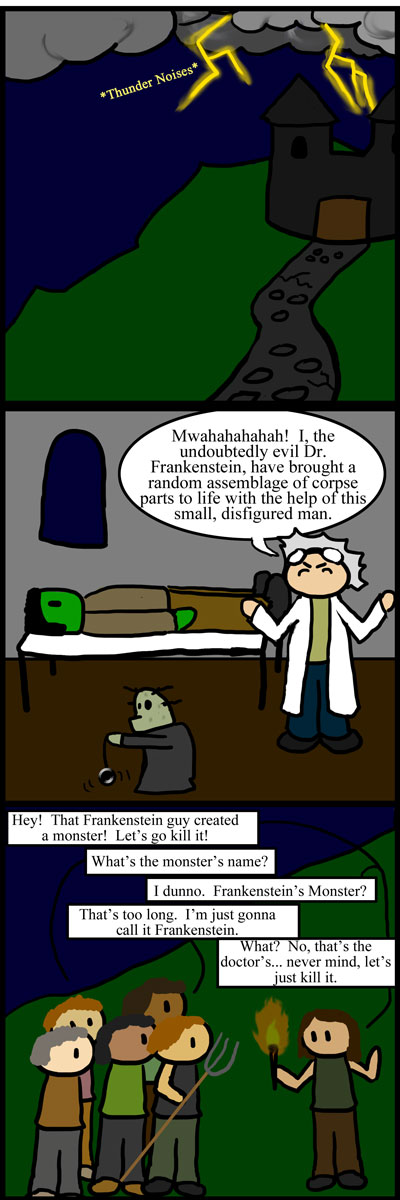
Boy, let me tell you, I was way off base about how this book was going to play out.  Turns out the various movies about Frankenstein and his monster may have exaggerated certain details.  As a result, this was what I thought the plot of Frankenstein was:

Wrong-Frankenstein

And here I thought Mel Brooks’ interpretation of the classic tale was super accurate!  (If you haven’t seen Young Frankenstein, you’re missing out).  But no.  As it turns out, the plot of Frankenstein actually goes something like this:

Frankenstein

That being said, what did I think of the book?  Well, it definitely resonated with me.  The subject matter Shelley touches upon is exactly what I want to do with Grotesque.  In a slightly different way.  I mean, my book has just a little bit more action, for starters.  Plus, a happier ending (spoiler alert).  But the themes are all there – loneliness, playing God, desperation for approval and acceptance, the juxtaposition of a humane(ish) monster and monstrous humanity.  It was a really interesting and inspiring read, and I have to thank the intern who recommended it to me.

Shelley also has a way with words.  I particularly enjoyed this sentence:

“I never beheld any thing so utterly destroyed.”

It’s beautiful, isn’t it?  I can’t begin to describe the impact those words had on me, especially within the context of the book.  They are perfect in their simplicity, yet they say so much more than you’d expect.  “Utterly destroyed.”  It’s almost foreshadowing, too.  The way so many lives are so utterly destroyed over the course of the book, including those of the creator and the created.

I also underlined a couple vocabulary words I love.  “Indefatigable” and “Purloined.”  Those are great words, aren’t they?  The former means “incapable of being tired out,” and the latter basically means “stole” or “pilfered.”

I’ll wrap up with a line I marked that pretty much sums up everything I want to encapsulate with the character of my Grotesque.  It was spoken by Frankenstein’s monster.

“Life, although it may only be an accumulation of anguish, is dear to me, and I will defend it.”

Such beautiful words coming from such a horrid creature.  Shelley really could use words as an art form in a way that I can only hope to accidentally achieve from time to time.

Now all that’s left is to take what I have learned from this book and apply it to my newest rewrite of Grotesque.

Wish me luck!

1 Comment

Filed under books, Comic, Humor, writing