Tag Archives: reading

Wear Your Veggies

Robin McKinley is a person.  More specifically, she’s an author.  She wrote a very interesting book called Sunshine, and another one that I like even better called Deerskin.  She’s also a person who decided to write two variations on the classic story of Beauty and the Beast and publish both of them.  One is called Beauty, the other, Rose Daughter.  I was reading the latter when I came across this piece of description: “…the cabbages, some of them so big around she could not have circled them with her arms, bore extravagant frills as elaborate as ball gowns and as exquisitely coloured” (Rose Daughter, 153).  After reading that, I thought of what any sane person would have.  This:
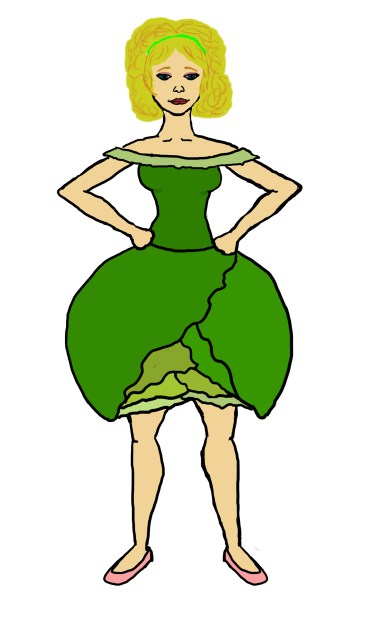
 

And then I again did the very sane thing and drew what I imagined, as you can see.  Then, continuing along the path of sanity, my brain (and subsequently my tablet) produced this…
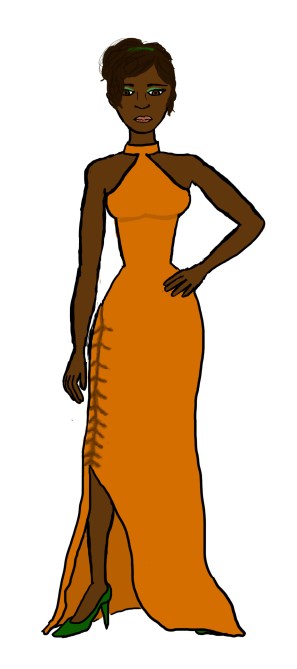
…and this:
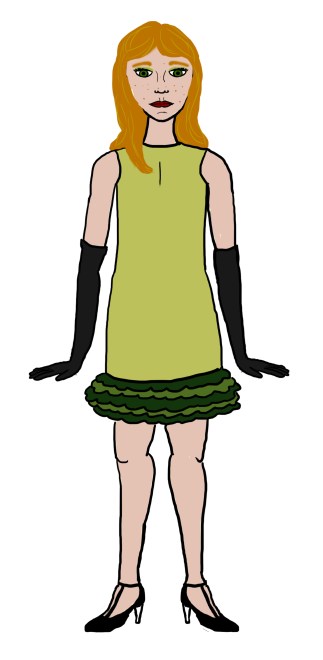
Please excuse my somewhat shabby drawing skills.  I was never really trained, though what I do know I learned from my fantastic mother.  One thing I could never master was drawing feet facing forward, so my figures always come out a bit duck-footed.  Oh well.  I figured it was best not to use Mini Bex in this instance since I don’t think my vision would have translated as well on her.
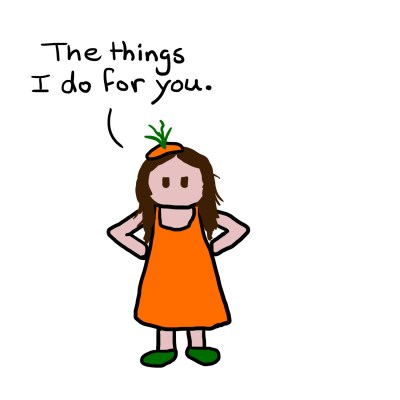
Actually that looks more adorable than I realized…

Also, if you’re curious if you’ve got the right vegetable in mind, hover your mouse over the image.  It’ll tell you.  I may or may not have been sneaking in some Alt-Text for my pictures.  For those who don’t know, that’s the name for the text boxes that pop up when you hover your mouse over a picture.

And, because I feel the need to make this post at least a little bit relevant to the theme of this blog, let me just say a quick word about Robin McKinley.  She’s a great writer.  All of her books (or at least the four I’ve read) have a couple things in common.  The first is that they can get a bit slow at times, especially in the beginning.  It’s worth sticking with them, though, because her writing is top notch and her stories are beautiful.  The second is that I’ve noticed a theme of survival that runs throughout all her books, even though they’re not related (even the two books about Beauty and the Beast exist as their own story and do not relate to each other in any way).  More importantly to me, it’s about women’s survival.  Her female characters are strong.  Quite literally, they lift heavy things, and hunt, and survive on their own.  So if you’re ever at the book store, I’d say go for Deerskin.  Even though I’m a huge fan of Beauty and the Beast (my favorite Disney cartoon), I liked Deerskin the best.

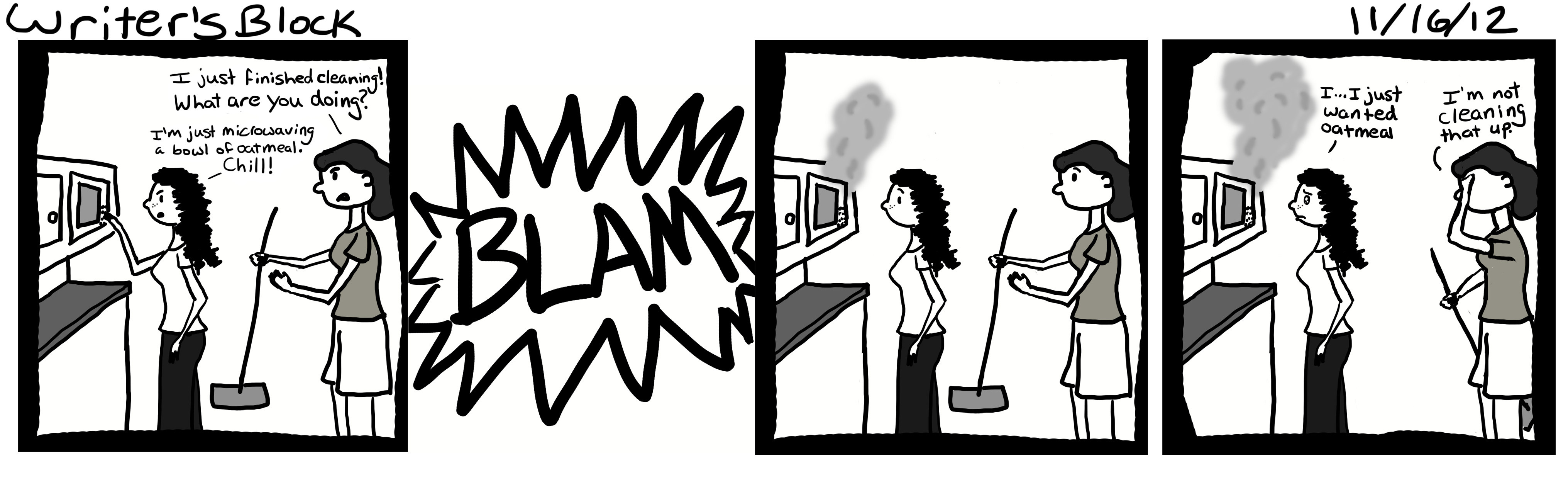
Ok, that’s it.  Have a comic.  You know the drill – click to enlarge.
Word of the Day: Verdant (adj) – green with vegetation; covered with growing plants or grass.
 

Leave a comment

Filed under books, Comic, Humor, writing

The Character You Can Be

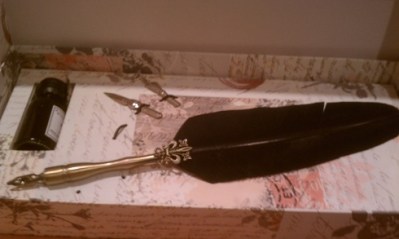
So I got a quill a while back as a gift, and I recently started practicing writing with it.

(Also, I’ll give you three guesses who bought the quill for me that’s right it was Liz)

So obviously I’m still a little shaky but check this out:

Nifty, no?

Anyway, on to the post…no, one more thing.  Watch this and laugh with me (Thanks to BuzzFeed for this gem):

Ok, now we can do the real post.

So I wanted to talk to you today about the things that make us human.  I’ve talked before about the little things your characters do to make them seem real, but now I want to talk about the things you do that make you real.  And these are the teeniest tiniest nuances.  Do I think these teeny tiny nuances need to go in your writing?  No probably not.  I mean, that can get boring fast.

John tried to turn the page but that thing happened where two pages stick together, so he took the two pages between his thumb and index finger and rubbed them together until they came apart.

The above situation has happened to most people.  It probably doesn’t need to happen to your characters, because it probably doesn’t add anything to the story.  You probably don’t even need to include “John turned the page.”  “John read a book,” is good enough most of the time, right?

So what’s the whole point of this ramble?  To get you to observe life.  Because that’s what we authors are (or what I believe we should be).  We are observers.  We wonder about things.  We unload the dishwasher with little care for the dishes’ well-being and narrate it as we’re doing it (I grabbed two plates together and they clanked loudly as I dropped them on the stack in the cabinet).  And the more you narrate in your head, and pay attention to minor details, and think about which ones would translate well in writing, the better you will become at conveying a story.

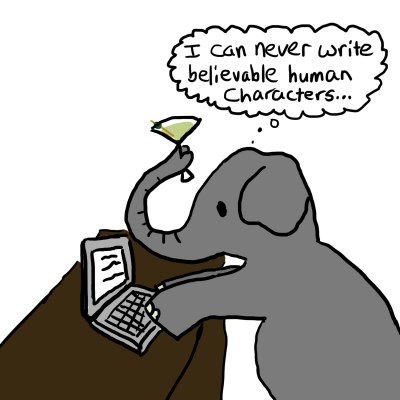
I am eating pita chips and hummus (homemade hummus!) as I write this.  But I’m not dipping the chips in the hummus because all the chips that were left in the bag were broken and tiny.  So what did I do?  I dumped the chip pieces into the hummus, stirred, and began eating with a fork.  Every now and then, I stop typing to take another couple bites and become very aware of the ensuing silence.  I type very loudly.  Almost everyone who has ever shared a room with me while I’m typing has told me so.  Elephants could type quieter than I do.

What do you do when you go to bed at night?  Do you crawl under the covers and pull them up to your neck?  Do you toss and turn?  Do you lie on your side or your stomach?  When you’re showering, do you read the label on your shampoo bottle?  Or do you contemplate the meaning of life?  Do you sing?  These are important things.  You are a character in your own story, as is everyone else in your life.  You are living a story right now.  Be aware of what you’re doing.  Because you are doing more than reading.  You are scrolling down with your right hand (or is it your left?), you are breathing, you are thinking about what I’m saying (hopefully).  Have I made a point?  I don’t know.  But I’m out of hummus chips so I’m going to stop writing.

Comic! (Click to Enlarge)

Word of the Day: Contemplate (v) – to look at or view with continued attention; observe or study thoughtfully.

1 Comment

Filed under books, Comic, Humor, writing

Taylor Swift, Mary Sue

The long awaited post by Liz is here!  I want you to know that everything from here on is going to be her material, with the exception of the one drawing I did.  Be nice, as this is her first post here.  Any comments you leave will be directed to her, and responded to by her if she deems them worthy.  Without further ado, Liz’s post!

Half of my preposterously superfluous degree is in literary theory. So, today, I thought I’d share two brief examples of the various readings an academic might apply to your writings, should you produce an insanely good book, or an insanely popular waste of arboreal destruction. As an example, I am going to use a poorly written character with whom you are probably familiar:


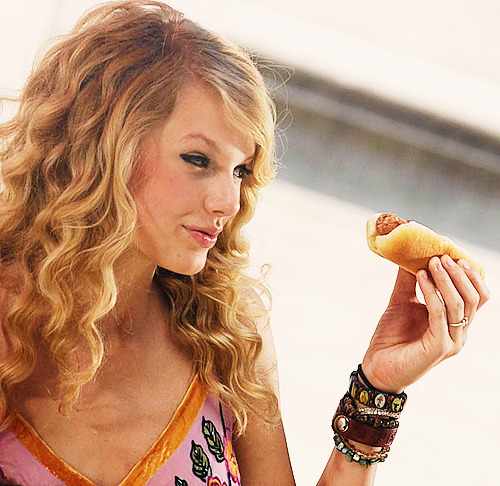
Taylor “Bubbles” Swift

For those of you unaware, Taylor Swift is the above wooden plank. Critics have called her “charming,” “sweet,” “the girl next door,” just a shrug, and “inoffensive.”* She’s meant to be some sort of musician, but the writer that penned her into existence failed to specify a genre. (Although, from her lyrics we might discern that she sings the sort of Pop that lulls her audience into a false sense of security while she steals their money.) The fact that she’s a musician, however, is an insignificant detail of the character. Now that you’re acquainted with Bubbles, let’s get knee deep in theory!

*Bex said that.

A Feminist Reading:

This would probably be the most troubling analysis. From her dialogue (“I love Karlie Kloss. I want to bake cookies with her!”), to her lyrics (“Abigail gave everything she had to a boy / Who changed his mind and we both cried”), Taylor hardly seems a paragon of gender enlightenment. Her primary preoccupations appear to be boys, the fact that she won’t wear the same dress twice, boys, and hoping that a ghost doesn’t sneak up on her to undo her nose job.

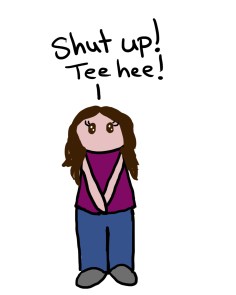
Also: boys. She never refers to her temporary male obsessions as “men.” Unless the 22 year old has a dark secret to share, this implies that the reader is meant to see her as considerably younger than the grown woman she is supposed to be. “But her songs are from the perspective of a teenager!” says nobody whose taste is good enough to be reading this blog. Shut up. I’ll get to that in four seconds.


This infantilization is common in badly written female characters and it sends the message that she is inexperienced, only fulfilled by men (sorry, “boys”), and virginal, to the detriment of virtually any other characterization. In other words, some asshole has written the Christian Right’s perfect woman into existence. It doesn’t matter what age or what level of experience she’s meant to possess; her carefully constructed image and not-so-carefully constructed musical drivel exude a coy yet artificial innocence that is devoid of any relatable personality.

This is not to say that the women you write shouldn’t enjoy baking cookies for boys. Or that they can’t be relationship-obsessed, offensively inoffensively good looking, sexually innocent or void of any complexity. But to do so without any awareness of the  feminist implications makes your character – and the rest of your work – pretty easy to attack from this perspective.

A Freudian Reading:


As you may recall from two paragraphs ago, Taylor is a one-dimensional character with virtually no human fears, aspirations, or anus. This would make it somewhat difficult for a Freudian scholar to reduce the entirety of her mental and emotional existence to her childhood (yes) sexuality.

I kid, of course. Freudian scholars never have trouble with that.


Freud was surprisingly prolific for one so addicted to cocaine and incest, making it impossible to sum up his writings here. For simplicity’s sake, a good place to start this type of analysis is with a simple question: “Why is this character so super depressed about sex?” While the answer may seem obvious (humans sometimes have to do things that are not sex, and that is super depressing), it is
actually quite complex. “But my characters aren’t depressed!” you might shout to nobody who cares or can hear you. Well you are wrong, and probably deeply (subconsciously) concerned about the feelings you exhibit towards breadsticks and your sister.

The root of Taylor Swift’s sexy depression is that she’s made a living by being repressed. And extolling the virtues of said repression. See, the central conflict in her life is murky and variegated, and her lyrics plumb the depths of human existence. Sometimes boys don’t notice her, and she really wants them to notice her. And sometimes, terrible women steal the boys who don’t notice her, or boys
notice her and then stop noticing her.

The point is, her incessant yearning for a four-year-old musical theater fan’s idea of romance is almost disquietingly chaste, and that can only mean that she is repressing her baser urges. To bone, is what I’m saying. I could provide some evidence here in the form of any one of her extremely boring quotes, but I won’t. You get it. She’s a terrible character and you can do better.

Word of the Day: Repression (n) – the ego’s ridding itself of unacceptable desires and ideas by dumping them into unconsciousness.

So that was Liz’s post you guys!  I have nothing to add except that you should read this comic by The Oatmeal.  It’s long but it’s worth it.  It describes my thoughts and my life really well.  I’ve got two comics lined up for my next couple posts, so be sure to check back!  And really don’t forget to thank Liz!  She worked really hard on this.

1 Comment

Filed under books, Humor, writing