Tag Archives: reading

Finally Marr

So IMDb just informed me that The Host, a book by Stephenie Meyer, is being made into a movie.  I should have known, of course.  Meyer has made it quite obvious to the movie industry that she can make them a fortune, and they’ve run out of Twilight movies.  So, yeah, making The Host into a movie is the logical next step.  But now I’m conflicted!  Because, on the one hand, The Host was a legitimately good book that I enjoyed very much, and even bought in Spanish since I like practicing other languages by reading my favorite books in them.  On the other hand, it’s Stephenie “Women don’t need to be smart as long as they’re pretty” Meyer.  I don’t want her to make any more money.  I really don’t think she deserves it.  So I guess I won’t be seeing that movie in theaters, even though I’d like to.  Twilight just taints everything it touches…like the plague.  Only instead of causing black sores to appear all over the body, I think people just start oozing glitter.
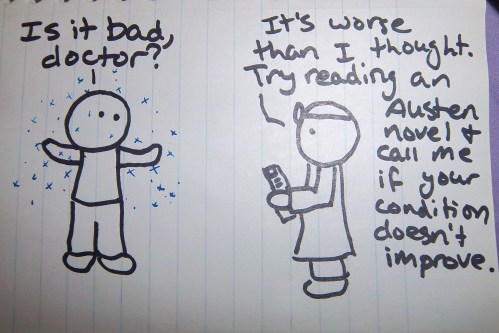
(I miss not having my tablet.  It’s so much easier to make longer pieces of speech fit in the frame)

Anyway, my point is that I can’t, in good conscience, support Stephenie Meyer.  So I guess I’ll Netflix it or something.

The next order of business for today is my homage to Melissa Marr, which I’ve been putting off for way too long.  So here we go:

(She gets a big number four because everyone else got a big number.  Don’t know what I’m talking about?  Then read this and this.)
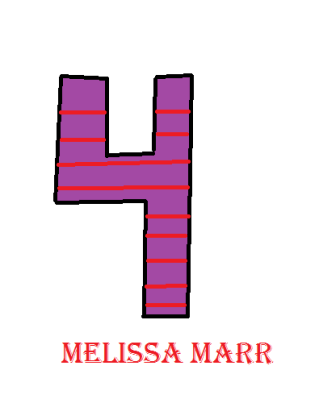
Thanks MS Paint, for being there when I needed you.

So Melissa Marr wrote the Wicked Lovely series, which is mainly what I want to talk about.  Her more recent novel is called Graveminder, and while it was quite good, I don’t believe it was the same caliber as Wicked Lovely.  See those books are about fairies, but not the kind that wear tiny green dresses and run off to tell Captain Hook where your secret hideout is the moment they get mad at you.  These fairies are kind of deadly and scary-looking, and sometimes just plain crazy.  But on top of that, the books all address really deep issues about loyalty, friendship, right and wrong, etc.  Marr definitely doesn’t coddle you.  Her books can be frustrating and terrifying and sad in all the right ways.  I also wasn’t sure a lot of the time who I was supposed to be rooting for, which is kind of awesome.  And that’s why I like her.  She’s one of my favorite authors because she doesn’t pull punches, and she doesn’t take the obvious route for her stories.  And she reinvents the concept of “fairy” in very interesting ways, too, which is always fun.

Yay!  I finally got around to doing this!  I’m very happy.  I think that’s where I’ll leave off on this list, because I know if I say I’ll continue, then I never will and then I’ll feel bad for not upholding my promise.

You get two words of the day because I used two in this post that I really like.

Word of the Day 1: Homage (n) – respect or reverence paid or rendered.

Word of the Day 2: Caliber (n) – degree of merit or excellence; quality.

Note: Caliber can also be used to measure the barrel of a gun and other cylindrical, tube-like objects.  Obviously that wasn’t the use I was going for, so I didn’t define it in that way.  Just thought I’d point that out.
Leave a comment

Filed under books, Humor, writing

This is my brain on movies

Sometimes I wonder about my own brain and why I’m creative and why I want to write.

I just finished watching a movie you may have heard of called Stranger than Fiction.  I like it a lot because it’s about writing and the creative process.  It also happens to be the only one of Will Ferrell’s movies that I can actually stand.  I like him in this movie because he proves he can act, and not just as some ridiculous caricature of a person, but as a realistic, believable human being.

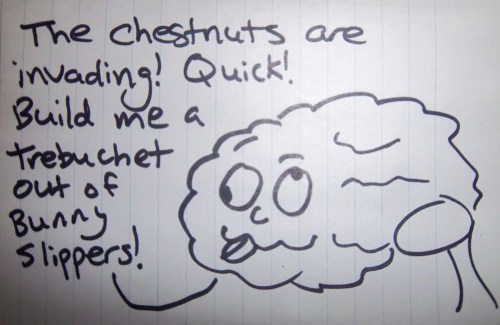
There are some movies out there that just set the creative part of my brain to whirring the moment they begin.  Stranger than Fiction is one of them.  I don’t know why.  Maybe because, as I said, it’s actually about writing.  But I really think that it’s just that type of movie.  It’s supposed to be thought-provoking, which for me means that I end up wanting to write really badly.  Unfortunately, it’s 1:52 AM right now, so writing is not something I can really do, at least not well, because sometime after 1:00 AM, my brain does this:

Despite that fact, my brain also feels the desperate need to write, and it’s very hard to convince it that maybe writing isn’t the best idea when it gets like this.  I’ve already forgotten what I was saying….OH right, okay, so what do I do when I want to write but my brain has shut down?  That’s right, I turn to blogging.  At least here I can be a little more informal, but I can also be writing and stuff, so maybe that’ll satisfy my creative urges.  (No I don’t know why I capitalized “bunny,” but maybe if you look at the picture of what my brain is doing right now, you’ll be able to forgive me for that small slip-up)

Here’s another thing about Stranger than Fiction: It’s all about an author whose main character is alive, and that character seeks out the author and they have a nice chat.  Now, not all authors want to meet their characters, (I’m sure Stephen King sleeps better at night knowing that his creations are going to stay firmly embedded in the paper) but I think I would love to see some of mine come to life.  It’s something I’ve often thought about.  What would I say to them?  What would they want to ask me?  How would we get along?  One of the requirements would be that they understand that they are fictional and that I am the author and that’s just how things go.  Otherwise there could be thoughts of rebellion, and I’m pretty sure most of my main characters could kill me quite easily.  There’s also the fact that I’ve killed some of their loved ones, so they might feel a little sore about that.  And then there’s Serrafiel.  I feel like he might be a little miffed that I knowingly brought him into a world of torment and servitude…

It’s a scary thought.  But also so cool!  Anyway, I think I’ve got the writing bug out of me, so I can finally go to sleep.


Shut up, brain.

Word of the Day: Trebuchet (n) – a medieval engine of war with a sling for hurling missiles.

2 Comments

Filed under books, Humor, writing

My Language Right Is!

I hope you’ll forgive me for going off on a slight tangent today.  It has nothing to do with books, but everything to do with language, which is another topic that I am immensely interested in.  Currently I’m taking a Linguistics course called “Teaching English as a Foreign Language,” and it got me to thinking about a lot of things.

Now, there’s no way to say this without sounding like I’m bragging, but I’m honestly not trying to do that.  For one thing, this is information that is relevant to this post.  Secondly, let’s face it, my family reads this blog, so I think they’ll probably be quite happy to read that my Linguistics professor called me a “Language Genius” the other day.  Her words, my capitalization.  Apparently my Japanese teacher reported that she’d never had a student like me before.  The fact of the matter is that my Japanese teacher was fascinated that I had picked up as much of the language as I did, and the reason she is fascinated is because there is a critical period (many Linguists would say) for learning languages, and it is much younger than 18-20.  So it’s rare to see an adult pick up a new language that they weren’t exposed to as a child.  This is all relevant, I promise.  It’s all leading up to this observation I’ve made about language learning, and I feel that it is worth thinking about, and worth sharing.  So what better place to share it than here?  Seriously, I have no other options.

Anyway, here’s what I’ve observed: People (in this case native English speakers) tend to fall into two traps when learning a new language that inhibits their acquisition of that language.

Trap 1: They assume that their native language is “right” (with reference to grammatical structure) and that the language they’re learning is somehow “wrong” if it does not follow the same structures as the native language.  Which leads to…

Trap 2: They assume that their native language is related in any way to the new language they’re learning, when really the two are almost completely unrelated.

Allow me to explain.

I think that language teachers should emphasize a difference between translating one language into another, and expressing the same or similar meanings in two different languages.  Take the following two sentences, for example.  (The Japanese will be written out phonetically in English as well, so you can read it)

  • 私はスーパーに緑りんごを買いに行きました。

Watashi-wa soopa-ni midori ringo-oh kaii-ni ikimashita.

  • Yo fui al mercado para comprar unas manzanas verdes.

If you take these two sentences and translate them into English, you get:

  • Japanese: I supermarket to green apple(s) buy to went.
  • Spanish: I went t’the market in order to buy some apples greens.

Now, it is important to recognize that the above translations do not make sense in English, but that they do make perfect sense in their own languages.  Both of those sentences mean the exact same thing as “I went to the market to buy green apples.”  And I feel like people do fall into these traps where they try to directly translate from English to the language they’re learning, which is where you get problems with false cognates, for one.  (“Embarazada” is not Spanish for “Embarrassed.”  It means “Pregnant.”)  And then another problem is that of direct translation, where you assume that every language will follow the same rules as your native tongue, so you say “Yo quiero a comprar una manzana” because you know that “a” in Spanish means “to” and “comprar” means “buy.”  What you wanted to say was, “I want to buy an apple.”  What you said was, “I want to to buy an apple.”  Why?  Because Spanish has one word for the infinitive of verbs where English has two.

To Buy – Comprar

To Eat – Comer

And so on.  But we (English speakers) are used to seeing two words there, so we assume that Spanish has to have two words there, too, in order to make sense.  It doesn’t.  Because languages that aren’t English don’t have to make sense in English.  They only have to make sense in accordance with their own rules and structures.  I feel like I’m making a mess of this.  It was all so clear in my head, and now I feel like it’s very muddled.  Maybe I should quit while I’m ahead.

I’ll finish with this: The title of my post is incorrect English, but if that were Japanese, then it would be A-Okay.  So, in conclusion, your language is no more or less correct than any other.  Languages all express the same meanings, just in very different ways.  So when you’re learning a language, you have to approach it as an infant would – as if you have no previous exposure to anything like it.  Because learning a new language really should be like starting fresh, learning to talk all over again, not learning how to say good English in something that’s not English.

Word of the Day: Cognate (n) –

Hmm…None of these dictionaries are saying what I want them to say.  “Cognate” apparently has a lot of possible meanings, but the one I’m referring to is this: Words that sound similar across two or more different languages and have the same (or similar) meanings.  e.g. Telephone and Teléfono (Spanish).  And “false cognates” are two words that sound really similar but have different meanings.  These usually throw people off when learning new languages because drawing associations between words like that is a pretty common tool for memorizing new vocabulary.  An example of a false cognate is the embarrassed/embarazada thing or “pan” and パン(pan), which is the Japanese word for “bread,” not a pan.  Interestingly enough, that was taken from Portuguese, I think, so the Portuguese word for “bread” and 「パン」 are probably cognates.  Ok, that was officially the longest Word of the Day ever.  Sorry I couldn’t find an official dictionary definition.  You can look it up if you’re still confused.

1 Comment

Filed under Grammar, Humor, Language