Tag Archives: reading

Urban Fantasy with Harry and Harry

Today I asked myself, “Rebecca, do you want to be productive?  Or do you want to draw ridiculous cartoons and then put them up on your blog?”  And myself replied, “How did you get this number?  I told you never to call me again.”  So I took that as a sign to do the cartoons and blogging thing.  But there will be a point to it, too.  Maybe.  This post is going to lead up to that writing sample I promised you guys, so you can expect another update very soon after this one.

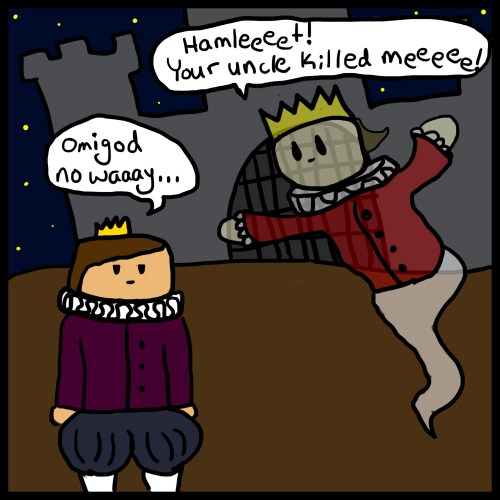
But first!  I drew Hamlet.  I just saw Michael Sheen play Hamlet at the Young Vic theatre here in London, and it was awesome, in case you were wondering why I drew this.
Right, so that’s done.  Now the current novel I’m working on is called Grotesque, and it is just my luck that I came up with the idea for it just as NaNoWriMo was coming to a close.  But I’m not bitter.  Even though I wrote 25,000 words in a single weekend, and could have easily reached the 50,000 word goal if I’d had the idea sooner, I’m really okay.

Anyway, Grotesque is a fantasy, even though my forte is really Urban Fantasy.  Now I realize that many people don’t actually know what Urban Fantasy is, so I have illustrated definitions for you.

Urban Fantasy is when you take the real world – cars, iPhones, email, Starbucks – and insert some element of Fantasy into it, like magic or super powers.  Observe:
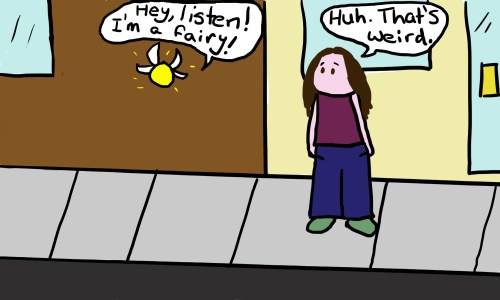
A good example of this is Harry Potter. [EDIT 3/13/21: I know JK Rowling sucks, but unfortunately Harry Potter is still a good example of this that many people recognize] It’s the real world, but there are people who can do magic.  Another example is The Dresden Files.  If you have not encountered this series yet, you haven’t lived, in my professional opinion.  Jim Butcher is a genius.  Honestly.  His writing flows in a way that I rarely see, even from authors that I truly love.  He is also so funny that it should be illegal.  His main character, Harry Dresden (Now the title of this post is starting to make sense, yes?), is sarcastic, witty, and lovable.  Here’s a picture I drew to illustrate all these qualities:
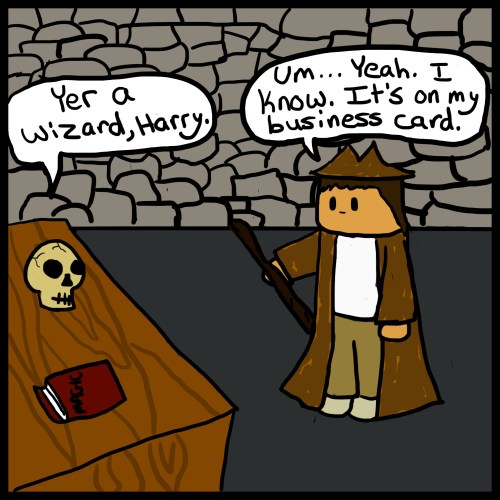
The skull’s name is Bob.  No I am not kidding.  I will say that reading The Dresden Files is kind of like being in a boxing match, only your hands are tied behind your back and your opponent (That would be the book, in this analogy) gets to wail on you for as long as he wants.  It really is a very rapid-fire, out-of-the-frying-pan-and-into-the-fire type deal.  But it’s worth every bruise, metaphorically speaking.  I’ve got more to say on Harry Potter, the character, but first I want to finish up my definitions.

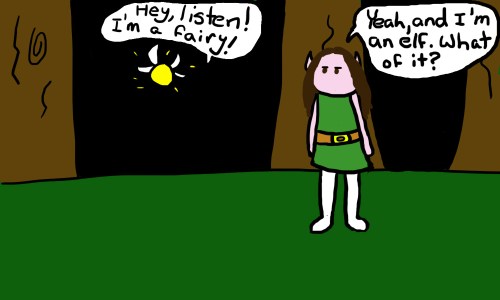
Fantasy is when you create an entirely new world from scratch, and that world involves things like magic, fairies, elves, and/or wizards.  Think Lord of the Rings.  Also keep in mind that these are the simplest definitions I can come up with, and that you should probably go to some form of dictionary if you want a more complex explanation.  Here’s Fantasy (Yes, I’m aware I look like a sarcastic Powerpuff Girl):
So Grotesque is a Fantasy, and I’m going to tell you, Fantasy is both a blessing and a curse.  Here’s why it’s a blessing: If you’re making up your own world from scratch, then you get to make up the rules as you go along.  The only boundaries that constrain your writing are the ones that you set up, and you can mold and change them as you see fit.

Here’s the curse: Creating everything from scratch means that everything, absolutely everything must be explained.  And you leave yourself vulnerable to criticism and plot holes if you forget to explain something.  It’s not like Urban Fantasy, because people are already familiar with the real world, so all you have to explain is whatever fantastical element you’ve added.  In Fantasy, the existence of magic brings up all sorts of questions that you have to answer.  For example, you might have a magical farming community.  And then you have to address the question of why they bother to grow food if they’re magic.  Can’t they just pull food out of thin air?  Or at the very least plant, harvest, etc. using magic?  Those are things you have to think about.  But then you run into another problem: Everything needs explaining, but nobody wants to read a book that is 50% exposition, where the story is constantly being interrupted by paragraphs of explanation.  This leads nicely into what I wanted to talk about with Harry Potter.

I’ve noticed that there is a very convenient way to get around this explanation problem if you introduce a certain type of character into your writing.  I call this character the Neophyte, with a capital N.  Harry Potter is my favorite example of the Neophyte.  See, if you have a book in which every character already knows the rules of their world, then the reader is left out.  They either have to figure out the rules for themselves, or they’re just plain left in the dark.  Letting the reader figure things out, by the way, is not a bad option, if you do it right.  Also here’s an analogy: The aforementioned divide between characters and reader is like having all the characters in a big, fancy yacht while the reader is in a little dinghy that’s attached to the back of the yacht by a rope.  But what happens if you put a character into that dinghy with the reader?  Then, suddenly, your reader isn’t alone.  They have someone to help them row and catch up to the yacht so they can get on board and party with everyone else.  Okay, enough of this convoluted metaphor.  What I’m saying is, that’s exactly what Harry Potter does.  Because he’s new to the wizarding world, he has to have everything explained to him, which means that the reader is informed vicariously through him.  It has the added bonus of inserting explanation without having to stop the story.

In Grotesque, my main character is, well… a grotesque.  [EDIT 3/13/21: Grotesque was terrible. So I rewrote it. It’s still terrible. I will never let it see the light of day. I suck at Fantasy. What’re ya gonna do?] You know, those scary statues that were put on churches and castles and stuff to fend off evil spirits and peasants?  Right.  The book begins with the grotesque – Serrafiel – being brought to life.  So one minute he’s a statue, and the next, he’s a living, breathing… monstrosity.  Serrafiel is the ultimate Neophyte, because literally everything, right down to breathing and speaking, is new to him.  Which is why I chose to narrate the book from the first person, in the present tense.  Because then the reader gets to see everything through his eyes, exactly as it’s happening.

So now that that super duper long post is out of the way, you can look forward to seeing the first chapter of Grotesque, coming soon to a computer near you.

Word of the Day: Neophyte (n) – a beginner or novice.

P.S. You get extra points if you got the Legend of Zelda reference.

2 Comments

Filed under books, writing

Oh yeah, and…

Jeez I’m posting a lot recently.  Don’t read too much into it (Ha! Reading pun) I’m not going to be able to keep this up.  I just keep forgetting stuff.  I have no idea how to organize this post, so I’m just going to list some stuff:

1 – I was thinking about how some people on this thing called YouTube make abridged versions of cartoon shows, and that got me to thinking that I should make abridged versions of books.  I don’t actually know if I’m ever going to do that, but it did lead me to draw this comic that is Twilight (all four books) abridged.  So I’ll share it with you:

2 – Now that I’ve done that, I have to explain a bit.  I always tried to avoid openly bashing Twilight because enough people already do that, and because there are still a lot of people out there who love it.  And God forbid someone insult something that they like. So I figured if I posted this, I would have to offer some objective reasons why the series is really very poorly written [Edit 5/29/13: I am fully aware that the list below is not as objective as I would have liked.  I’m just really bad at keeping my opinion out of things.  Sorry about that.  I still feel the points are valid].  I would also like to point out that Stephenie Meyer wrote another book – The Host – that is incredibly good.  I don’t remember if I put that on the Books I Recommend page, but I’ll be sure to get it on the list after I’m done with this post.  So, why is Twilight bad?  I will list a few of the biggest reasons, though this is in no way a comprehensive list.

  • Bella Swan is a Mary Sue.  I’ve talked about the Mary Sue before, and when I thought about my definition, I honestly just tried to describe Bella.  And here’s why: No fewer than three boys compete for her affections.  All three of them even ask Bella to a dance that is supposed to be a girls-ask-guys thing.  Then there is the vampire boy who decides he loves her because he can’t read her thoughts, which leads me to…
  • Edward is a controlling, manipulative boyfriend who is also a stalker.  Yes, it’s been said before, and I’ll say it again.  He sneaks into her room to watch her sleep.  He’s done it for months before they even started going out…or mooning at each other, or whatever it is they do.  Then there is the fact that, as I recall, Edward does things like break Bella’s car so she can’t go visit her werewolf friend, Jacob.  That’s actually not okay.  Then there’s the whole second book where he decides that she’s not safe being involved with him so, having decided what’s best for her (again), he breaks up with her, removes every last trace of himself from her life, and uproots his family, moving them far, far away.  Which brings us back to…
  • Bella’s symptoms after losing Edward are not unlike PTSD (Post Traumatic Stress Disorder).  She stops connecting with her family and friends, moves through life like a zombie, and has night terrors.  For months.  And then, diverging from the PTSD thing a little, she realizes that she hallucinates her boyfriend if she does dangerous stuff.  So what does she do?  Well, desperate to see Edward again, she proceeds to approach a group of people who might be rapists, go on a joyride with one of these would-be rapists (That’s not a euphemism.  They just ride a motorcycle), manipulate Jacob into helping her build her own motorcycle just so she can ride that and nearly die on it, and jump off a cliff.  This, again, is not okay.  What it’s supposed to be: A sign of her true love.  What it actually is: Crazy.  What message it sends: Girls, especially the young, impressionable ones, please remember that your boyfriend is the only thing worth living for.  K thnx.
  • She uses “chagrin” too much.  Not Bella.  Stephenie Meyer.  It’s like…it must have been on her Word-of-the-Day calendar when she started writing the book or something, because she really does use it way too much.
  • I could go on forever.  I think Cracked sums it up really well, so if you need more, go ahead and read this: http://www.cracked.com/funny-36-twilight/  I agree with everything they say.  Also it’s hilarious.  Okay, not to confuse you, but we’re going to go back to that numbered list now.  Remember how we started with that?

3 – I realized that I talk a lot about my own writing in this blog without ever sharing any of it.  I feel like that isn’t good, because how do you know my writing isn’t crap?  I mean, I feel like my advice is still sound, but you could be reading advice from a hypocrite!  Like, I could be a terrible writer who is writing about how much she hates terrible writing!  And that just won’t do.  So I suppose I’ll have to start posting writing samples.  I won’t do it today since this post is already really long, but I will do it eventually.  That way you can see (I hope) that my writing isn’t crap.

4 – The End!

Word of the Day: Anoesis (n) – a state of mind consisting of pure sensation or emotion without cognitive content.

Huh, that Word of the Day is more relevant than I thought.  Also, I want to do this one:

Word of the Day Part II: Chagrin (n) – a feeling of vexation, marked by disappointment or humiliation.

2 Comments

Filed under books, writing

Actually, I have a bit more to say…

So I was thinking about my last post and how I wrote about trusting your instincts and stuff, and I was thinking that I didn’t say everything I wanted to about that.  (Most awesome run-on sentence ever!)  But first, I have a special request to fulfill.  See, I have this sister.  I won’t tell you her name, but I drew you a picture of us together:

As you can see, we look nothing alike.

Now, this sister of mine asked me for the honor of living vicariously through my blog.  That is, she wanted me to post a short piece based on one of her grammatical pet peeves, since I do occasionally hint at my dislike for bad grammar.  Since she’s my sister, and I owe her for helping me that one time I knocked a guy unconscious in a Wal-Mart (Haha just kidding.  I never shop at Wal-Mart.  It was in a Target.  And I didn’t knock him unconscious.  I killed him) I’m going to help her out here.

My sister’s complaint is this: People seem to have forgotten about the word “among.”  So when they are picking from a list of things that is longer than two, they still say “between.”  Now, I know that you probably know this, but on the off chance someone else is reading this who doesn’t, I’m going to spell it out.  The word “between” involves two things.  Remember that old expression?  It goes a little something like, “Oh shit!  I am totally between a rock and a hard place.”  Note that there are simply two things there.  The rock, and the hard place.  I have also drawn a picture of this:

Now I have two choices: I can either run headfirst into the rock, or I can run headfirst into the hard place…which appears to be some rectangular, green mass.  To reword that, I can choose between running into the rock and running into the hard place.

Now let’s say that I am between a rock and a hard place, and there’s also a lion behind me.  (It’s a lion.  Just trust me on this one.)

Now I have three choices.  I can run headfirst into the rock, I can run headfirst into the hard place, or I can run headfirst into the lion.  Or, I suppose, I can break the fourth wall and run right into your lap.  So I have four choices.  Please note that four is a greater number than two.  Three is also greater than two.  Which means that I am going to have to choose among those four, aforementioned options.

In conclusion, please don’t neglect “among.”  It only ever says nice things about you.  For more hilariously illustrated grammar help, I recommend http://theoatmeal.com/.  Hope that makes you feel better, sis!

As for the title of this post, and the introduction, I do have a bit more to say.  See, my first book, The Dreamcatchers, was written when I was thirteen.  It was crap.  I believe I’ve already mentioned this, but I’m too lazy to go back and find out, so I might be repeating myself a bit.  When I was in my junior year of high school, I realized that I would have to start the book over from scratch.  This was one gut feeling that led me to making a very hard, but ultimately good, decision.  Still, after I finished the book again, I would say things about it like, “It’s my first book, so the writing is really bad,” and “Please don’t judge me!  It’s really bad writing, but the plot is good.”  And I passed this off as normal.  After all, the writing was pretty bad, and it was my first book, so it couldn’t be helped.  Right?  No.

I recently came to the conclusion that I should never feel the need to make excuses about my writing, and if I’m doing that, it means something’s wrong.  After I came to that conclusion, I died a little inside because it means I have to rewrite The Dreamcatchers again.  What I realized is this: I was thirteen or fourteen when I first wrote it, and I was fifteen or sixteen when I rewrote it.  I was only two or three years older when I wrote it again, and I’m twenty now, which means I’ve had four more years of practice since then.  When I rewrote it the first time, I thought it was amazing how much I’d grown as a writer.  And I wasn’t wrong.  It was a dramatic improvement, but I mistakenly thought that because it had been improved, it was done.

Now that I’ve realized my mistake, I’m going to bite the bullet and rewrite the book again. I’ve come to understand that there is always room for improvement.  I’ll know that the book is somewhere around the realm of truly completed when I stop making excuses for it, when my gut tells me it’s good.

So now I think I’m done with the whole “listen to your gut” subject.  And yeah, you should really go to The Oatmeal.  And Hyperbole and a Half, because if you haven’t seen this yet – http://hyperboleandahalf.blogspot.com/2010/04/alot-is-better-than-you-at-everything.html – then you haven’t lived.

Cheers!

Word of the Day: Fracas (n) – a noisy, disorderly disturbance or fight; riotous brawl; uproar

Leave a comment

Filed under books, Grammar, writing