Tag Archives: Show Don’t Tell

Working Woman

As my last post may have hinted, I have found a job.  I am now working as a short-order cook at an IHOP.  This means that, of all the training and life skills I received in college, it was my time working in the dining halls that proved most useful to me.  Ah well.  It is hard work, and most days my legs feel like they’re going to fall off, but…money.  It’s also a fitting job for me, considering how many books I’ve discussed with my friends while eating late-night pancakes.

Anyway, about writing.

I’ve talked so much about the concept of “Show Don’t Tell.”  There are so many posts, and I know you’re not going to go back and read all of them, so I shouldn’t even link to them.  But I’ll give you a few, just for the hell of it.  Here’s one and then there’s this one, and there’s another here.

The thing is, after all that preaching about the concept, I found I’ve made a mistake.  I failed to specify when you should Show instead of Telling.  This occurred to me because I was rereading Hellbound, and I realized that sometimes it’s the narrator’s job to Tell.  That’s what description is, after all.  Sometimes you’re going to write something like this:

Sally looked at the old house on the corner and shuddered.  It looked ready to fall apart, with boarded up windows and peeling paint.  Plus, no matter what time of day it was or what the weather was like, that particular house always seemed to be in the shadows.

The above paragraph employs description to inform the reader.  That form of Telling is okay.  Sometimes you just need to tell the reader what a person or place looks like, who said what, what someone is thinking, etc.  You will notice, however, that the first sentence employs more of the Showing technique.  It implies that Sally is scared of the house, or creeped out by it, without explicitly saying, “Sally was scared of the old house on the corner.”  There is a difference between exposition and “Telling” in the bad way.  A lot of it comes from instinct and practice.  And the whole reason I’m bringing this up is so you know that I am not an advocate for trying to “Show” your readers every last little detail of the book.  I don’t even know if that’s possible.

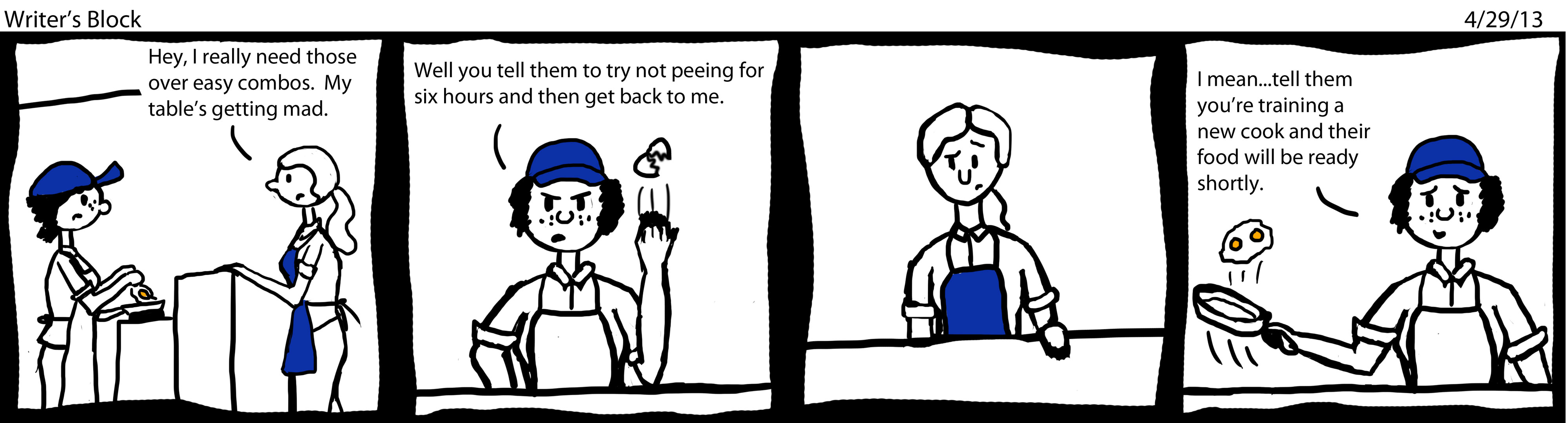
Anyway, that’s all I wanted to say.  Have a comic.
Writer's-Block-Strip-23

Word of the Day: Carapace (n) – a bony or chitinous shield or shell covering some or all of the dorsal part of an animal, as of a turtle.
 

2 Comments

Filed under books, Comic, Humor, writing

Extracurricular Activities for Zebras

I have a lot of respect for short story writers because I can’t do what they do.  I just don’t have a mind for it. Unless I’m given a specific prompt, as I was in my fiction workshops, I just can’t come up with good ideas.  And I’ve also read a lot of great short stories.  Amy Hempel is an amazing writer.  The story Brad Carrigan, American by George Saunders is absolutely fantastic, as is anything else by George Saunders.  David Foster Wallace has also produced some incredibly memorable work.  My point is, I think that I’m going to try to write a short story.  And I think I’m going to title it “Extracurricular Activities for Zebras.”  Don’t ask why, because it’s a long story.  It came out of a conversation with a friend of mine.  (I miss you, Adrian.)

All that said, I’m going to talk a little about Show Don’t Tell today, thanks to a kind comment that was left on my last post.

I always hated Show Don’t Tell because I didn’t understand what it meant.  Various people tried to explain it to me, and I still couldn’t wrap my head around the idea.  My mind just kept flashing back to preschool Show and Tell when I would put an arbitrary item on display for my class and tell them why it mattered.

I don’t remember when I finally figured out what Show Don’t Tell means, or how I figured it out.  I think I might have done it on my own, but there’s a good chance my best friend explained it to me in a way that I finally understood.  The reason I’m talking about this now, by the way, is because of my last post on romance.  It was essentially a really long way of saying “Show the romance, don’t tell it.”

It really is a hard thing to define.  Even now I’m having trouble putting it into words.  I suppose, if your narrator is saying things like, “Sally finally understood why she had to quit her job.  It had taken her a long time, but she had come to the conclusion that her job was killing her, and that she would truly be free to live her life if she quit” then that’s too much telling.  Showing Sally’s new understanding of her work situation is different.  It could be shown through dialogue, like:

Bossman: Sally, I need you to do a bunch of different things for me by five minutes ago, and also I think you’re inferior to me because you are a woman.

Sally: You know what, Bossman?  I quit.

And then you could follow it up with some emotion.  Not, “Sally felt so much better.  Everything seemed a little brighter.  She wished she’d quit years ago” because that’s still Telling.  But something like, “Sally smiled as she walked out of the office.  Several of her coworkers watched, mouths agape, as she strolled out of the building.  Some of them even looked envious.  Sally took a deep breath of fresh air, and yadda yadda…”  It’s not the best writing ever, but I hope I’ve illustrated the concept understandably anyway.

Word of the Day: Compunction (n) – a feeling of uneasiness or anxiety of the conscience caused by regret for doing wrong or causing pain; contrition; remorse.

Leave a comment

Filed under books, writing