Tag Archives: urban fantasy

A Look Back – Familiar

Chugging right along, here’s a look at one of my books, Familiar.  (If you’re just joining us, you might want to read this post first)

INSPIRATION – You know that archetypal witch on a broomstick that you usually see silhouetted against the moon, her black cat inexplicably riding behind her without falling off?  Usually as a Halloween decoration?
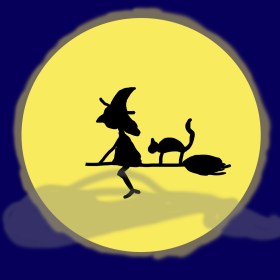
Witch and Cat

I was thinking about that image and decided to write a story from the black cat’s perspective.  But I ended up writing it from both the  cat’s and the witch’s points of view, alternating every chapter.

PLOT – A young woman named Aradia is a modern-day witch who attends college and works a part-time job, and when she’s not doing those things she’s practicing magic with her familiar, a black cat named Kemnebi (Kem for short).  Aradia and Kem soon learn that an evil, immortal shapeshifter has been summoned to do the bidding of an unknown evil mage who has a keen interest in Aradia because of her unusual connection to the elemental spirits – Fire, Water, Air, and Earth.  (Magic, in this book, is created by drawing on the power of the Spirits, which coexist with the real world and are born from strong emotions and feelings and things that cause strong emotions, like Death or a Home.  And also from just…strong things, I guess, since there are elemental spirits.)

PROBLEMS – My biggest problem, I realized after gaining a great deal more experience in the field of writing, is that Aradia is a Mary Sue.  She is beautiful, but doesn’t see herself that way, she acts cute and demure around her friends and her love interest, and she is Special in the way that needs capitalization.  There’s nothing wrong with main characters being Special, of course.  It happens all the time – Harry Potter, Clary Fray, Katniss Everdeen, to name a few – but these Special characters do need to have personalities outside of their Specialness.  Aradia does not.

“Should’ve known better than a surprise party, huh?” I heard Lynn say to Aradia.

“I’m sorry.  I shouldn’t have reacted that way, but thank you.  Now that I’m over the shock, I can acknowledge that it was a nice surprise.”

“You certainly know how to make an entrance,” interjected Nameless-Snake-Man.

“Yes, it’s a gift,” Aradia replied. “Don’t get me wrong, I’m glad that you helped replace the bulbs, but I’m afraid I have no idea who you are.”

“Lynn invited me,” was his reply. “I’m Theo, and this is Samson.”

He pointed to the snake around his neck as he spoke the second name, and it responded by turning its fluttering tongue in Aradia’s direction.

“It’s nice to meet you both,” Aradia said politely. “It looks like you’re not the only one to have brought a pet.  Have you met mine?  Come here, Kem.”

So that was the biggest problem I could think of.  Aradia was a Mary Sue who easily fell in love with Sean – the love interest who has a wolf familiar named Circe – in a matter of days.  And he fell in love with her.  And that led to INCREDIBLY embarrassing dialogue like:

“You’re lying to yourself, Aradia,” Sean stated. “Do you understand that?  You’re so afraid of hurting someone, you won’t even let yourself try and see if you’d actually do it.  Deep down you know you can control it, but you refuse to believe it.”

“Sure I can try to control it, but what if I mess up?  I don’t want to take that chance.  It would be too painful, and I don’t think I would ever be able to recover from it.  Would you please just let me go?”

“Well, I don’t mind taking that chance at all, and I’m not letting you go.  If you leave then you’ll be taking my heart with you and then I’ll never see it again.”
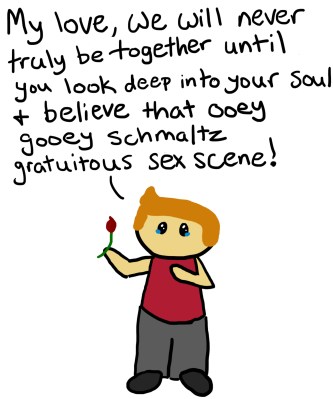
Ooey Gooey Schmaltz

Why did this happen?  Because Familiar, as well as a number of other books, was written in a time when I was trying desperately to live vicariously through my characters.  I wanted a boyfriend and a relationship so badly that many of the books I wrote ended up being about a stupid, sappy, romance-novel-worthy relationship with only a shaky plot that was added in as an afterthought.  I also contributed my own self-consciousness and low self esteem, making a character who thought herself plain but was actually beautiful, since that is what I so wanted to be true of me.  I, like many young men and women of a certain age and awkwardness, wished fervently for some prince to come along and tell me how wrong I was about my looks, how I was a beautiful thing to behold and all my self-consciousness was unfounded.  Since I didn’t see that happening anytime soon, I made it happen again and again in my books.  And my writing suffered for it.  So…

HOW I’D FIX IT – By taking all of the above information into account and changing it.  Aradia would become surly and guarded, foul-mouthed and friendless, except for her faithful familiar.  Kem would continue to be his proper, tightly-wound self, with his own love interest – a calico named Trinka – and his own motivations – get Aradia to open up to other human beings, stop the evil shapeshifter, yadda yadda.  This could work.  I think I could do it.  It would just take a lot of effort.  I didn’t leave myself very much to work with when I wrote this one.  But I’ll try my best, because I like the idea.

Next post will be about Leaves (as if that means anything to you).  See you then!

Word of the Day: Demure (adj) – characterized by shyness and modesty; reserved
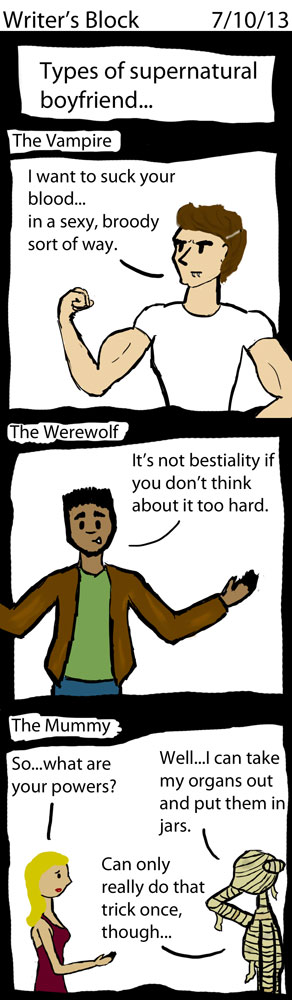
Writer's-Block-Strip-32

Leave a comment

Filed under books, Comic, Humor, writing

Flash Fiction

A while back I wrote a post about my rules for writing.  At the end of that post was a writing exercise that consisted of a list of words that had to be used in a piece of flash fiction.  I said that I would do the exercise and post the results, and so I have.

First, the list of words:

Apple

Expensive

Ordinary

Superfluous

Tangible

Officer

Weirdly

Now the story:

It all started with an apple.  I was at the supermarket, obviously.  I mean where else do you buy apples?  My wife is pregnant.  She’s going on four months now.  She wanted apple soup.  I don’t even know how to make apple soup.  Is that a thing?  I looked for it in the soup aisle, but all they had was the ordinary stuff.  Like chicken noodle and clam chowder.  No apple soup.

So I was looking at the apples, and I was thinking of buying organic, but they were way too expensive.  Can you believe how much they charge for one freaking apple?  And as I was thinking that, I kid you not, a man with a gun ran into the supermarket and open fired on the freezer section.  Not on the people.  On the food.  The noise was deafening.  Like it was so loud it was almost tangible.

Weirdly enough, I wasn’t scared.  All I could think was, I have to get home to my wife.  I don’t know why I thought that.  She probably wasn’t in any danger.  It was a weird impulse.  So I ran out of the store, and I didn’t even realize I was still holding one of the apples, but I don’t think they would care that much if they found out I stole it.  In the light of the recent freezer shooting, a stolen apple would just be superfluous, you know?  They don’t need to deal with that.  So I’m driving home, with just this one apple, and I’m just thinking about my wife and getting back to her.  I shouldn’t have been driving so fast, but I was.

And that’s my story, officer.  That’s why I was speeding.

The policeman glared down at him for a moment and then smiled.

“Where’s the apple?” he asked.

“I’m sorry?”

“The apple.  You said you stole it.  Where is it?”

“I…uh…I don’t know.  It must have rolled under the seat.”

“It was a nice try, sir, but I’m still giving you a ticket.  Maybe consider driving a little closer to the speed limit next time.  Give your wife my regards.”

The officer pulled the ticket off his pad and handed it to the driver.

“Have a nice day, sir,” he said, and walked back to his car.

The man sighed and drove home.  It wasn’t until he pulled into the garage and was able to search around a bit that he found the apple under the passenger seat.

Sighing, he walked into the house and tossed the thing into the trash.

He found his wife sitting on the couch.

“Hey, honey,” he said.  “You’re never going to believe what just happened to me.”

[End]

And there you have it.  You’re still welcome to give it a try yourself.  I realize now that 500 words might be a little long for a comment.  For some reason I thought it’d be shorter.  But you should still try.  It’s fun.

Here’s a comic:

Writer's Block Strip 13

Word of the Day: Superfluous (adj) – being more than is sufficient or required; excessive.

Leave a comment

Filed under books, Comic, Humor, writing

Urban Fantasy with Harry and Harry

Today I asked myself, “Rebecca, do you want to be productive?  Or do you want to draw ridiculous cartoons and then put them up on your blog?”  And myself replied, “How did you get this number?  I told you never to call me again.”  So I took that as a sign to do the cartoons and blogging thing.  But there will be a point to it, too.  Maybe.  This post is going to lead up to that writing sample I promised you guys, so you can expect another update very soon after this one.

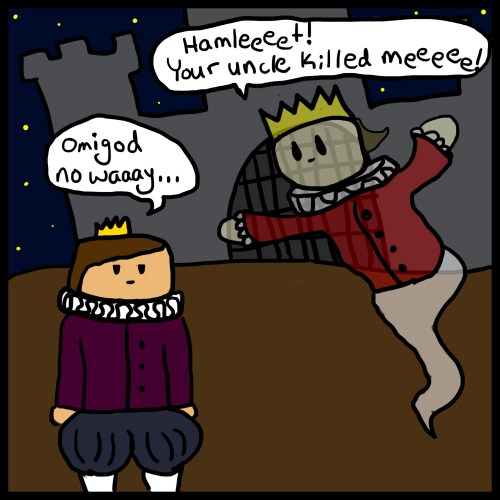
But first!  I drew Hamlet.  I just saw Michael Sheen play Hamlet at the Young Vic theatre here in London, and it was awesome, in case you were wondering why I drew this.

Right, so that’s done.  Now the current novel I’m working on is called Grotesque, and it is just my luck that I came up with the idea for it just as NaNoWriMo was coming to a close.  But I’m not bitter.  Even though I wrote 25,000 words in a single weekend, and could have easily reached the 50,000 word goal if I’d had the idea sooner, I’m really okay.

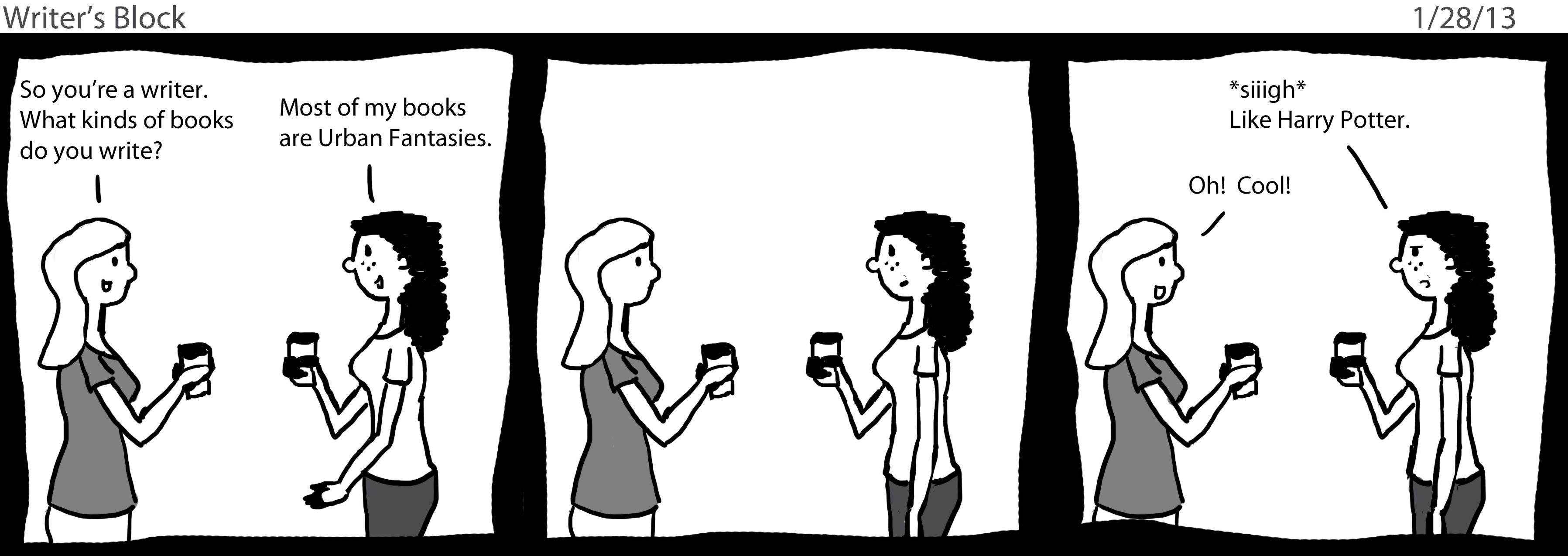
Anyway, Grotesque is a fantasy, even though my forte is really Urban Fantasy.  Now I realize that many people don’t actually know what Urban Fantasy is, so I have illustrated definitions for you.

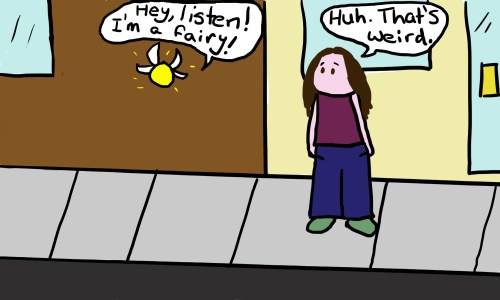
Urban Fantasy is when you take the real world – cars, iPhones, email, Starbucks – and insert some element of Fantasy into it, like magic or super powers.  Observe:

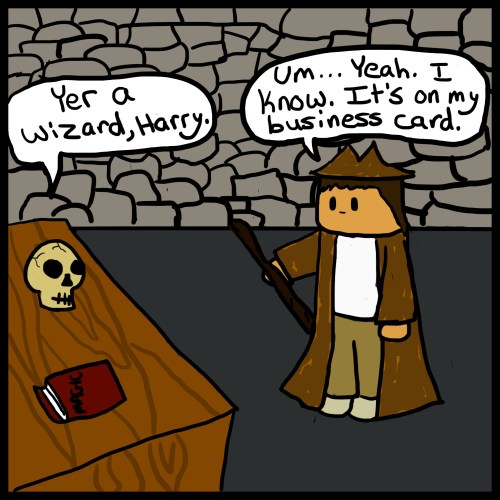
A good example of this is Harry Potter. [EDIT 3/13/21: I know JK Rowling sucks, but unfortunately Harry Potter is still a good example of this that many people recognize] It’s the real world, but there are people who can do magic.  Another example is The Dresden Files.  If you have not encountered this series yet, you haven’t lived, in my professional opinion.  Jim Butcher is a genius.  Honestly.  His writing flows in a way that I rarely see, even from authors that I truly love.  He is also so funny that it should be illegal.  His main character, Harry Dresden (Now the title of this post is starting to make sense, yes?), is sarcastic, witty, and lovable.  Here’s a picture I drew to illustrate all these qualities:

The skull’s name is Bob.  No I am not kidding.  I will say that reading The Dresden Files is kind of like being in a boxing match, only your hands are tied behind your back and your opponent (That would be the book, in this analogy) gets to wail on you for as long as he wants.  It really is a very rapid-fire, out-of-the-frying-pan-and-into-the-fire type deal.  But it’s worth every bruise, metaphorically speaking.  I’ve got more to say on Harry Potter, the character, but first I want to finish up my definitions.

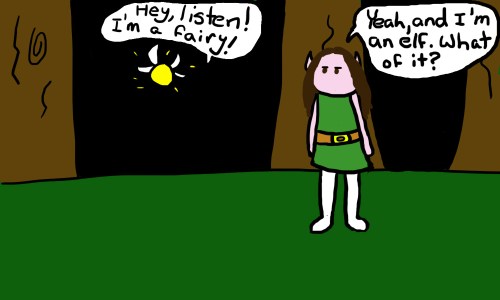
Fantasy is when you create an entirely new world from scratch, and that world involves things like magic, fairies, elves, and/or wizards.  Think Lord of the Rings.  Also keep in mind that these are the simplest definitions I can come up with, and that you should probably go to some form of dictionary if you want a more complex explanation.  Here’s Fantasy (Yes, I’m aware I look like a sarcastic Powerpuff Girl):

So Grotesque is a Fantasy, and I’m going to tell you, Fantasy is both a blessing and a curse.  Here’s why it’s a blessing: If you’re making up your own world from scratch, then you get to make up the rules as you go along.  The only boundaries that constrain your writing are the ones that you set up, and you can mold and change them as you see fit.

Here’s the curse: Creating everything from scratch means that everything, absolutely everything must be explained.  And you leave yourself vulnerable to criticism and plot holes if you forget to explain something.  It’s not like Urban Fantasy, because people are already familiar with the real world, so all you have to explain is whatever fantastical element you’ve added.  In Fantasy, the existence of magic brings up all sorts of questions that you have to answer.  For example, you might have a magical farming community.  And then you have to address the question of why they bother to grow food if they’re magic.  Can’t they just pull food out of thin air?  Or at the very least plant, harvest, etc. using magic?  Those are things you have to think about.  But then you run into another problem: Everything needs explaining, but nobody wants to read a book that is 50% exposition, where the story is constantly being interrupted by paragraphs of explanation.  This leads nicely into what I wanted to talk about with Harry Potter.

I’ve noticed that there is a very convenient way to get around this explanation problem if you introduce a certain type of character into your writing.  I call this character the Neophyte, with a capital N.  Harry Potter is my favorite example of the Neophyte.  See, if you have a book in which every character already knows the rules of their world, then the reader is left out.  They either have to figure out the rules for themselves, or they’re just plain left in the dark.  Letting the reader figure things out, by the way, is not a bad option, if you do it right.  Also here’s an analogy: The aforementioned divide between characters and reader is like having all the characters in a big, fancy yacht while the reader is in a little dinghy that’s attached to the back of the yacht by a rope.  But what happens if you put a character into that dinghy with the reader?  Then, suddenly, your reader isn’t alone.  They have someone to help them row and catch up to the yacht so they can get on board and party with everyone else.  Okay, enough of this convoluted metaphor.  What I’m saying is, that’s exactly what Harry Potter does.  Because he’s new to the wizarding world, he has to have everything explained to him, which means that the reader is informed vicariously through him.  It has the added bonus of inserting explanation without having to stop the story.

In Grotesque, my main character is, well… a grotesque.  [EDIT 3/13/21: Grotesque was terrible. So I rewrote it. It’s still terrible. I will never let it see the light of day. I suck at Fantasy. What’re ya gonna do?] You know, those scary statues that were put on churches and castles and stuff to fend off evil spirits and peasants?  Right.  The book begins with the grotesque – Serrafiel – being brought to life.  So one minute he’s a statue, and the next, he’s a living, breathing… monstrosity.  Serrafiel is the ultimate Neophyte, because literally everything, right down to breathing and speaking, is new to him.  Which is why I chose to narrate the book from the first person, in the present tense.  Because then the reader gets to see everything through his eyes, exactly as it’s happening.

So now that that super duper long post is out of the way, you can look forward to seeing the first chapter of Grotesque, coming soon to a computer near you.

Word of the Day: Neophyte (n) – a beginner or novice.

P.S. You get extra points if you got the Legend of Zelda reference.

2 Comments

Filed under books, writing