Tag Archives: web comic

Catching Up

Haven’t written in a while.  I bet you’re all waiting on the edge of your seats to find out what’s new and different in my life.  Good news, everyone!  I won’t keep you waiting any longer.

First, as of December 24, 2012, I am 22 years old.  Wooooo….

Second, as of December 18, 2012, I am done with my internship.  However, I am not done with my boss, because also as of December 18, 2012, she has agreed to represent me.  So I have an agent who is going to help me sell Hellbound.  WOOOOO!

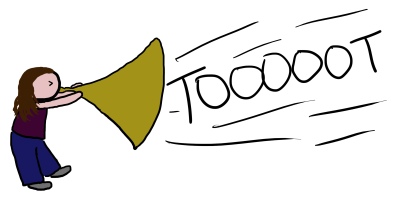
For the record, my book finally getting representation does have a lot to do with the fact that I worked for this woman.  BUT, my boss would not have represented me if she thought my book was sub par.  I would know – She has read and rejected her own interns’ work while I was working for her.  I don’t want to toot my own horn…
Blowing own Horn

…but Hellbound is written pretty well, so I’m glad that she recognized this.

So I have an agent who likes my work.  Does this mean that Hellbound is now officially going to get published absolutely yes no doubt about it?  Unfortunately, no.  Part of this blog is about you guys following me on my path to getting published, so I decided to share with you more about the process.  What I have just embarked on is an even longer journey than the actual “writing the book” part, and the road is still paved with rejection.

Let’s say you’re a writer.  For the purposes of this exercise, you are a clown.
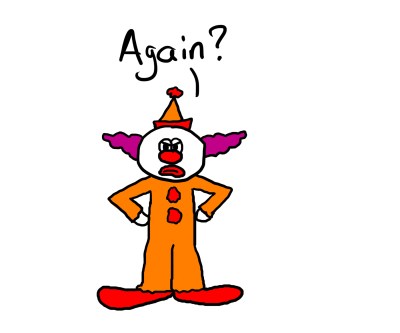
Clown Again

Actually, let’s say you’re a clown who has written a book.
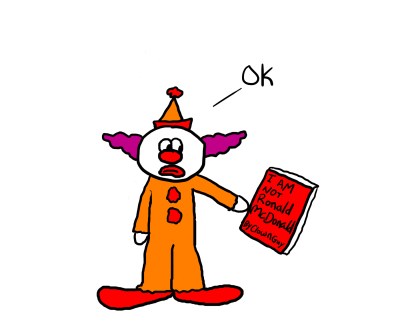
Clown with Book

Now, you want to get your book published.  There are a lot of people out there that your book has to impress before that can happen.  There’s your agent…
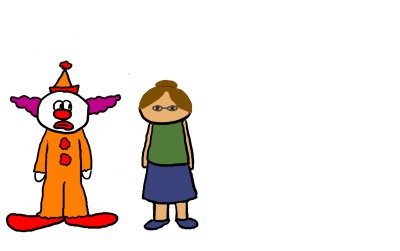
Clown with Agent

If the agent likes it, he or she will pitch your book to an editor…
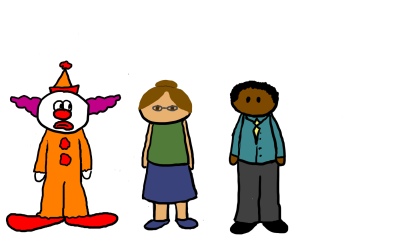
Clown with Agent and editor

If the editor likes it, he or she will pitch your book to the editorial staff + whoever the editorial staff reports to.  They are represented here by an amorphous blob of rejection, sometimes known as the Rejection Amoeba.
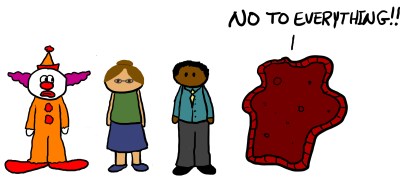
Clown with Agent and editor and amoeba

If any of these people or Amoebas say no to your book, back to you it goes.  All the way down the line.  And you’re back to being a sad clown with a book, standing on square one and wondering if maybe you should have stuck to making balloon animals at birthday parties.

Depressing as that sounds, I am really happy to have an agent.  It means I am on my way.  I will give you the details of the process as it continues, because I know this is just as important to you as it is to me.  And who knows?  Maybe one day I’ll give away signed copies to all my blog followers.  And by “give away” I mean “Sell at maybe a discounted price.”  Hey, authors need to eat, too.

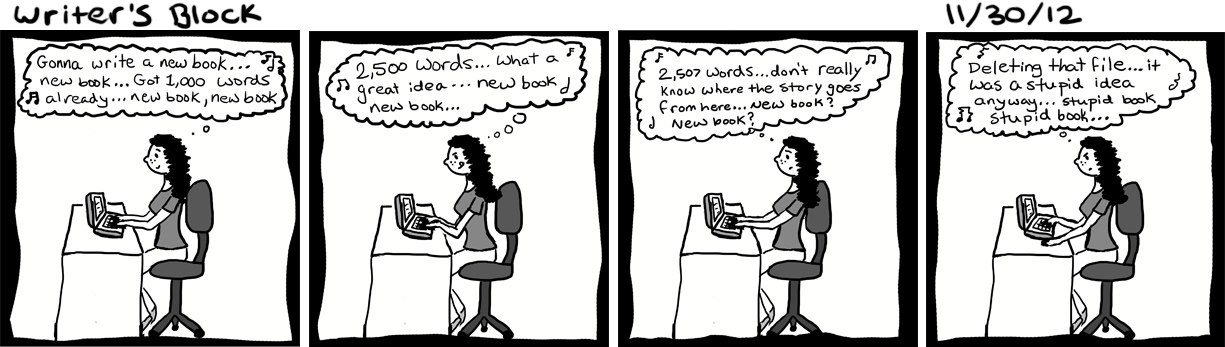
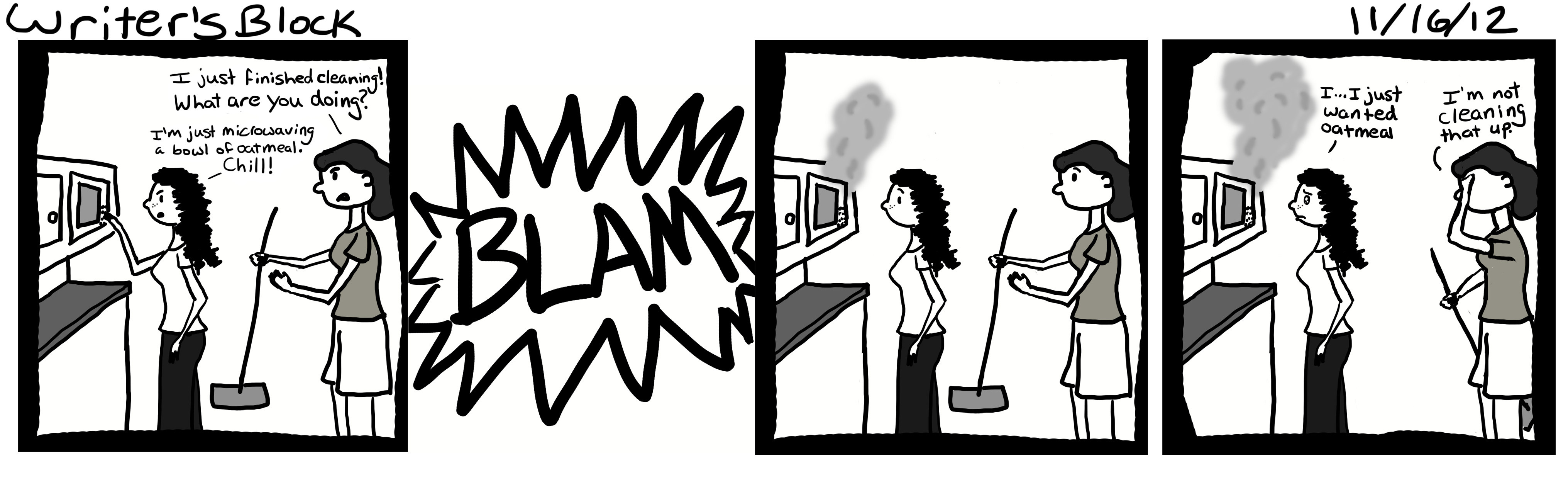
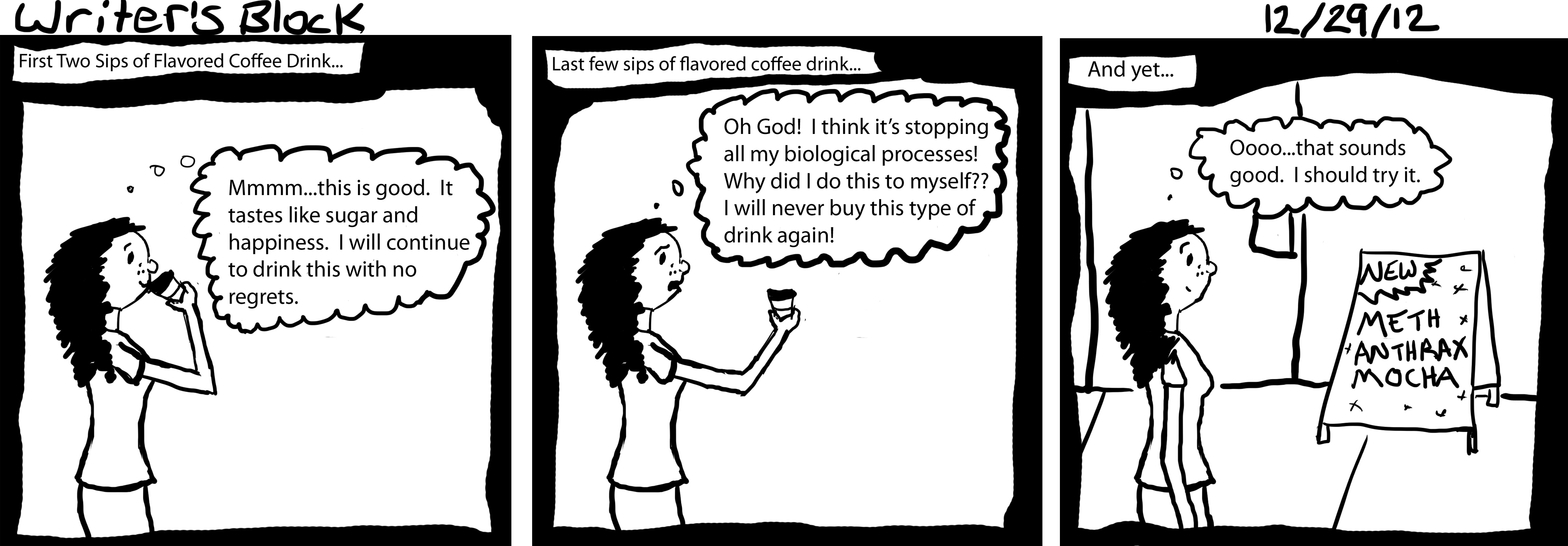
Comic!  I gave up on trying to write comprehensibly.  You’re welcome! (Click to enlarge)
Writer's Block Strip 7

Word of the Day: Sycophant (n) – a self-seeking, servile flatterer; fawning parasite.

P.S. I haven’t forgotten about the fact that I mentioned writing my own comprehensive list of advice for writers.  I’ll get around to it eventually.  It’s harder than it seems.

2 Comments

Filed under books, Comic, Humor, writing

Random Advice and Stuff

As the title of this post suggests, I just have a few random things to throw at you today.

The first is the difference between the words “compliment” and “complement.”  This is important, I feel, because even I have trouble remembering the difference.  “Compliment” (with an I) refers to praise.  I complimented her on her taste in Jello.  She complimented her boss in the hopes that he would give her a raise.  You get it.  “Complement” (with an E) refers to things that go well together.  This wine complements this chicken dish.  Or the drapes complement the carpet.  That kind of thing.

Next is something my sister emailed me.  It’s pretty self-explanatory, so I’ll just paste it here for your amusement.  My comments are in red, and my cartoons are in…cartoon.

Kurt Vonnegut’s Eight Rules for Writing Fiction:

1. Use the time of a total stranger in such a way that he or she will not feel the time was wasted.  In other words, when someone picks up the book you’ve written, make sure they know fairly quickly that it was worth it.

2. Give the reader at least one character he or she can root for.  This does not have to be the main character, but it helps to achieve point #1 if you have point #2.

3. Every character should want something, even if it is only a glass of water.  Motivation.  Your characters should have motivation.  If they do not feel motivated to do anything, then your reader will pick up on that, and then they will cease to be motivated to read your book.  Again, see point #1.

4. Every sentence must do one of two things — reveal character or advance the action.  This you’re allowed to disagree with, though I feel these two definitions can be given a very broad spectrum.  For instance, describing your main character’s workplace may not be either of those two things, unless you consider that the way the character views their workplace provides insight into their…well, character.

5. Start as close to the end as possible.  I believe he’s referring to starting in Medias Res, or the middle of the action.  This is your choice, but do remember that if starting at the beginning is as close to the end as you feel you can start, then technically you are following the rule properly.  After all, he did say “as possible.”  It’s up to your judgment where and when to start your story.

6. Be a sadist. No matter how sweet and innocent your leading characters, make awful things happen to them — in order that the reader may see what they are made of.  Yes.  If you’re having trouble with this, it may be necessary to write “They aren’t real” on the back of your hand in Sharpie.  The fact of the matter is that your characters are at their best when all aspects of their strengths, weaknesses, and personalities (that is, each character’s personality, not each character’s multiple personalities) show through.  And this can only happen if you put them in situations that are all over the spectrum of “Good” and “Bad.”

7. Write to please just one person. If you open a window and make love to the world, so to speak, your story will get pneumonia.  You can’t please everyone.  But if you can make just one person read your story and say that it made them think, or changed their life forever, then you’ve accomplished something big.  Never forget that.

8. Give your readers as much information as possible as soon as possible. To heck with suspense. Readers should have such complete understanding of what is going on, where and why, that they could finish the story themselves, should cockroaches eat the last few pages.  This is hilarious, but not entirely true, depending on who you talk to.  I do agree that you can’t leave your readers totally lost.  Readers, for the most part, don’t want to have to fight to keep up with your story.  They should be safely strapped into the rollercoaster, not running on the track behind it hoping to keep up.  However, some suspense and mystery is good, if that’s the type of book you’re writing.  It is okay to keep some things secret, but it is not necessary.  If your readers know something that your characters don’t, that’s called Dramatic Irony.  It’s a thing.  Work with it.  Or don’t.

— Vonnegut, Kurt Vonnegut, Bagombo Snuff Box: Uncollected Short Fiction (New York: G.P. Putnam’s Sons 1999), 9-10.
Kurt Vonnegut: How to Write with Style

Vonnegut was a fantastic writer, may he rest in peace, and I think his advice is great.  But, as this is my blog, I do believe I should start working on my own comprehensive list of this sort.  So maybe I’ll whip one up and make that my next post.

Lastly, I think, was just a new comic.  So here you go.  Click to enlarge.

[Edit: I remembered what the last thing actually was!  I made a meme.  Ever heard of First World Problems?  Check it out.  I knew there was something I was forgetting.]

Word of the Day: Complement (v) – something that completes or makes perfect.

4 Comments

Filed under books, Comic, Grammar, Humor, writing

Wear Your Veggies

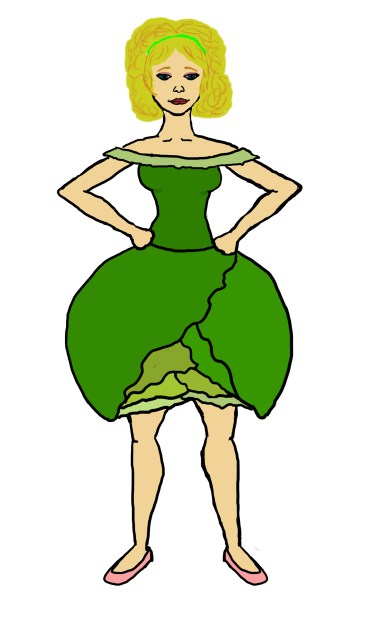
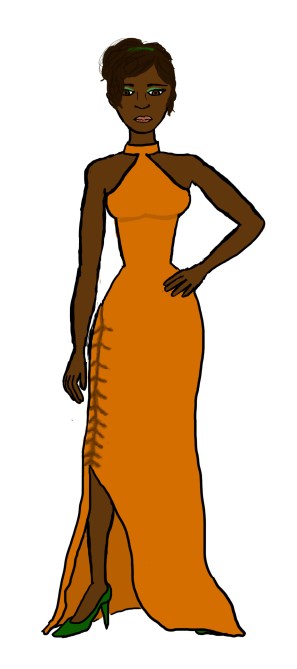
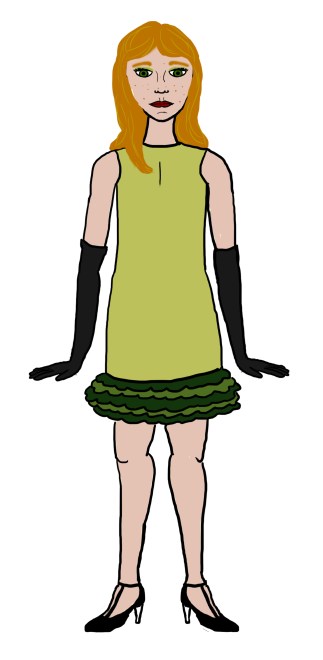
Robin McKinley is a person.  More specifically, she’s an author.  She wrote a very interesting book called Sunshine, and another one that I like even better called Deerskin.  She’s also a person who decided to write two variations on the classic story of Beauty and the Beast and publish both of them.  One is called Beauty, the other, Rose Daughter.  I was reading the latter when I came across this piece of description: “…the cabbages, some of them so big around she could not have circled them with her arms, bore extravagant frills as elaborate as ball gowns and as exquisitely coloured” (Rose Daughter, 153).  After reading that, I thought of what any sane person would have.  This:


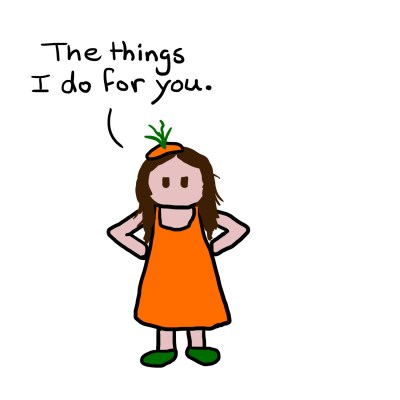
And then I again did the very sane thing and drew what I imagined, as you can see.  Then, continuing along the path of sanity, my brain (and subsequently my tablet) produced this…

…and this:

Please excuse my somewhat shabby drawing skills.  I was never really trained, though what I do know I learned from my fantastic mother.  One thing I could never master was drawing feet facing forward, so my figures always come out a bit duck-footed.  Oh well.  I figured it was best not to use Mini Bex in this instance since I don’t think my vision would have translated as well on her.

Actually that looks more adorable than I realized…

Also, if you’re curious if you’ve got the right vegetable in mind, hover your mouse over the image.  It’ll tell you.  I may or may not have been sneaking in some Alt-Text for my pictures.  For those who don’t know, that’s the name for the text boxes that pop up when you hover your mouse over a picture.

And, because I feel the need to make this post at least a little bit relevant to the theme of this blog, let me just say a quick word about Robin McKinley.  She’s a great writer.  All of her books (or at least the four I’ve read) have a couple things in common.  The first is that they can get a bit slow at times, especially in the beginning.  It’s worth sticking with them, though, because her writing is top notch and her stories are beautiful.  The second is that I’ve noticed a theme of survival that runs throughout all her books, even though they’re not related (even the two books about Beauty and the Beast exist as their own story and do not relate to each other in any way).  More importantly to me, it’s about women’s survival.  Her female characters are strong.  Quite literally, they lift heavy things, and hunt, and survive on their own.  So if you’re ever at the book store, I’d say go for Deerskin.  Even though I’m a huge fan of Beauty and the Beast (my favorite Disney cartoon), I liked Deerskin the best.

Ok, that’s it.  Have a comic.  You know the drill – click to enlarge.

Word of the Day: Verdant (adj) – green with vegetation; covered with growing plants or grass.


Leave a comment

Filed under books, Comic, Humor, writing