Tag Archives: writing

Wrebecca’s Writing Wrules

I found it was hard to come up with a comprehensive list of rules for writers.  Mainly because this whole blog is that, and I don’t just want to sit here repeating myself.  But also because something like writing is hard to sum up.  Everyone has a different process, their own muse, their own favorite time to write, etc.  That being said, I did take a crack at it.  You will see some repetition; that was unavoidable.  That’s why certain things on the list will have links in them – they’ll just lead to the posts where I talked in more detail about that particular item.  Soooo…here goes with the list.

1. You never know nearly as much as you think you do – This is not as depressing as it sounds.  If you have read the beginning of my blog, and I’m talking about the first ten posts or so, you will notice that I was an idiot back then.  Did you see the kinds of advice I gave?  Did you see the apologies I had to issue for that advice?  Writing means, among other things, constantly learning.  You will never be done learning.  It is ongoing.  And that is good.  Constant improvement.  It’s not something you have to strive for; it just happens.  The more you write, the more you learn.

2. Go with your gut – I cannot count how many times I have brought this up in this blog.  But I figure there’s a reason for it.  I really do believe that your gut instinct as a writer is your greatest resource.
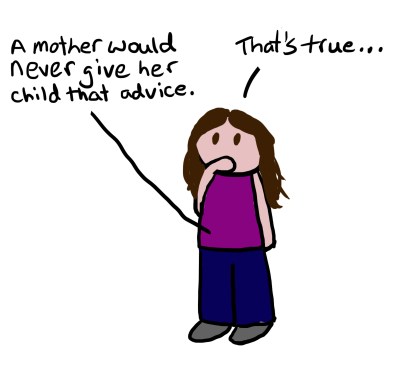
Listen to Your Gut

If your are reading a sentence, and that sentence simply doesn’t feel right, then there is a good chance you need to reword it.  If a character does not feel believable to you, then maybe you need to think about why that is.

3. Read – This should be obvious, but I want to restate it here.  You cannot be a good writer if you do not first have a basic grasp of what good writing is.  Now I am not saying that all published books are good.  *cough* Twilight *cough*  But the point is that you should be able to weed out which books are and aren’t good if you read enough.  And it’s not enough to say “I don’t like this book” and then throw it into the trash.  You have to be able to identify why you don’t like it.  It’s the same if you like a book.  Why?  What are the best aspects of your favorite author’s writing?  Being able to identify you reasons for liking or disliking some piece of writing will help you grow as a writer.

4. Nothing is anything until it is something – I started saying this to my friends and family the moment the possibility of me getting an agent arose.  It’s true in the book business, but probably in most of the entertainment industry and just the business world in general.  It’s my own variation on “Don’t count your chickens until they hatch” I guess.  But it applies to more than just signing with an agent and chewing your nails down to stubs while you wait anxiously to see if your book will actually get published or if the Rejection Amoeba will shoot you down.  It’s about writing at its core.  You have to actually write something for it to be something.  An idea is just an idea.  Words on a page are a thing.  You can change, edit, delete, whatever, but none of that is possible without taking the first step.  Embark on the journey.  There’s no risk, except maybe carpal tunnel.
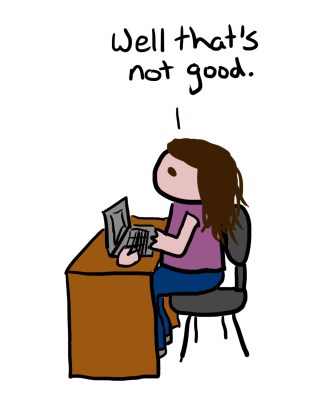
Carpal Tunnel

5. Read it out loud – You should be prepared to read your whole book out loud, though special attention should be given to the dialogue.  You will be able to tell if your writing sounds genuine pretty easily if you feel comfortable saying the words you wrote out loud.  If you don’t, maybe you need to rework it a bit.  This works really well with dialogue because that is the part we are most used to delivering through speech, so if something you wrote as speech doesn’t sound normal to your ears, then you know it’s probably not believable in writing.
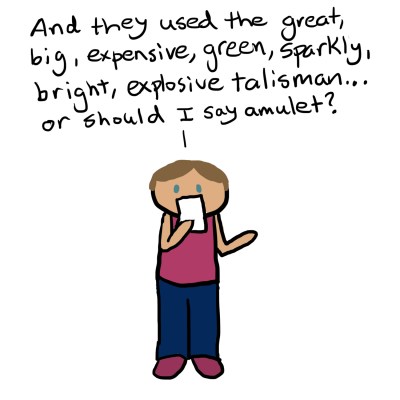
Read Aloud

6. Show Don’t Tell – This is a classic.  And I know I’ve talked about it at least twice before, but I only remember one post where I talked about it extensively, so that’s the one I’m going to link to.  Other than that, I have nothing to say besides please please please follow this rule.  I know Telling can be a style choice, but it’s very hard to do that well if you’re not already a skilled writer.

7. Challenge Yourself – One of my favorite posts on this blog is the one titled “They Say.”  I had a lot of fun writing it, and it expressed one of my biggest beliefs about writing – that you don’t have to limit yourself.  If you feel most comfortable writing short stories, maybe the challenge is to write a novel.  If you write mainly Fiction, maybe the challenge is to try some Nonfiction.  It might be terrible.  At least on your first attempt (I know my first attempts at Realistic Fiction were all just…awful.)  But it’s a learning experience, and one that I think is really crucial to the growth of a writer.  If you are constantly pushing your limits, you not only learn new things about yourself, but you learn new things about writing, and what it means to you.  So find a challenge, give yourself an assignment, Google “writing exercises,” ask a friend for a list of words that must be included in a story (see below the Word of the Day), and just get to it.

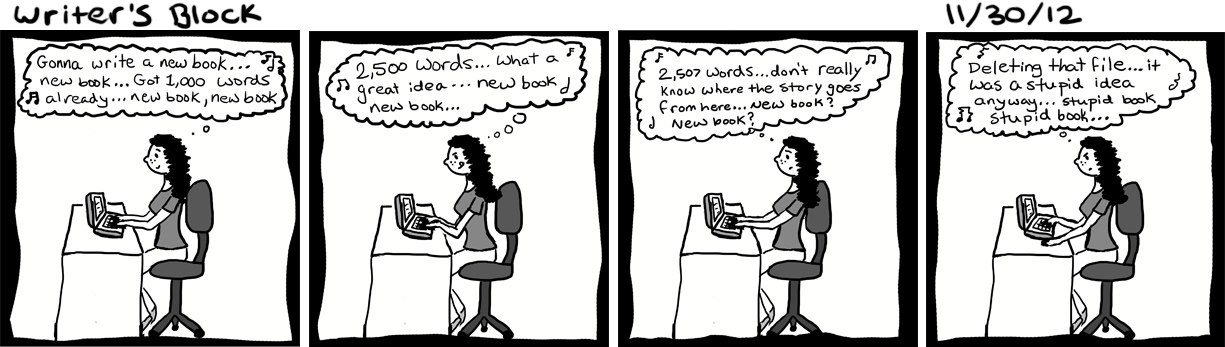
I think that’s it.  I don’t know if that advice was so much about writing.  It may have been more about being a writer.  But I think that kind of advice is just as valid.  So here’s a comic (click to enlarge) and Word of the Day.  Don’t forget to keep scrolling down for my Writing Challenge!
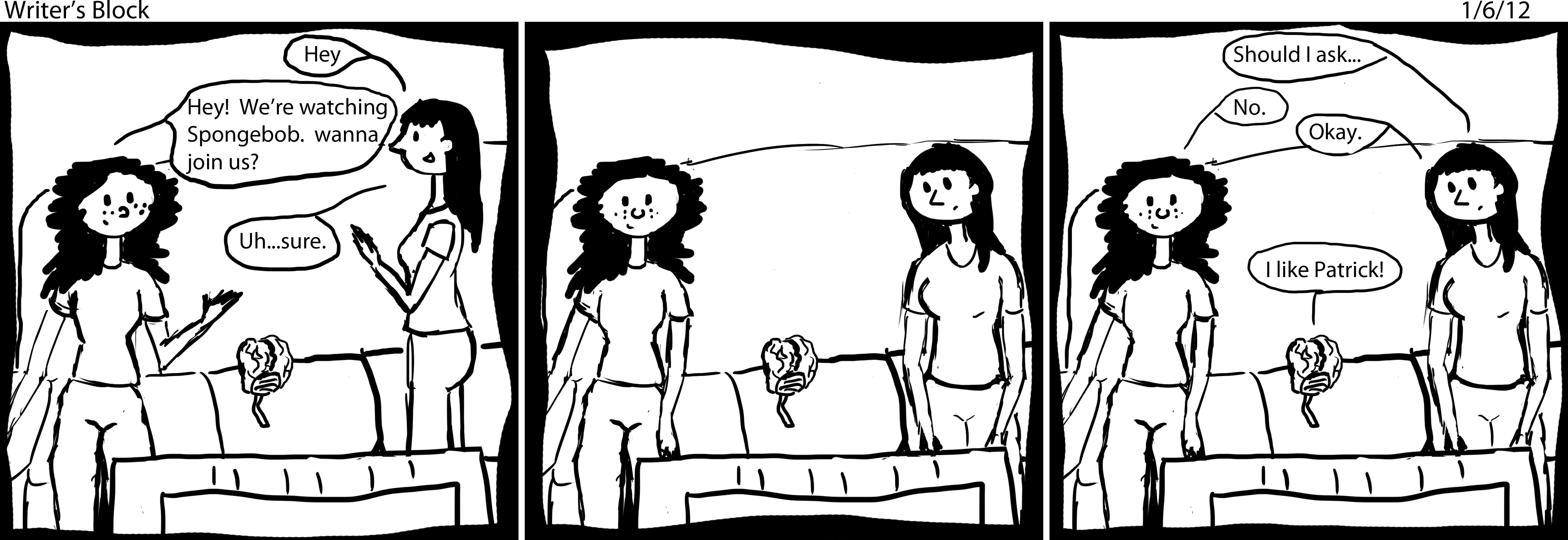
Writer's Block Strip 9

Word of the Day: Crucial (adj) – involving an extremely important decision or result; decisive; critical.

Bex’s Writing Challenge!

In order to do my part to encourage you to challenge yourself, I have decided to offer a small writing assignment for all interested parties.  As I said above, a great writing challenge is to take a random list of words and incorporate them into a story.  Ever heard of Flash Fiction?  It’s a really, really short piece of fiction that usually ranges from about 200 to 500 words.  My challenge to you is to take the list of words below and use them in a piece of Flash Fiction.  Then, if you so desire, post that story in the comments section.  I will read and offer my comments to all those who choose to take part.  (Don’t worry.  I’ll be nice.  And this is an optional thing, obviously.  I’m not going to find where you live and threaten you until you write short fiction for my amusement).

So here’s your list:

Apple

Expensive

Ordinary

Superfluous

Tangible

Officer

Weirdly

[End List]

I will probably take up the challenge myself and post my story for all to see.  Until then, Happy Writing!
3 Comments

Filed under books, Comic, Humor, writing

Catching Up

Haven’t written in a while.  I bet you’re all waiting on the edge of your seats to find out what’s new and different in my life.  Good news, everyone!  I won’t keep you waiting any longer.

First, as of December 24, 2012, I am 22 years old.  Wooooo….

Second, as of December 18, 2012, I am done with my internship.  However, I am not done with my boss, because also as of December 18, 2012, she has agreed to represent me.  So I have an agent who is going to help me sell Hellbound.  WOOOOO!

For the record, my book finally getting representation does have a lot to do with the fact that I worked for this woman.  BUT, my boss would not have represented me if she thought my book was sub par.  I would know – She has read and rejected her own interns’ work while I was working for her.  I don’t want to toot my own horn…

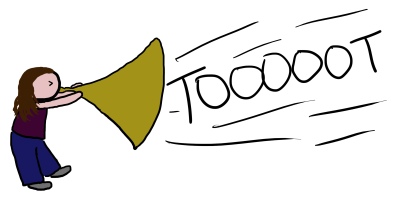
Blowing own Horn

…but Hellbound is written pretty well, so I’m glad that she recognized this.

So I have an agent who likes my work.  Does this mean that Hellbound is now officially going to get published absolutely yes no doubt about it?  Unfortunately, no.  Part of this blog is about you guys following me on my path to getting published, so I decided to share with you more about the process.  What I have just embarked on is an even longer journey than the actual “writing the book” part, and the road is still paved with rejection.

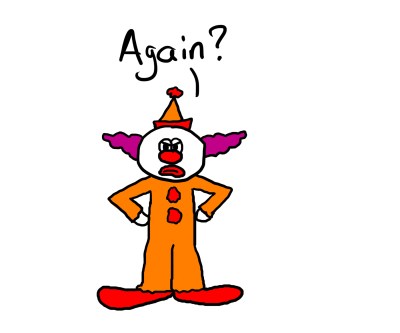
Let’s say you’re a writer.  For the purposes of this exercise, you are a clown.

Clown Again

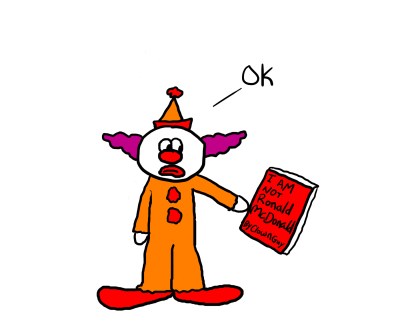
Actually, let’s say you’re a clown who has written a book.

Clown with Book

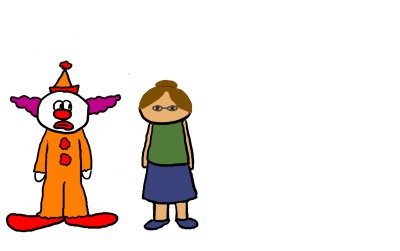
Now, you want to get your book published.  There are a lot of people out there that your book has to impress before that can happen.  There’s your agent…

Clown with Agent

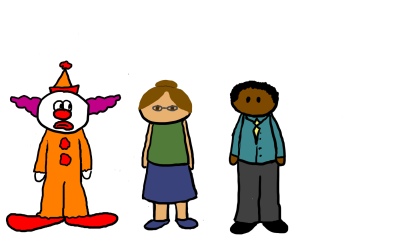
If the agent likes it, he or she will pitch your book to an editor…

Clown with Agent and editor

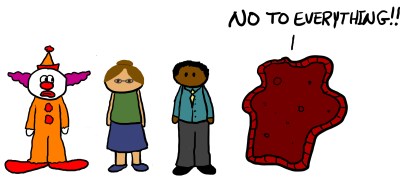
If the editor likes it, he or she will pitch your book to the editorial staff + whoever the editorial staff reports to.  They are represented here by an amorphous blob of rejection, sometimes known as the Rejection Amoeba.

Clown with Agent and editor and amoeba

If any of these people or Amoebas say no to your book, back to you it goes.  All the way down the line.  And you’re back to being a sad clown with a book, standing on square one and wondering if maybe you should have stuck to making balloon animals at birthday parties.

Depressing as that sounds, I am really happy to have an agent.  It means I am on my way.  I will give you the details of the process as it continues, because I know this is just as important to you as it is to me.  And who knows?  Maybe one day I’ll give away signed copies to all my blog followers.  And by “give away” I mean “Sell at maybe a discounted price.”  Hey, authors need to eat, too.

Comic!  I gave up on trying to write comprehensibly.  You’re welcome! (Click to enlarge)

Writer's Block Strip 7

Word of the Day: Sycophant (n) – a self-seeking, servile flatterer; fawning parasite.

P.S. I haven’t forgotten about the fact that I mentioned writing my own comprehensive list of advice for writers.  I’ll get around to it eventually.  It’s harder than it seems.

2 Comments

Filed under books, Comic, Humor, writing

Random Advice and Stuff

As the title of this post suggests, I just have a few random things to throw at you today.

The first is the difference between the words “compliment” and “complement.”  This is important, I feel, because even I have trouble remembering the difference.  “Compliment” (with an I) refers to praise.  I complimented her on her taste in Jello.  She complimented her boss in the hopes that he would give her a raise.  You get it.  “Complement” (with an E) refers to things that go well together.  This wine complements this chicken dish.  Or the drapes complement the carpet.  That kind of thing.

Next is something my sister emailed me.  It’s pretty self-explanatory, so I’ll just paste it here for your amusement.  My comments are in red, and my cartoons are in…cartoon.

Kurt Vonnegut’s Eight Rules for Writing Fiction:

1. Use the time of a total stranger in such a way that he or she will not feel the time was wasted.  In other words, when someone picks up the book you’ve written, make sure they know fairly quickly that it was worth it.

2. Give the reader at least one character he or she can root for.  This does not have to be the main character, but it helps to achieve point #1 if you have point #2.

3. Every character should want something, even if it is only a glass of water.  Motivation.  Your characters should have motivation.  If they do not feel motivated to do anything, then your reader will pick up on that, and then they will cease to be motivated to read your book.  Again, see point #1.

4. Every sentence must do one of two things — reveal character or advance the action.  This you’re allowed to disagree with, though I feel these two definitions can be given a very broad spectrum.  For instance, describing your main character’s workplace may not be either of those two things, unless you consider that the way the character views their workplace provides insight into their…well, character.

5. Start as close to the end as possible.  I believe he’s referring to starting in Medias Res, or the middle of the action.  This is your choice, but do remember that if starting at the beginning is as close to the end as you feel you can start, then technically you are following the rule properly.  After all, he did say “as possible.”  It’s up to your judgment where and when to start your story.

6. Be a sadist. No matter how sweet and innocent your leading characters, make awful things happen to them — in order that the reader may see what they are made of.  Yes.  If you’re having trouble with this, it may be necessary to write “They aren’t real” on the back of your hand in Sharpie.  The fact of the matter is that your characters are at their best when all aspects of their strengths, weaknesses, and personalities (that is, each character’s personality, not each character’s multiple personalities) show through.  And this can only happen if you put them in situations that are all over the spectrum of “Good” and “Bad.”

7. Write to please just one person. If you open a window and make love to the world, so to speak, your story will get pneumonia.  You can’t please everyone.  But if you can make just one person read your story and say that it made them think, or changed their life forever, then you’ve accomplished something big.  Never forget that.

8. Give your readers as much information as possible as soon as possible. To heck with suspense. Readers should have such complete understanding of what is going on, where and why, that they could finish the story themselves, should cockroaches eat the last few pages.  This is hilarious, but not entirely true, depending on who you talk to.  I do agree that you can’t leave your readers totally lost.  Readers, for the most part, don’t want to have to fight to keep up with your story.  They should be safely strapped into the rollercoaster, not running on the track behind it hoping to keep up.  However, some suspense and mystery is good, if that’s the type of book you’re writing.  It is okay to keep some things secret, but it is not necessary.  If your readers know something that your characters don’t, that’s called Dramatic Irony.  It’s a thing.  Work with it.  Or don’t.

— Vonnegut, Kurt Vonnegut, Bagombo Snuff Box: Uncollected Short Fiction (New York: G.P. Putnam’s Sons 1999), 9-10.
Kurt Vonnegut: How to Write with Style

Vonnegut was a fantastic writer, may he rest in peace, and I think his advice is great.  But, as this is my blog, I do believe I should start working on my own comprehensive list of this sort.  So maybe I’ll whip one up and make that my next post.

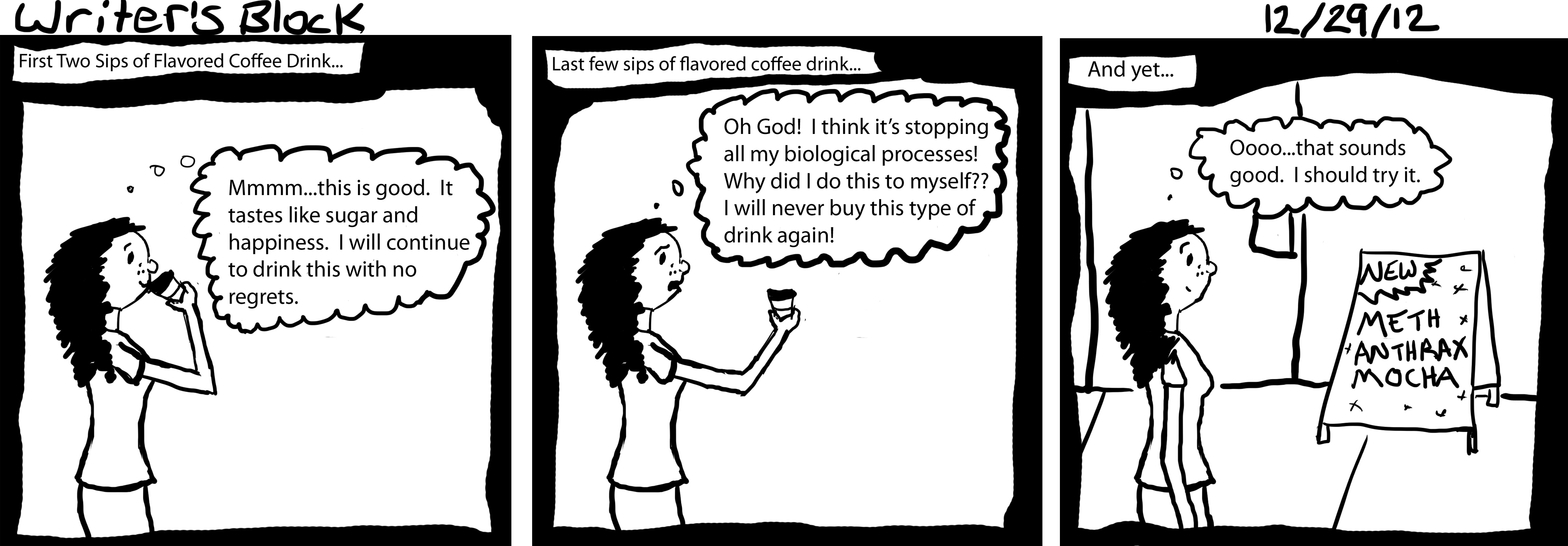
Lastly, I think, was just a new comic.  So here you go.  Click to enlarge.

[Edit: I remembered what the last thing actually was!  I made a meme.  Ever heard of First World Problems?  Check it out.  I knew there was something I was forgetting.]

Word of the Day: Complement (v) – something that completes or makes perfect.

4 Comments

Filed under books, Comic, Grammar, Humor, writing