Category Archives: books

He Said/She Said

So here I am again.  I’m preparing to go back to Los Angeles after a wonderful semester abroad, and I’ve decided to take time out of my busy (read: not at all busy) schedule to blog.

Today’s post is all about the nuances of dialogue.  I have this motto/saying/whatever that I came up with a while ago.  It goes like this: Writing is the easiest, safest way to play God.  And it’s true.  Not only do you create entire worlds, populate those worlds, and control the course of events, but you also put words directly into people’s mouths.  The best part is that there’s absolutely no pressure.  If you screw up, or kill somebody, or end the world, you’re not disappointing anybody.  Your characters aren’t exactly going to rebel.  But if you want any real-life readers, you’re going to have to be a pretty competent deity.  No pressure or anything.

Dialogue is a sensitive topic.  You’re given this power to dictate what each and every character is going to say, but at the same time, you have to be aware that we can never predict what people are going to say in real life.  Dialogue at its best will never go beyond mimicking real life really, really well.  And that’s fine.  If your dialogue didn’t take a little literary license well then…it wouldn’t be literary.  It’s still easy to mess up, though.  Trust me.  I have experience.  Ever written a character of the opposite sex?  Ever caught yourself writing that character’s dialogue like he/she is the same sex as you?  I have.  Being female, I found it really hard to get into the male mindset.  Especially when I was a thirteen-year-old girl writing a teenage boy.  He was constantly being emasculated when he spoke, and I didn’t even realize it.

There are other errors you can make, too.  When one character says something, the other character’s response has to be appropriate.  I know this seems like it’s obvious, but it is really difficult to get right sometimes.  Below is an example of an “inappropriate” response.
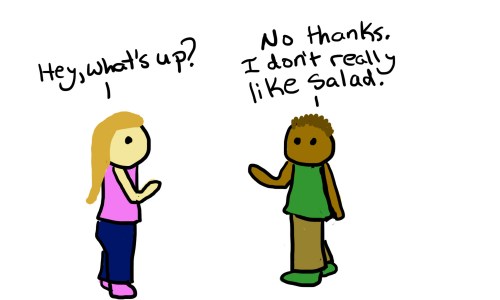
The only way this conversation could be made appropriate would be if you created a scenario to fit it.  For example, the guy could have misheard her.  Or he could be desperately trying to avoid her.  Any number of things could make it work, but on its own without any context, it doesn’t.  This is, as usual, an extreme example.  But when you’re reading through your sections of dialogue, you really do have to ask yourself if the conversation feels real.  This is when that whole “Listen to your gut” thing comes in handy.  If something doesn’t feel right about the conversation, then something’s probably not right.

Usually, when I have a problem with inappropriate responses, it’s because I’m trying to rush the conversation.  I know where I want the characters to end up, and it’s going to be far more interesting than this conversation, so I just kind of…push it a bit.  And it ends up reading something like this:
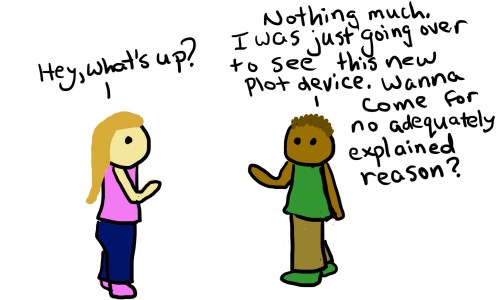
Then I have to go back and slow things down a bit, make sure their conversation reaches A, B, and C before they get to D.  Then there are dialogue tags.  Now those are a bitch to get right.  I really hate them.  If left unchecked, you can have a conversation that goes like this:

“Hey, I’m drinking some coffee,” she said.

“I noticed that,” he said.

“I like pointing out the obvious,” she said.

“I am going to leave this room now,” he said.

Note the overabundance of he said/she said.  Breaking up dialogue tags so that you don’t have too much repetition can get tough.  Usually, if it’s just a conversation between two people, you can just drop the tags altogether like so:

“Hey, I’m drinking some coffee,” she said.

“I noticed that,” he said.

“I like pointing out the obvious.”

“I am going to leave this room now.”

Or, if you like, you could switch things up a bit:

“Hey, I’m drinking some coffee,” she said.

“I noticed that,” he muttered.

“I like pointing out the obvious!” she shouted.

“I am going to leave this room now,” he whispered, eyes darting towards the door.

But this is all pointing out the obvious, which is why I didn’t spend too much time on it.  I know this post is long, but I want to say one more thing:  Often, when writing dialogue, I get into this groove where the conversation flows, feels real, and takes the right amount of time.  The problem is that when I get into that groove, I don’t stop to switch perspectives based on who’s talking.  In other words, it’s like I’m writing a conversation between myself and myself, where everything that’s said is what I would say.  So, my final note is: Not only do you have to make the dialogue appropriate, but you have to make it appropriate to each character, too.  “Hey, what’s up?” Sure, someone could say that.  Hell, people have said that.  They’re probably saying it right now.  But would the Queen of MadeUpLand say that?  Maybe not.  Just something to think about.

Word of the Day: Diatribe (n) – a bitter, sharply abusive denunciation, attack, or criticism
Leave a comment

Filed under books, Grammar, writing

The Swirling Vortex of Doom (AKA Character Development)

Remember how I was talking about how very wrong I was in my first few posts?  [EDIT 3/13/21: These posts have since been unpublished due to being blatantly wrong and insulting.] Yeah, I remember now that there’s something else I wanted to clear up besides how sorry I am – What I wrote about character development.

My methods for getting to know your character?  Sound.  Good enough anyway.

My timeline for getting to know your character?  WRONG.  I made it seem like you had to know everything there is to know about your character before you even start your story!  No no no!  I don’t even think that’s possible.  Even if you have an absolutely super special intimate relationship with your character before you start writing, and you think you know all there is to know, I’m still pretty convinced that something about that character is going to change once you start writing.  And that’s the whole point!  It’s supposed to change!  If your writing isn’t teasing out more and more little things about your character that you didn’t even think about before you started, then maybe you’re not doing it right.  To illustrate this point (literally) I painstakingly drew my character development process for Serrafiel.

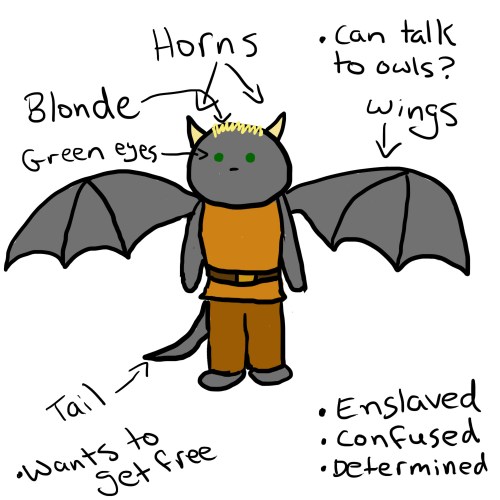
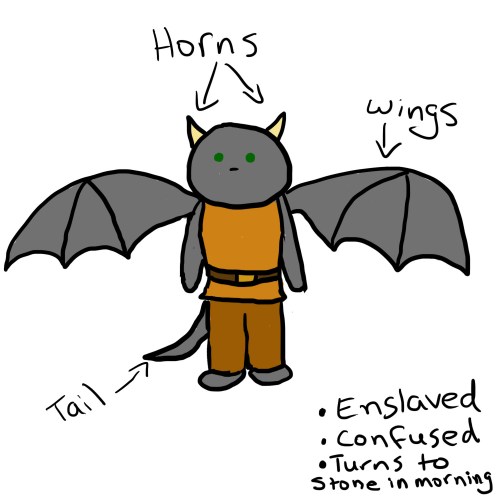
First, we have what I knew about the character before I started writing:

Yeah, that’s about it.  So I ask you: Does this look like a fully-developed character?  The answer is no.  So I had that, and then I started writing and, after a chapter or two, I got this:

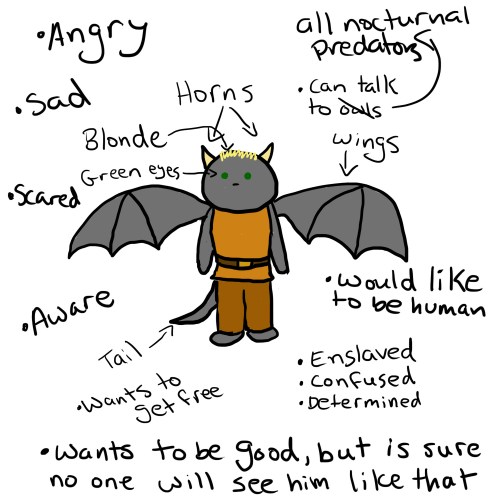
So there’s a little more.  He’s blonde now, and he has green eyes.  I didn’t know either of those things until I wrote about him looking at himself in the mirror for the first time.  And the talking to owls thing, yeah…decided that one on a whim.  It worked out really well once I got further in the book, which brings me to:

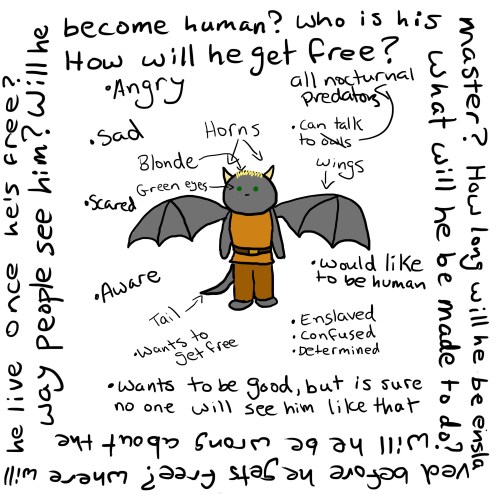
So now I’ve got a pretty well-rounded character.  By now, I’m really into the book, and I know a lot about him.  You may also notice that this picture has a lot more words in it than the first one.  But it’s also important to remember that all of these things I know about him are constantly framed by questions, things I don’t know yet.  So in the next picture, he’s literally framed by questions.

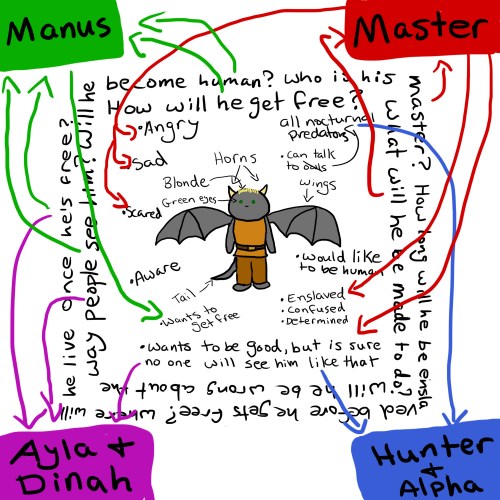
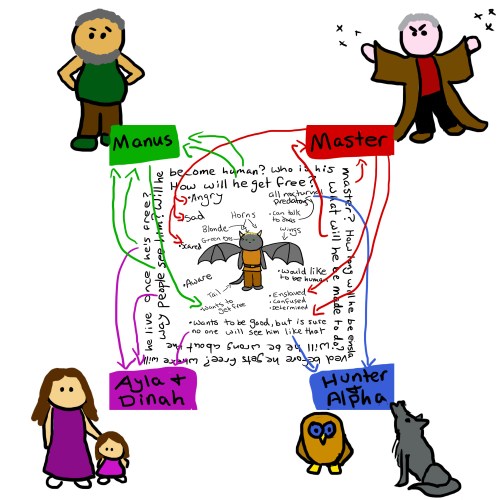
And then you have to remember that all of these questions and personality traits and feelings and words are often linked directly (or indirectly) to other characters in the book.  Which I have also drawn.

Believe it or not, there is some rhyme and reason to the direction of the arrows.  If a question is going to be answered by a character, then the arrow points to them.  If a character caused the question, or the feeling/emotion whatever, then the arrow points from that character to the corresponding word(s).  I mean, that’s not totally important.  This is just supposed to show how incredibly complicated character development is.  In other words, I’m trying to prove without a doubt that I was epically wrong the first time I talked about this.  Oh and we’re not done by the way.  Because you have to remember that all those colored blobs aren’t just blobs, they’re other characters.

And all of those other characters, plus any number of others, need their own swirling mass of words, arrows, and relationships.  They all need to be developed just like I developed Serrafiel.  (Don’t worry, I didn’t draw out their developments, too.  That was the last picture)

In conclusion, you should definitely get to know your character as well as you might know a sibling or close friend, but don’t be afraid to use your writing to help you develop that relationship.

Word of the Day: Nascent (adj) – beginning to exist or develop

2 Comments

Filed under books, writing

The Zebras have Landed

I was bored yesterday, so I decided to try and write that short story I promised you.  I opened up a Word document, typed the title at the top of the page – Extracurricular Activities for Zebras – and then proceeded to stare at the blank screen.  I stared for a while, tried to type something, hated it, tried to revise, and hated that, too.  Then I decided it might be interesting to make the story about the conversation that led to me getting that fantastic title.  That idea seemed nice, and it sort of evolved from there.  The finished result was a work of Creative Nonfiction, and I’m actually very happy with it.  So today’s post is that short story.  No cartoons or witticisms today.  So, without further ado, I give you my short story:

Extracurricular Activities for Zebras

Fellow students asked me why I left sunny Los Angeles for Syracuse, New York.  My response was always the same – Because I wanted to see snow for the first time.  And this would shock them, and we’d get to discussing other things, and they’d never figure out I was lying.  I’d seen snow before.  Once, my dad took me and my siblings skiing.  But the snow there was manufactured.  Snow machines.  But we did drive up to the mountains once, and that snow was real.  It just wasn’t fresh.  I’d never seen snow falling, never lived in a place where snow was considered normal.  So I lied, but it wasn’t a really big or malicious lie.  It just simplified things.

My mom asked me what I wanted to be when I grew up.  When I was younger, I replied with things like “veterinarian” and “doctor,” because I liked animals and… I don’t remember my reasons for wanting to be a doctor.  Mom told me that I might have trouble with that since both vets and doctors have to see blood.  I’d forgotten that detail.  Being a very squeamish person, I knew I’d never be able to go down either of those career paths.

What surprised me in middle school, and then high school, was that I was still tempted to add “when I grow up” to the end of any sentence that began, “I want to be a…”  And then I wondered when exactly we can be considered grownups.  When is it okay to stop saying “when I grow up” and acknowledge that you already have?  I assumed it would happen when I actually got the career I was hoping for, and then I could say, “Now I am a _____.  Now I am grown up.”  But when you’re sixteen and saying “when I grow up,” well, that just doesn’t sound right.  Except, if you don’t say it, then the sentence feels incomplete somehow, so I stumbled over the words.  “I want to be a teacher when I – well, not when I grow up.  Just when I get older, I guess.”

My college applications asked me what my hobbies were outside of the classroom.  I told the truth: I played the clarinet, rode horses, sketched, wrote stories.  But that still left a lot of blank space, like I wasn’t fulfilling their expectations.  What more could I say?  My life was consumed by school.  When I wasn’t in school, I was doing homework.  When I wasn’t doing homework, I was too tired to do anything else.

My stepmom asked me why I feared blue eyes.  I was baffled.  Didn’t everybody?  No?  Huh.  I had no answer for her.  To this day, I have trouble looking people in the eye, and it’s even worse if the other person’s eyes are blue.  But at least I know the reason now.  After pondering the question, I had this little jolt of memory.

I remembered the first place where I took riding lessons.  No, that’s not true.  It was technically the second.  When I was very little, my mom signed me up for pony riding classes.  So I remembered the second place where I rode.  This place was really messed up, though I didn’t realize it until after I left.  They had a horse camp there over the summer, and I was a junior counselor.  I was about thirteen.  Another girl, a counselor who was sixteen, told me to put away a bag of apples.  I forgot.  The campers had gone home, and the junior counselors were hanging out in the tack shed.  Then I remembered the apples, and rushed to find the bag.  But it was gone.  Thinking I had been helped out by some anonymous do-gooder, I prepared to go back to what I was doing.

But then that sixteen-year-old, my superior, came rushing out of the office, screaming my name, the bag of apples dangling from her hand.  She was furious that someone else had had to do the task she’d set to me.  She started taking apples out of the bag, and one by one, she threw them at me.  I could see that she was holding herself back, so that the throws weren’t too powerful, but apples are hard.  One of them hit my chest.  It still hurt, even if she wasn’t throwing them that hard.  That wasn’t the worst part, though.  Another counselor – twenty years old with clear blue eyes – stood behind her, encouraging her.  When there were no more apples left in the bag, the sixteen-year-old ordered me to clean them up, and then stormed off.  I cried as I dropped the broken, dirty apples into the horses’ feed buckets.

That ranch, it was bad.  Besides the twenty-year-old counselor, there were two grown women who owned and ran the ranch together.  They both wore sunglasses all the time, but if you got in trouble with them – and you did, on a regular basis – they called you over and took those sunglasses off to stare you straight in the eye.  Both these women had icy blue eyes.  Years later, sitting in my stepmom’s armchair, I figured out why I feared blue eyes.

I tell a lot of people about the apple incident.  It’s a funny story, if you take out the pain and humiliation, as I do when I retell it.  I think I need to laugh about it, because if I’m laughing at them, then I’ve won.

My friend asked me why people major in Philosophy.  I told him I didn’t know.  He told me to answer the question anyway.  How could I answer something I didn’t know?  I said, “Because if 2+7=9, then Jupiter is in alignment with Venus, which provides an extracurricular activity for zebras, that directly affects butterflies which land on the eyelashes of certain college students and cause them to major in Philosophy.”  And he replied, “I hate it when 2+7=9.”  And I said, “I know, right?  No wonder I didn’t major in Philosophy.”

(End story)

There you go.  I hope you liked it.  You might have noticed that the majoring in Philosophy thing came directly from this blog (Read the post titled “They Say” if you haven’t already), so now you’re in on the origins of the story.  Doesn’t that make you feel special?  It should.  That’s all for now.

Word of the Day: Reminisce (v) – to recall past experiences, events, etc.

Leave a comment

Filed under books, writing