Category Archives: Grammar

He Said/She Said

So here I am again.  I’m preparing to go back to Los Angeles after a wonderful semester abroad, and I’ve decided to take time out of my busy (read: not at all busy) schedule to blog.

Today’s post is all about the nuances of dialogue.  I have this motto/saying/whatever that I came up with a while ago.  It goes like this: Writing is the easiest, safest way to play God.  And it’s true.  Not only do you create entire worlds, populate those worlds, and control the course of events, but you also put words directly into people’s mouths.  The best part is that there’s absolutely no pressure.  If you screw up, or kill somebody, or end the world, you’re not disappointing anybody.  Your characters aren’t exactly going to rebel.  But if you want any real-life readers, you’re going to have to be a pretty competent deity.  No pressure or anything.

Dialogue is a sensitive topic.  You’re given this power to dictate what each and every character is going to say, but at the same time, you have to be aware that we can never predict what people are going to say in real life.  Dialogue at its best will never go beyond mimicking real life really, really well.  And that’s fine.  If your dialogue didn’t take a little literary license well then…it wouldn’t be literary.  It’s still easy to mess up, though.  Trust me.  I have experience.  Ever written a character of the opposite sex?  Ever caught yourself writing that character’s dialogue like he/she is the same sex as you?  I have.  Being female, I found it really hard to get into the male mindset.  Especially when I was a thirteen-year-old girl writing a teenage boy.  He was constantly being emasculated when he spoke, and I didn’t even realize it.

There are other errors you can make, too.  When one character says something, the other character’s response has to be appropriate.  I know this seems like it’s obvious, but it is really difficult to get right sometimes.  Below is an example of an “inappropriate” response.
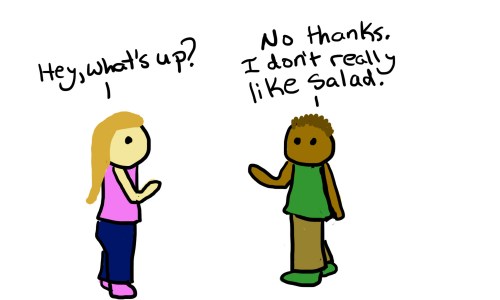
The only way this conversation could be made appropriate would be if you created a scenario to fit it.  For example, the guy could have misheard her.  Or he could be desperately trying to avoid her.  Any number of things could make it work, but on its own without any context, it doesn’t.  This is, as usual, an extreme example.  But when you’re reading through your sections of dialogue, you really do have to ask yourself if the conversation feels real.  This is when that whole “Listen to your gut” thing comes in handy.  If something doesn’t feel right about the conversation, then something’s probably not right.

Usually, when I have a problem with inappropriate responses, it’s because I’m trying to rush the conversation.  I know where I want the characters to end up, and it’s going to be far more interesting than this conversation, so I just kind of…push it a bit.  And it ends up reading something like this:
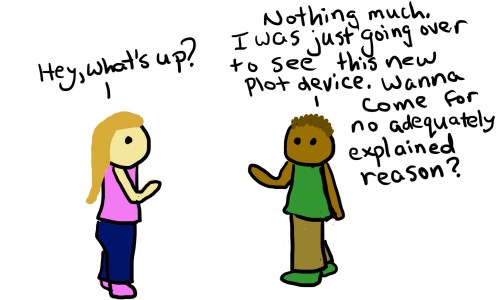
Then I have to go back and slow things down a bit, make sure their conversation reaches A, B, and C before they get to D.  Then there are dialogue tags.  Now those are a bitch to get right.  I really hate them.  If left unchecked, you can have a conversation that goes like this:

“Hey, I’m drinking some coffee,” she said.

“I noticed that,” he said.

“I like pointing out the obvious,” she said.

“I am going to leave this room now,” he said.

Note the overabundance of he said/she said.  Breaking up dialogue tags so that you don’t have too much repetition can get tough.  Usually, if it’s just a conversation between two people, you can just drop the tags altogether like so:

“Hey, I’m drinking some coffee,” she said.

“I noticed that,” he said.

“I like pointing out the obvious.”

“I am going to leave this room now.”

Or, if you like, you could switch things up a bit:

“Hey, I’m drinking some coffee,” she said.

“I noticed that,” he muttered.

“I like pointing out the obvious!” she shouted.

“I am going to leave this room now,” he whispered, eyes darting towards the door.

But this is all pointing out the obvious, which is why I didn’t spend too much time on it.  I know this post is long, but I want to say one more thing:  Often, when writing dialogue, I get into this groove where the conversation flows, feels real, and takes the right amount of time.  The problem is that when I get into that groove, I don’t stop to switch perspectives based on who’s talking.  In other words, it’s like I’m writing a conversation between myself and myself, where everything that’s said is what I would say.  So, my final note is: Not only do you have to make the dialogue appropriate, but you have to make it appropriate to each character, too.  “Hey, what’s up?” Sure, someone could say that.  Hell, people have said that.  They’re probably saying it right now.  But would the Queen of MadeUpLand say that?  Maybe not.  Just something to think about.

Word of the Day: Diatribe (n) – a bitter, sharply abusive denunciation, attack, or criticism
Leave a comment

Filed under books, Grammar, writing

Actually, I have a bit more to say…

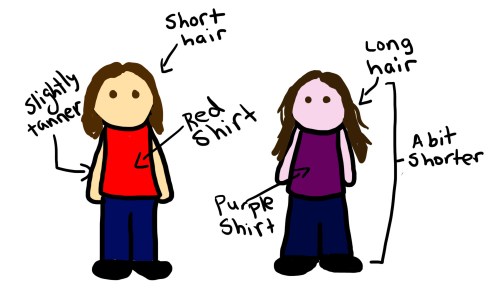
So I was thinking about my last post and how I wrote about trusting your instincts and stuff, and I was thinking that I didn’t say everything I wanted to about that.  (Most awesome run-on sentence ever!)  But first, I have a special request to fulfill.  See, I have this sister.  I won’t tell you her name, but I drew you a picture of us together:

As you can see, we look nothing alike.

Now, this sister of mine asked me for the honor of living vicariously through my blog.  That is, she wanted me to post a short piece based on one of her grammatical pet peeves, since I do occasionally hint at my dislike for bad grammar.  Since she’s my sister, and I owe her for helping me that one time I knocked a guy unconscious in a Wal-Mart (Haha just kidding.  I never shop at Wal-Mart.  It was in a Target.  And I didn’t knock him unconscious.  I killed him) I’m going to help her out here.

My sister’s complaint is this: People seem to have forgotten about the word “among.”  So when they are picking from a list of things that is longer than two, they still say “between.”  Now, I know that you probably know this, but on the off chance someone else is reading this who doesn’t, I’m going to spell it out.  The word “between” involves two things.  Remember that old expression?  It goes a little something like, “Oh shit!  I am totally between a rock and a hard place.”  Note that there are simply two things there.  The rock, and the hard place.  I have also drawn a picture of this:

Now I have two choices: I can either run headfirst into the rock, or I can run headfirst into the hard place…which appears to be some rectangular, green mass.  To reword that, I can choose between running into the rock and running into the hard place.

Now let’s say that I am between a rock and a hard place, and there’s also a lion behind me.  (It’s a lion.  Just trust me on this one.)

Now I have three choices.  I can run headfirst into the rock, I can run headfirst into the hard place, or I can run headfirst into the lion.  Or, I suppose, I can break the fourth wall and run right into your lap.  So I have four choices.  Please note that four is a greater number than two.  Three is also greater than two.  Which means that I am going to have to choose among those four, aforementioned options.

In conclusion, please don’t neglect “among.”  It only ever says nice things about you.  For more hilariously illustrated grammar help, I recommend http://theoatmeal.com/.  Hope that makes you feel better, sis!

As for the title of this post, and the introduction, I do have a bit more to say.  See, my first book, The Dreamcatchers, was written when I was thirteen.  It was crap.  I believe I’ve already mentioned this, but I’m too lazy to go back and find out, so I might be repeating myself a bit.  When I was in my junior year of high school, I realized that I would have to start the book over from scratch.  This was one gut feeling that led me to making a very hard, but ultimately good, decision.  Still, after I finished the book again, I would say things about it like, “It’s my first book, so the writing is really bad,” and “Please don’t judge me!  It’s really bad writing, but the plot is good.”  And I passed this off as normal.  After all, the writing was pretty bad, and it was my first book, so it couldn’t be helped.  Right?  No.

I recently came to the conclusion that I should never feel the need to make excuses about my writing, and if I’m doing that, it means something’s wrong.  After I came to that conclusion, I died a little inside because it means I have to rewrite The Dreamcatchers again.  What I realized is this: I was thirteen or fourteen when I first wrote it, and I was fifteen or sixteen when I rewrote it.  I was only two or three years older when I wrote it again, and I’m twenty now, which means I’ve had four more years of practice since then.  When I rewrote it the first time, I thought it was amazing how much I’d grown as a writer.  And I wasn’t wrong.  It was a dramatic improvement, but I mistakenly thought that because it had been improved, it was done.

Now that I’ve realized my mistake, I’m going to bite the bullet and rewrite the book again. I’ve come to understand that there is always room for improvement.  I’ll know that the book is somewhere around the realm of truly completed when I stop making excuses for it, when my gut tells me it’s good.

So now I think I’m done with the whole “listen to your gut” subject.  And yeah, you should really go to The Oatmeal.  And Hyperbole and a Half, because if you haven’t seen this yet – http://hyperboleandahalf.blogspot.com/2010/04/alot-is-better-than-you-at-everything.html – then you haven’t lived.

Cheers!

Word of the Day: Fracas (n) – a noisy, disorderly disturbance or fight; riotous brawl; uproar

Leave a comment

Filed under books, Grammar, writing