Category Archives: Humor

The Cold Truth About Depression

WordPress is kinda getting on my nerves.  I wrote this post already.  Last night.  I saved it as a draft because I wasn’t ready to publish it yet.  This morning, I wake up and go to my site.  Lo and behold, no drafts.  The entire post isn’t there.  So now I’m rewriting from memory.  Let’s see if I can remember how I did this.

The title is a pun.  I apologize to all those pun-haters out there that I have offended.

A few days ago, I watched the movie, Frozen, in Spanish because I was trying to practice my oral comprehension.  Incidentally, the song, “Let it Go,” is changed to, “I’m free” [Libre Soy].  Disney spares no expenses with their translations.  They translate the songs, the signs, everything.  They even make sure the songs still rhyme in Spanish, all while fitting the same meter.  Anyway, I watched Frozen [Congelado] and then a few days after that I had an “off day.”  Some of you will recall that I have written about my mental issues in the past.  Funnily enough, that post also had to do with the cold.  I don’t like to make my depression or anxiety a secret, because I think they’re a part of my humanity, and I think that it’s good to remind the internet of your humanity every once in a while.

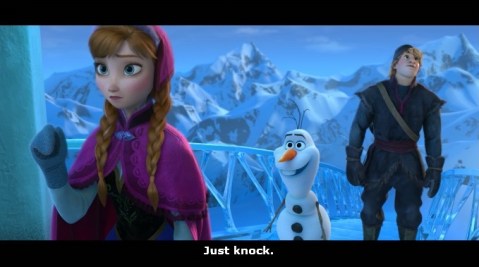
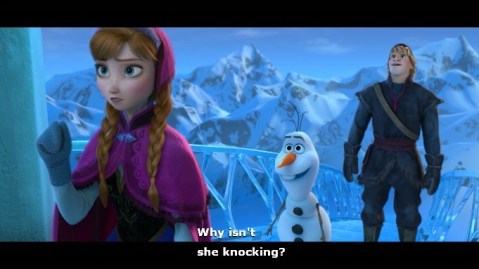
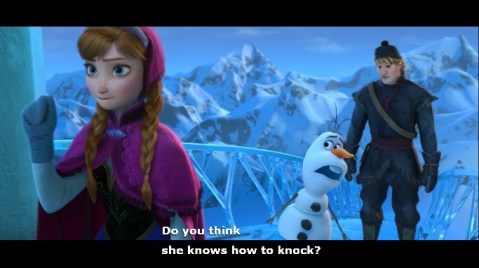
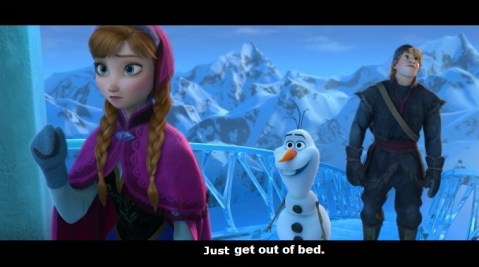
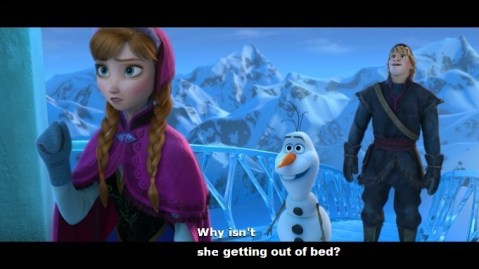
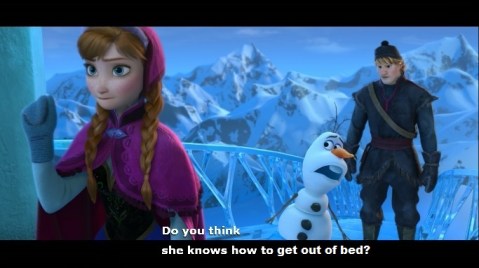
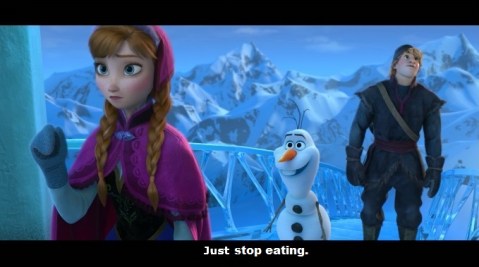
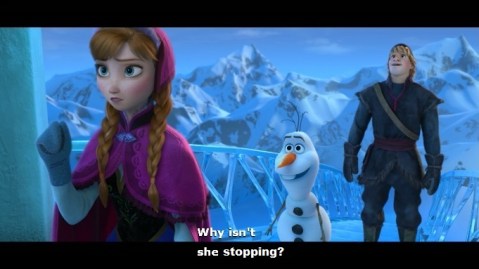
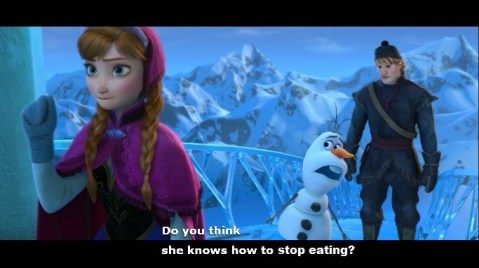
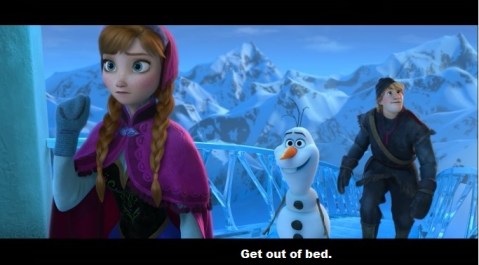
So on my “off day,” I was feeling depressedI was stress-eating and I couldn’t stop myself.  And that’s when it hit me: There is a scene in Frozen that perfectly encapsulates the nature of depression.  It’s a fairly innocuous scene in context, with throwaway humor from the comic relief snowman.  Take a look:
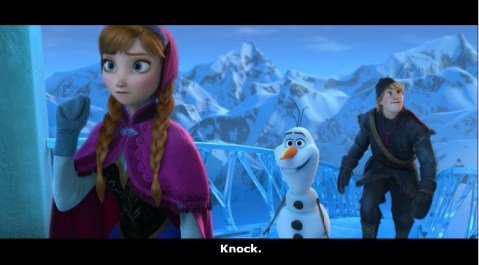
Frozen 1

Frozen 2

Frozen 3

Frozen 4

Look at the hesitation on Anna’s face, and the confusion on Olaf’s.  It’s such a simple task.  Olaf can’t understand what on Earth would prevent Anna from being able to knock on a door.  Now comes the frustrating truth:
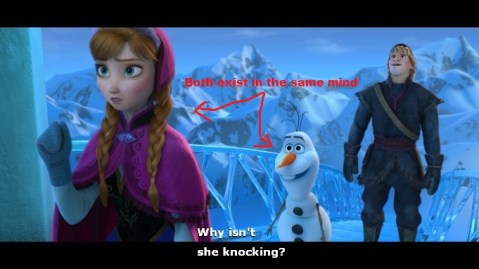
The Frustrating Truth

These two characters do not represent two different minds.  Both of them exist in the same mind.  Anna’s hesitation and Olaf’s confusion exist together.  There’s a third character on screen, but you can ignore him.
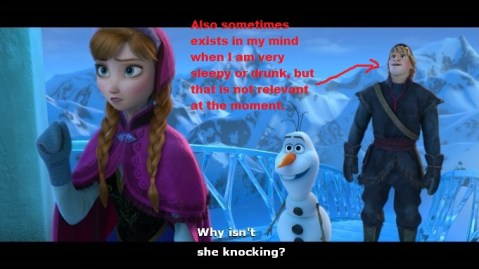
Not Relevant

Look at this scene with different wording.  When I’m depressed, getting out of bed suddenly becomes a herculean effort.
Depression 1

Depression 2

Depression 3

Depression 4

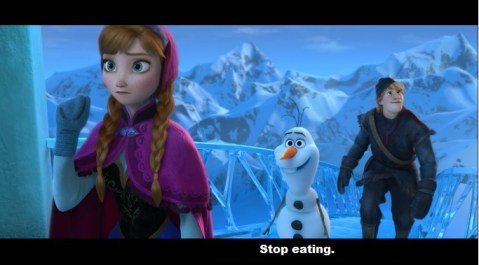
That’s my brain.  Right there.  Depression in a nutshell.  Oh yeah, and my stress-eating, too.  It’s the exact same thing.
Depression 5

Depression 6

Depression 7

Depression 8

That’s what it feels like.

I want to say for the record that I am fine now.  I had one bad day in a sea of good ones.  I didn’t write (and then rewrite) this post just to make non-depressed people feel bad, or to make depressed people feel worse, or to make my family and friends worry.  All I wanted to do was jump on the Explaining Mental Health Issues Bandwagon.  Raising awareness is important.  For those with depression, this might seem obvious and familiar.  For those without it, maybe I’ve shed some light on the condition.  There’s nothing much else for me to say, except of course:

It gets better!

If you have depression, do not suffer in silence.  You owe yourself a chance at getting better, and remember that, thanks to the internet, the world is your support group.  There’s help out there.  There are people out there who understand what you’re going through.  Remember not to berate yourself when you can’t knock on the door.  Olaf will get through to you eventually.  Take it at your own pace.

That’s all I’ve got!
We're-Okay

1 Comment

Filed under Animation, Humor, psychology, writing

Defining a Genre

If you’ve been keeping up with my last few posts, you’ll know that I’ve been working on revising a book entitled Grotesque.  This book has been with me since 2012.  It has come so far since its first draft, but it’s not quite ready to be sent out to editors.  Why?  Because, as my agent, her interns, and I discussed, the book was hovering in an uncomfortable space between two genres.  It had adult themes and characters, but still read like a Young Adult novel.  In order to revise it, I had to take a step back and ask why the narrative voice wasn’t working, why it still sounded like it was aimed at teenagers.

Through extensive discussions with my husband, my best friends, and my siblings, I discovered that I was never going to be able to revise the current draft of the book to read more “adult.”  Why?  Because the content, structure, and plot of the novel were always going to be too YA.  No amount of aging up the narrative voice was going to change that.  At best I could have ended up with a YA novel that read with an incongruously adult voice.

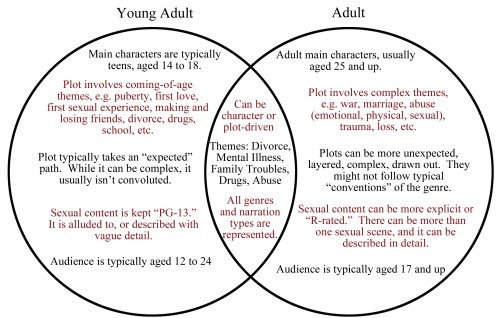
This is how I decided to address the problem:  I gutted the book.  Took out the YA content and upped the ante.  I’m expanding the world, going into more details with regards to history and characters, raising the stakes.  And it’s working, though I’m only a few pages into the new draft.  My purpose for writing this post was to offer a quick, easy glimpse at the difference between a YA novel and a plain ol’ adult novel.  Here’s a handy Venn diagram:

Venn Diagram

You’ll note that I use a lot of words like “typically” and “usually.”  Why?  Anyone who knows me knows I hate blanket statements.  Obviously each genre has its own conventions – otherwise it wouldn’t be a genre – but there are exceptions to every rule.  The Elegance of the Hedgehog is a book that I would classify as “Adult” but one of the main characters is a twelve-year-old girl.  Similarly, Sarah Dessen has written a Young Adult novel about relationship abuse, which might be considered by some as an “adult” theme.  As for audience, there’s no set age-limit.  Adults read YA all the time.  Younger readers can find adult novels that they enjoy, or they might be exposed to adult novels through school.  I read Cold Mountain when I was thirteen years old (Summer reading assignment), and believe me that book is not YA.  It’s the Odyssey of Vaginas and it made me supremely uncomfortable.

The point I’m trying to make here is that Grotesque had elements of both genres.  Oftentimes it comes down to the way a story is approached.  You’ll note in the middle section of the diagram that there are several themes mentioned that could belong to either side.  The difference is that an adult novel will approach a theme of sexual abuse differently than a Young Adult novel.  I don’t know why I always capitalize Young Adult, but not adult.  Just go with it.

With that in mind, I began rethinking GrotesqueGrotesque deals with a main character who has only been alive for a few weeks, yet his body is that of an adult… monster.  He’s an adult monster.  His love interest is an adult with a child of her own.  Interestingly, a common theme in YA is the transition from childhood to adulthood.  This theme is present in Grotesque, but in a different way.  Again, it’s all about how the content is approached.  The statue that comes to life starts out with the mind of a child, but he is exposed to the horrors of the world, and that causes him to age rapidly.  He is overwhelmed by the complexity of life, the gray areas of morality, etc.  These are adult quandaries.  And so that is the direction I am taking.  I am going all in with this.  We’ll see how it turns out.

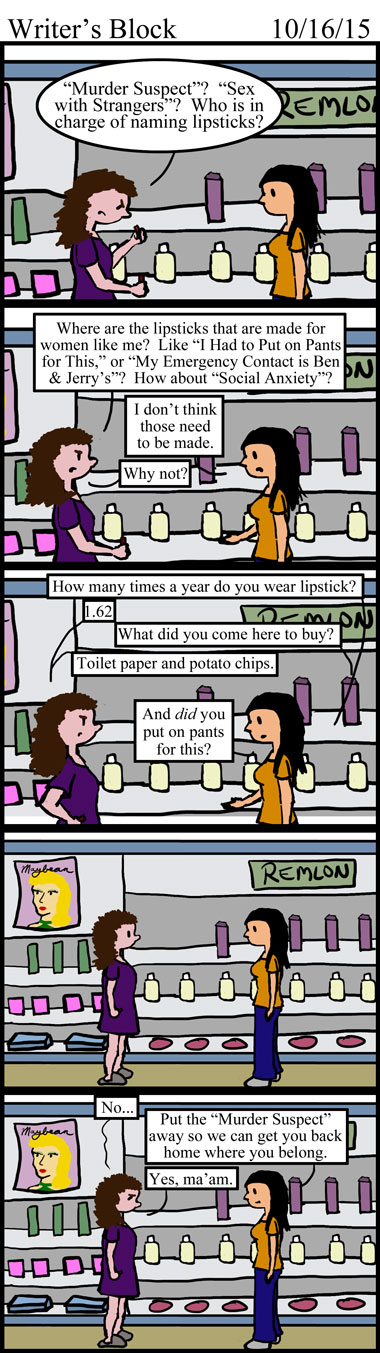
Can you believe I did a comic?  It’s been forever, right?  Enjoy!

Writer's-Block-Strip-45

1 Comment

Filed under books, Comic, Humor, writing

It’s Alive!

A few weeks back I met with my agent and her interns to discuss my book, Grotesque.  One of those interns told me that the manuscript reminded her of Mary Shelley’s Frankenstein, and suggested I read it for inspiration.

So I did.

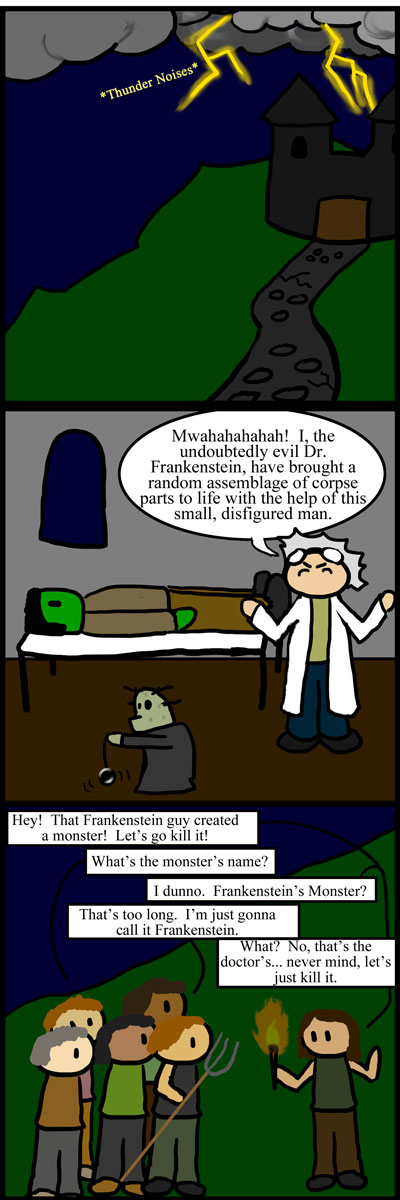
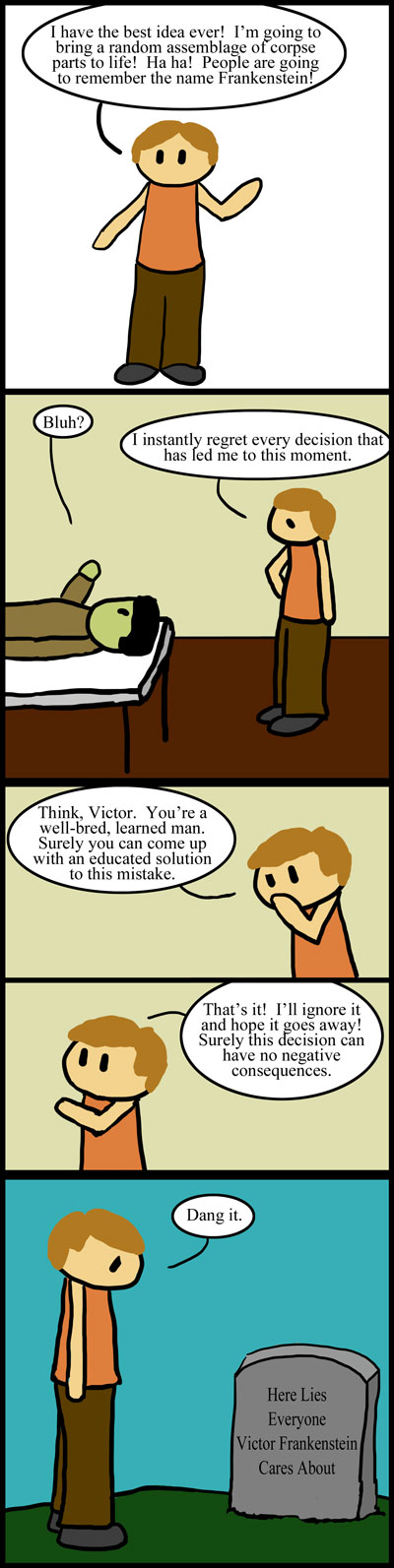
Boy, let me tell you, I was way off base about how this book was going to play out.  Turns out the various movies about Frankenstein and his monster may have exaggerated certain details.  As a result, this was what I thought the plot of Frankenstein was:

Wrong-Frankenstein

And here I thought Mel Brooks’ interpretation of the classic tale was super accurate!  (If you haven’t seen Young Frankenstein, you’re missing out).  But no.  As it turns out, the plot of Frankenstein actually goes something like this:

Frankenstein

That being said, what did I think of the book?  Well, it definitely resonated with me.  The subject matter Shelley touches upon is exactly what I want to do with Grotesque.  In a slightly different way.  I mean, my book has just a little bit more action, for starters.  Plus, a happier ending (spoiler alert).  But the themes are all there – loneliness, playing God, desperation for approval and acceptance, the juxtaposition of a humane(ish) monster and monstrous humanity.  It was a really interesting and inspiring read, and I have to thank the intern who recommended it to me.

Shelley also has a way with words.  I particularly enjoyed this sentence:

“I never beheld any thing so utterly destroyed.”

It’s beautiful, isn’t it?  I can’t begin to describe the impact those words had on me, especially within the context of the book.  They are perfect in their simplicity, yet they say so much more than you’d expect.  “Utterly destroyed.”  It’s almost foreshadowing, too.  The way so many lives are so utterly destroyed over the course of the book, including those of the creator and the created.

I also underlined a couple vocabulary words I love.  “Indefatigable” and “Purloined.”  Those are great words, aren’t they?  The former means “incapable of being tired out,” and the latter basically means “stole” or “pilfered.”

I’ll wrap up with a line I marked that pretty much sums up everything I want to encapsulate with the character of my Grotesque.  It was spoken by Frankenstein’s monster.

“Life, although it may only be an accumulation of anguish, is dear to me, and I will defend it.”

Such beautiful words coming from such a horrid creature.  Shelley really could use words as an art form in a way that I can only hope to accidentally achieve from time to time.

Now all that’s left is to take what I have learned from this book and apply it to my newest rewrite of Grotesque.

Wish me luck!

1 Comment

Filed under books, Comic, Humor, writing