
So here I am again. I’m preparing to go back to Los Angeles after a wonderful semester abroad, and I’ve decided to take time out of my busy (read: not at all busy) schedule to blog.
Today’s post is all about the nuances of dialogue. I have this motto/saying/whatever that I came up with a while ago. It goes like this: Writing is the easiest, safest way to play God. And it’s true. Not only do you create entire worlds, populate those worlds, and control the course of events, but you also put words directly into people’s mouths. The best part is that there’s absolutely no pressure. If you screw up, or kill somebody, or end the world, you’re not disappointing anybody. Your characters aren’t exactly going to rebel. But if you want any real-life readers, you’re going to have to be a pretty competent deity. No pressure or anything.
Dialogue is a sensitive topic. You’re given this power to dictate what each and every character is going to say, but at the same time, you have to be aware that we can never predict what people are going to say in real life. Dialogue at its best will never go beyond mimicking real life really, really well. And that’s fine. If your dialogue didn’t take a little literary license well then…it wouldn’t be literary. It’s still easy to mess up, though. Trust me. I have experience. Ever written a character of the opposite sex? Ever caught yourself writing that character’s dialogue like he/she is the same sex as you? I have. Being female, I found it really hard to get into the male mindset. Especially when I was a thirteen-year-old girl writing a teenage boy. He was constantly being emasculated when he spoke, and I didn’t even realize it.
There are other errors you can make, too. When one character says something, the other character’s response has to be appropriate. I know this seems like it’s obvious, but it is really difficult to get right sometimes. Below is an example of an “inappropriate” response.
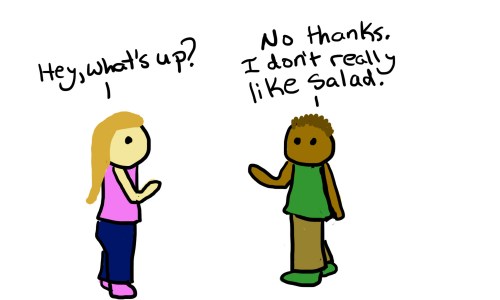
The only way this conversation could be made appropriate would be if you created a scenario to fit it. For example, the guy could have misheard her. Or he could be desperately trying to avoid her. Any number of things could make it work, but on its own without any context, it doesn’t. This is, as usual, an extreme example. But when you’re reading through your sections of dialogue, you really do have to ask yourself if the conversation feels real. This is when that whole “Listen to your gut” thing comes in handy. If something doesn’t feel right about the conversation, then something’s probably not right.
Usually, when I have a problem with inappropriate responses, it’s because I’m trying to rush the conversation. I know where I want the characters to end up, and it’s going to be far more interesting than this conversation, so I just kind of…push it a bit. And it ends up reading something like this:
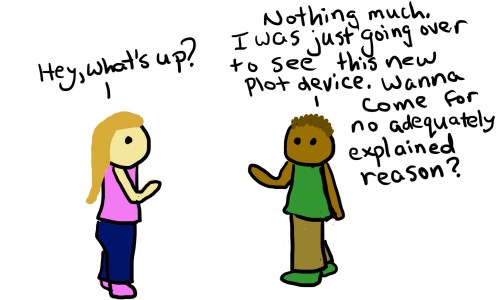
Then I have to go back and slow things down a bit, make sure their conversation reaches A, B, and C before they get to D. Then there are dialogue tags. Now those are a bitch to get right. I really hate them. If left unchecked, you can have a conversation that goes like this:
“Hey, I’m drinking some coffee,” she said.
“I noticed that,” he said.
“I like pointing out the obvious,” she said.
“I am going to leave this room now,” he said.
Note the overabundance of he said/she said. Breaking up dialogue tags so that you don’t have too much repetition can get tough. Usually, if it’s just a conversation between two people, you can just drop the tags altogether like so:
“Hey, I’m drinking some coffee,” she said.
“I noticed that,” he said.
“I like pointing out the obvious.”
“I am going to leave this room now.”
Or, if you like, you could switch things up a bit:
“Hey, I’m drinking some coffee,” she said.
“I noticed that,” he muttered.
“I like pointing out the obvious!” she shouted.
“I am going to leave this room now,” he whispered, eyes darting towards the door.
But this is all pointing out the obvious, which is why I didn’t spend too much time on it. I know this post is long, but I want to say one more thing: Often, when writing dialogue, I get into this groove where the conversation flows, feels real, and takes the right amount of time. The problem is that when I get into that groove, I don’t stop to switch perspectives based on who’s talking. In other words, it’s like I’m writing a conversation between myself and myself, where everything that’s said is what I would say. So, my final note is: Not only do you have to make the dialogue appropriate, but you have to make it appropriate to each character, too. “Hey, what’s up?” Sure, someone could say that. Hell, people have said that. They’re probably saying it right now. But would the Queen of MadeUpLand say that? Maybe not. Just something to think about.
Word of the Day: Diatribe (n) – a bitter, sharply abusive denunciation, attack, or criticism

 Potato Lady Blogs