Tag Archives: Books

The Pinch and the Ouch

Hello!  Happy New Year!  2012 is gonna be great.  I just know it.  I made you all a Happy New Year cake, too!
What?  You didn’t eat the last one.  I didn’t want it to go to waste.

Now that that’s out of the way, I want to talk about two things today.  First, I will finish up my spiel about Chekhov’s Gun by doing a magic trick.  I am going to turn Chekhov’s gun into a fish, right before your very eyes!  And not just any fish.  A red fish.  Presto Magic-Wordo!  Chekhov’s Gun is now a Red Herring!
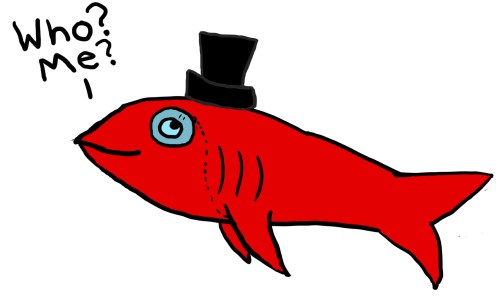
See, the thing about Chekhov’s Gun is that you have to make everything count.  Stuff has to be there for a reason.  At first glance, the Red Herring doesn’t seem to fit that description.  It’s not there for any reason.  It’s just a distraction.  But that’s just it.  Its purpose is the distraction.  For those who don’t know, a Red Herring is a term that refers to something in a story that appears significant, but isn’t at all.  The point of it is usually to distract the characters and the reader/viewer from the stuff that really is relevant.  It’s a common plot device, and it does add a lot to the story in its own way.  So the herring is a gun, it’s just a gun that’s never fired.  You can spend the whole play/movie/book/story thinking that the gun is going to be fired, only to find that the main character murders someone with a kitchen knife instead.  Like, Fred could be robbing Marco, and he could place himself in front of the gun on the mantle thinking that it was Marco’s only form of defense.  Then won’t Fred be surprised when Marco pulls his pocket-machete out and kills him!  The gun never got fired but it was really important!  See?  See?  I hope you do, because I don’t think I can spend any more time explaining this.

On to the next topic!  I was thinking the other day about something my high school theater teacher taught me.  She always said that in acting, the pinch has to justify the ouch.  Meaning if someone walks up and pinches you, and you say (without irony) “Oh God!  It hurts so much!  Someone please help me!  Call an ambulance!  I don’t think I’m going to make it!” then your “ouch” isn’t justified.  Turn that pinch into a gunshot wound, however, and the “ouch” is justified.  In short, you have to make sure the reactions make sense.  This applies to more than just acting.  It can also pertain to dialogue, action, and narration in a story.  Like so:
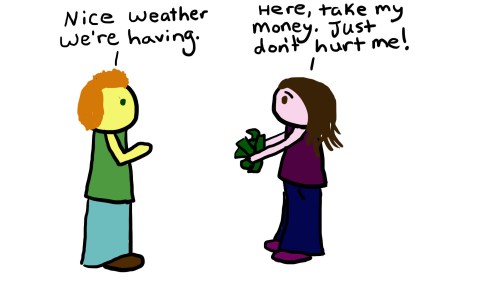
Little does he know, that’s not a wad of cash I’m holding.  It’s a head of lettuce.

But the reason I’m pointing this out isn’t because I think people are making errors like the one above.  I’ve said before that sometimes I’ll rush scenes or dialogue in order to get to some important information, and this can often lead to some “ouches” that aren’t justified by the pinch.  Take this example:
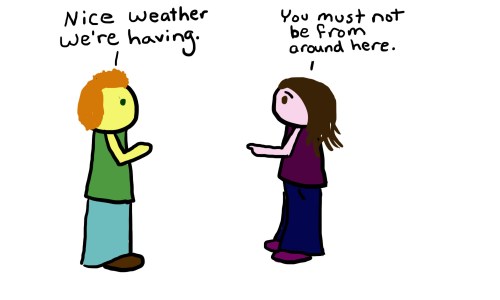
My reaction isn’t that extreme anymore, but it still isn’t quite right.  A step or two is missing in this conversation.  Now it’s perfectly understandable to want to point out that a character is new around town.  Maybe the guy up there is your Neophyte.  (Remember my post about that?)  But jumping straight from talk about the weather to “Hey, you’re new” isn’t the way to go.  My response still isn’t justified.

The response, justified or otherwise, doesn’t have to come in the form of speech either.  If I’d said nothing in the above situation, or slapped the guy across the face, those reactions would have been just as weird.  So if you want them to get by, then sometimes you have to justify them with narration, which is perfectly okay.  Like, maybe he was saying one thing, and I was thinking that I’d never seen him around town before, and we both spoke at the same time.  Or I’m just an incredibly awkward human being.  Basically what I’m saying is that you should think about your story as a set of dominoes.  It’s a string of causes and effects that should flow along smoothly.  Unless (because there’s always an “unless”) your story is meant to be disjointed or disorienting or something like that.  That is all!

Word of the Day: Spiel (n) – a usually high-flown talk or speech, especially for the purpose of luring people to a movie, a sale, etc.; pitch
Leave a comment

Filed under books, Humor, writing

Chekhov’s Gun

Well, by the time I post this, it will be the 24th.  And you know what that means!  (Hint: I’m not referring to Christmas)

That’s right!  It’s my birthday!  I’ve turned twenty-one!  Yaaay!  Happy birthday to me!

I will say merry Christmas, too.  And happy Chanukah to my fellow Jews!  But this post is not about the holidays, or my really inconveniently timed birthday.  No, I’ve actually got more literary things to say, and as you may have gleaned from the title of this post, it is about Chekhov’s gun.

Anton Chekhov wrote lots of stuff like short stories and plays and things.  If you haven’t heard of him, you should probably look him up.  He’s relevant to this post because of this thing he once said about writing plays.  Quoth the Chekhov: “If in the first act you have hung a pistol on the wall, then in the following one it should be fired.  Otherwise don’t put it there.”  I remember a different variation, which I guess he never said, but I like to tell it like this: If you put a shotgun on the mantle in the first act, it better have gone off by Act III.  I don’t know where I got the shotgun from if he was talking about a pistol.  I guess it just sounds more purposeful or something.

Anyway, this quote pertains to more than just plays.  It can apply to movies and books, too.  Since we’re more interested in the latter, I’m going to focus on that one.  This concept is all about the world you create.  The thing about writing books, movies, and plays is that, unlike in real life, you get to choose each and every person, place, and thing that shows up in the story.  So, by that logic, if you’re going to choose to put it there, it has to have a purpose.  Otherwise why would you put it there in the first place?  It could just as easily have been left out.  That’s the shotgun/pistol/grenade launcher on the mantle.  If you put it there, use it.

Earlier in this blog, I offered a couple literary exercises.  I would like to add this one: Write a story that contains a “Chekhov’s gun,” so to speak.  Put in some seemingly innocuous object towards the beginning that ends up being really important or relevant at the end.  The point is to make its relevance a surprise (though it doesn’t always have to be).  Then have other people read it and ask them if they predicted what that “gun” was going to be used for.  Obviously for this exercise to work, you can’t tell people ahead of time what you’re doing.

The reason I’m talking about this is…no, scratch that.  There are two reasons I’m talking about this.  One: I get so many of my ideas by accident through this Chekhov’s gun method.  I don’t even try to do it.  I just mention something in passing and then realize later that it would fit perfectly into the plot for such and such reason.  And soon after that, I realize that it’s a good thing I thought of a point for that thing, otherwise I would have had to take it out.  And the reason for that is that readers/audiences know, at some base level, all about Chekhov’s gun.  If they see something or hear something get mentioned, they are likely going to expect to see it come up again.  So if it doesn’t ever come back, that might leave the writer open to criticism.  For an example of one of the times this situation has snuck up on me in my writing…I once had two characters talk about Character Two’s older brother having a job interview.  It was really just to make them seem more human by having them converse about everyday things, but later the job interview became a plot point.  Who knew?  Certainly not me.  Now for an example of the failure to bring something back.  Unfortunately, this means I have to admit to seeing Real Steel.  You know…Rock ’em Sock ’em Robots the Movie?  With Hugh Jackman?  Yeah, I was bored that day.  Anyway, (no spoilers here, not that you care) the kid finds a robot and at some point realizes that the robot “understands” him.  As in it’s sentient.  And that just…doesn’t go anywhere.  I kept waiting for it to be relevant somehow and it never really came back.  The robot was just a robot…that punched other robots.  So that was bad.  Not that the movie was very good to begin with, but still.

The second reason I brought up Chekhov’s gun is this: I think it works in reverse, too.  In this case it would be, “If at the end of the book your character fires a shotgun, the gun better have been mentioned at least once before.”  I came to this conclusion a few days ago when I was writing Grotesque.  I’m almost at the end of it now, and I realized I was missing some key element that would tie everything together.  But it was a really little thing, not something I cared very much about.  I just needed an ingredient.  Literally.  I needed an ingredient for a magical potion.  And I came up with some leaves and decided to bring them up and be like “Look!  These are the leaves! The ones that we had but now he has them and we need them back and oh God he can’t be allowed to use them because that would spell disaster for us!”  (You get extra brownie points if you were able to follow that)  But then I realized I was doing a lot of exposition to explain these leaves and it was so close to the end of the book that it didn’t feel right.  It felt like I was throwing them in at the last second, and they started to get more significant than I’d originally intended them to be.  Which meant that I had to go back through the book and mention them earlier, do the exposition earlier, so that my readers wouldn’t feel like I just threw this thing at them out of nowhere.  As in, “This exists now!  I am the author and I say it exists so it does!  Just go with it, man.”  And that’s how I came to understand the reverse of Chekhov’s Gun.  This post has gone on way too long and there haven’t even been any cartoons to break up the wordiness.  I am sorry for that.  I feel like I want to talk more about this, but I’ll save it for another post.  Until then, enjoy your holidays!  And to anyone else out there who shares my Christmas Eve Birthday, Happy Birthday to you!

Word of the Day: Chekhovian (adj) – of, pertaining to, or characteristic of Anton Chekhov or his writings, especially as they are evocative of a mood of introspection and frustration.

P.S. I just realized that the leaves thing is doubly relevant to this post.  Yes, it was the reverse of Chekhov’s gun, but there was also this point earlier in the story when I had someone mention that they were going to try to find some edible plants, and then he never found any or brought up his search or anything.  Which is an example of mentioning something and then failing to bring it up again.  So then I decided to fix that problem by going back and adding the super special leaves in to that scene, thus killing two birds with one stone, and it worked out perfectly which is so amazing because I never even predicted it would happen that way.  I mean, I didn’t even know those leaves existed until long after I’d written that scene.  It’s cool how writing works, huh?  Ok, good-bye for real this time.

Leave a comment

Filed under books, writing

He Said/She Said

So here I am again.  I’m preparing to go back to Los Angeles after a wonderful semester abroad, and I’ve decided to take time out of my busy (read: not at all busy) schedule to blog.

Today’s post is all about the nuances of dialogue.  I have this motto/saying/whatever that I came up with a while ago.  It goes like this: Writing is the easiest, safest way to play God.  And it’s true.  Not only do you create entire worlds, populate those worlds, and control the course of events, but you also put words directly into people’s mouths.  The best part is that there’s absolutely no pressure.  If you screw up, or kill somebody, or end the world, you’re not disappointing anybody.  Your characters aren’t exactly going to rebel.  But if you want any real-life readers, you’re going to have to be a pretty competent deity.  No pressure or anything.

Dialogue is a sensitive topic.  You’re given this power to dictate what each and every character is going to say, but at the same time, you have to be aware that we can never predict what people are going to say in real life.  Dialogue at its best will never go beyond mimicking real life really, really well.  And that’s fine.  If your dialogue didn’t take a little literary license well then…it wouldn’t be literary.  It’s still easy to mess up, though.  Trust me.  I have experience.  Ever written a character of the opposite sex?  Ever caught yourself writing that character’s dialogue like he/she is the same sex as you?  I have.  Being female, I found it really hard to get into the male mindset.  Especially when I was a thirteen-year-old girl writing a teenage boy.  He was constantly being emasculated when he spoke, and I didn’t even realize it.

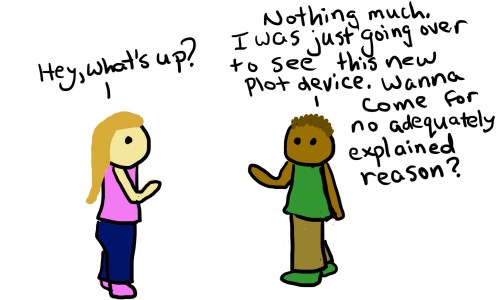
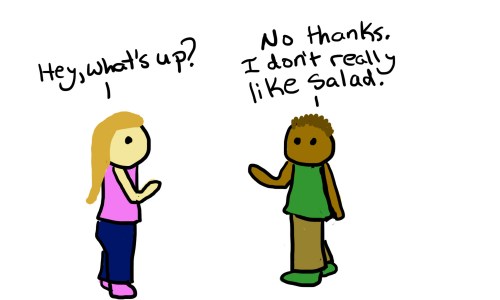
There are other errors you can make, too.  When one character says something, the other character’s response has to be appropriate.  I know this seems like it’s obvious, but it is really difficult to get right sometimes.  Below is an example of an “inappropriate” response.

The only way this conversation could be made appropriate would be if you created a scenario to fit it.  For example, the guy could have misheard her.  Or he could be desperately trying to avoid her.  Any number of things could make it work, but on its own without any context, it doesn’t.  This is, as usual, an extreme example.  But when you’re reading through your sections of dialogue, you really do have to ask yourself if the conversation feels real.  This is when that whole “Listen to your gut” thing comes in handy.  If something doesn’t feel right about the conversation, then something’s probably not right.

Usually, when I have a problem with inappropriate responses, it’s because I’m trying to rush the conversation.  I know where I want the characters to end up, and it’s going to be far more interesting than this conversation, so I just kind of…push it a bit.  And it ends up reading something like this:

Then I have to go back and slow things down a bit, make sure their conversation reaches A, B, and C before they get to D.  Then there are dialogue tags.  Now those are a bitch to get right.  I really hate them.  If left unchecked, you can have a conversation that goes like this:

“Hey, I’m drinking some coffee,” she said.

“I noticed that,” he said.

“I like pointing out the obvious,” she said.

“I am going to leave this room now,” he said.

Note the overabundance of he said/she said.  Breaking up dialogue tags so that you don’t have too much repetition can get tough.  Usually, if it’s just a conversation between two people, you can just drop the tags altogether like so:

“Hey, I’m drinking some coffee,” she said.

“I noticed that,” he said.

“I like pointing out the obvious.”

“I am going to leave this room now.”

Or, if you like, you could switch things up a bit:

“Hey, I’m drinking some coffee,” she said.

“I noticed that,” he muttered.

“I like pointing out the obvious!” she shouted.

“I am going to leave this room now,” he whispered, eyes darting towards the door.

But this is all pointing out the obvious, which is why I didn’t spend too much time on it.  I know this post is long, but I want to say one more thing:  Often, when writing dialogue, I get into this groove where the conversation flows, feels real, and takes the right amount of time.  The problem is that when I get into that groove, I don’t stop to switch perspectives based on who’s talking.  In other words, it’s like I’m writing a conversation between myself and myself, where everything that’s said is what I would say.  So, my final note is: Not only do you have to make the dialogue appropriate, but you have to make it appropriate to each character, too.  “Hey, what’s up?” Sure, someone could say that.  Hell, people have said that.  They’re probably saying it right now.  But would the Queen of MadeUpLand say that?  Maybe not.  Just something to think about.

Word of the Day: Diatribe (n) – a bitter, sharply abusive denunciation, attack, or criticism

Leave a comment

Filed under books, Grammar, writing