Tag Archives: character development

Character Squiggle

As you may know, I occasionally like to go back through my blog to freshen up on the topics I’ve covered and keep an eye out for typos.  Sometimes when I do this I realize I was an absolute nut job when I first started this blog, and I find myself issuing apologies to make up for it.

Yes, I still feel awful about the juvenile writing and “advice” that I dished out in my first few posts.  But at least one good thing came out of it: I thought up a new post.  I’m going to revisit a topic I already “covered” way back when.  Even though I already sort of revisited that post already. 

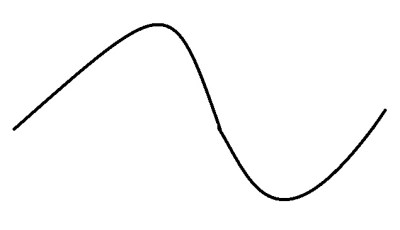
The topic is character development.  Or rather, the character arc.  See, when I think of an arc, this is what I imagine:
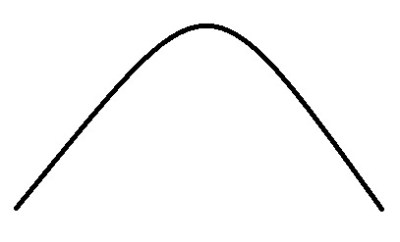
arc

But character arcs aren’t that simple, because characters aren’t simple.  That got me to thinking about the different forms or “shapes” that character arcs can take that regular arcs won’t.  They can look like this:
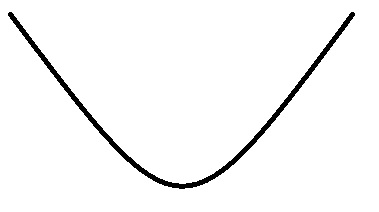
Upside Down Arc

Or even this:

Squiggle Arc

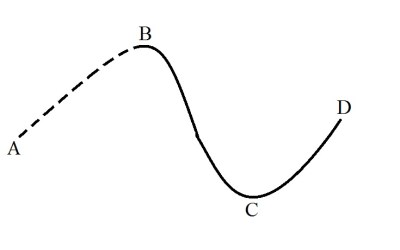
This isn’t an arc in the traditional, mathematical sense, but it can be one in the literary sense.  I shall show you what I mean, because that is what I do.  First I’m going to put some letters on it…
Squiggle Arc Labeled

Ok, so Point A is on a dotted line, which represents the part of the story that is not included in the book.  Instead, points A to B represent the character’s backstory that is intermittently revealed throughout the book.  This backstory represents a low point that climbs to a high.  So say our character is a rich CEO.  Points A to B would represent the part of his life when he started out in the mailroom and clawed his way to the top.  The book doesn’t start with him in the mailroom, but we get glimpses of that part of his life from time to time in the narration.

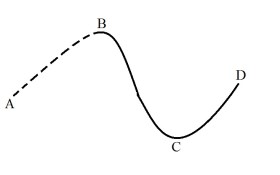
Moving on to Point B.  That’s where the story starts.  Rich McBoss is a CEO with swimming pools full of money.  He’s happy, he’s got a trophy wife and two spoiled kids, and he has about a thousand underlings at his beck and call.
Squiggle Arc Labeled

From points B to C, we get a good part of the plot.  Everything that goes up must come down, and our rich CEO finds his life spiraling out of control.  He makes some bad decisions, nearly goes to jail (or does go to jail?), drives his company into the ground, etc.  We’ve all seen this story before, yes?

C is the lowest point.  He has hit rock bottom, which means it is time to begin the process of healing and starting anew.  There’s nowhere to go but up.  Up to Point D.  Not as high as Point B, but higher than C.  This is where the story ends.  Rich has learned the error of his ways, cleaned up his act, and come out of the ruin a better man.  (I could get into the fact that putting D lower than B goes against the very lesson this character is learning, which is that being happy with little is a better place to be than being falsely happy with a great deal of excess.  Thus it could be argued that Point D should be higher than Point B.  But I won’t get into that.  Too time consuming.)

See?  Arc.  Looks like math, reads like a story.

Just so you know, a character arc implies that a character starts out one way and ends up another.  Rich McEveryman up there started out (in the book) as a rich CEO who had few scruples and lived in the lap of luxury, and ended up an honest man who was content with what little he had.

I remember when I was in high school, every year there would be a film assembly where a selection of student-made short films would play.  One assignment for the film students that year was to present a character arc – where a person started one way and ended up another.  A film started.  A homeless man was sitting by the side of the road “drinking” from a clearly closed bottle of “liquor.”  He collects some money from passersby, and then a car drives up and he hops right into the passenger seat.

“See?” he says to the driver.  “Told you I could be homeless for a day.”

This was not a character arc.  The student had taken the parameters literally – his character had started out one way, as a fake homeless man, and ended up a different way, as a guy who was admitting to pretending to be homeless.  The character himself had not changed or learned anything.  No arc had taken place.  All the film had depicted was a character straight line.  This is something you probably want to avoid, unless (because this “unless” always crops up) you are making a statement.

That’s it!

Comic!  (We’re back to clicking to enlarge)
Writer's-Block-Strip-27

Word of the Day: Scruple (n) – a moral or ethical consideration or standard that acts as a restraining force or inhibits certain actions.
Leave a comment

Filed under books, Comic, Humor, writing

Quirky, Idiosyncratic Nuances

This blog is chugging along at a nice pace, which means there are a lot of posts, and I’m going to be touching on a lot of the same ideas.  Because of this, I’ve decided to include links whenever I refer to something I’ve said in the past.  Obviously you don’t have to click them, but if you do want to check back and reread what I said so you know what I’m referring to, you’ll now be able to.

That being said, I’d like to refer back to my post about writing what you know.  I stand by what I said in that post, but I thought I’d expand a bit.  This time I want to talk about when it’s appropriate to write what you know.

Most often, when I find myself writing what I know, it is when I’m trying to make my characters seem human.  The one thing that you (hopefully) know better than your characters is how to be real, and sometimes you can use that to make them seem real, too.  What I usually do is take my own personal experiences with quirks, flaws, and traits, and I sprinkle those things throughout my stories.

For example, the first character I ever created, Shauna McKay, mentions once in her narration that she hates it when people tug on her hair.  This comes directly from me.  When I wear my hair in a ponytail, my dad often tugs on said ponytail, and I hate it.  It’s  just a thing about me that I can’t change, and other people probably wouldn’t mind it.  So I used my own personal pet peeve to give my character depth, because nothing will make a fictional character seem more human than having very real, human quirks.

And, yes, I do this a lot.  They’re not always my peeves or quirks, though.  Sometimes I use my friends’ or my siblings’.  Whatever comes to mind really.  Whatever fits.  Which is not to say that you can’t make up a quirk for your character.

It just so happens that the things that are inspired by real life have this great guarantee that they are absolutely true to real life.  Even if people think you made them up, you’ll know that those things could absolutely happen because they actually have.

Now here’s a question: How many monkeys can be found in the average zoo?  Here’s another question: What’s so important about giving your characters these little quirks?  Well, I kind of already said it.  The answer I’m going to give is that it makes your characters seem real.  It gives them depth.  It’s an added dimension to your story that people might not consciously look for, but when they see it, they might smile a little and think, I know someone who does that.  Or even, That’s so funny.  I do that all the time.  You yourself might have thought that at one point or another while reading a story.  And if that happens when someone is reading your work, then you get this wonderful thing where your reader begins to relate to your character, and the more they do that, the more invested they become in the story.  If your goal is to have your reader sympathize with your character(s) and become invested in your story, then giving your characters these extra traits can help accomplish that.  This all has to do with character development, something else I’ve talked about before.  I believe I called it a swirling vortex of doom.  These idiosyncrasies are part of that.

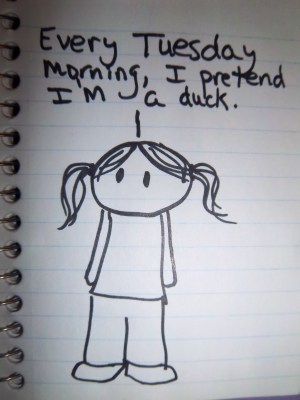
In conclusion, it’s okay to write what you know sometimes.  I do it often when I need to draw on my humanity to make my characters seem human.  I also make up things when I need to, things that are more believable than Duck Girl up there.  For example, Shauna also has a thing she does that I don’t do – she carries a sketch pad with her wherever she goes and draws people.  I made that up completely.   I don’t know anyone who does that, and, while I like drawing, I don’t do that either.  But Shauna does, and that makes her unique.  That’s all I wanted to say about that.  At least for now.

Word of the Day: Idiosyncrasy (n) – a characteristic, habit, mannerism, or the like that is peculiar to an individual

Leave a comment

Filed under books, Humor, writing

The Swirling Vortex of Doom (AKA Character Development)

Remember how I was talking about how very wrong I was in my first few posts?  [EDIT 3/13/21: These posts have since been unpublished due to being blatantly wrong and insulting.] Yeah, I remember now that there’s something else I wanted to clear up besides how sorry I am – What I wrote about character development.

My methods for getting to know your character?  Sound.  Good enough anyway.

My timeline for getting to know your character?  WRONG.  I made it seem like you had to know everything there is to know about your character before you even start your story!  No no no!  I don’t even think that’s possible.  Even if you have an absolutely super special intimate relationship with your character before you start writing, and you think you know all there is to know, I’m still pretty convinced that something about that character is going to change once you start writing.  And that’s the whole point!  It’s supposed to change!  If your writing isn’t teasing out more and more little things about your character that you didn’t even think about before you started, then maybe you’re not doing it right.  To illustrate this point (literally) I painstakingly drew my character development process for Serrafiel.

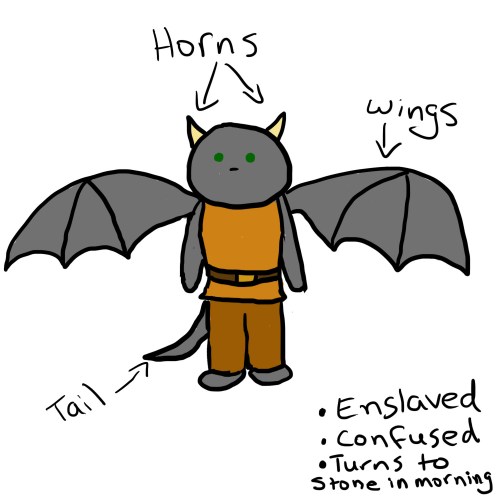
First, we have what I knew about the character before I started writing:

Yeah, that’s about it.  So I ask you: Does this look like a fully-developed character?  The answer is no.  So I had that, and then I started writing and, after a chapter or two, I got this:

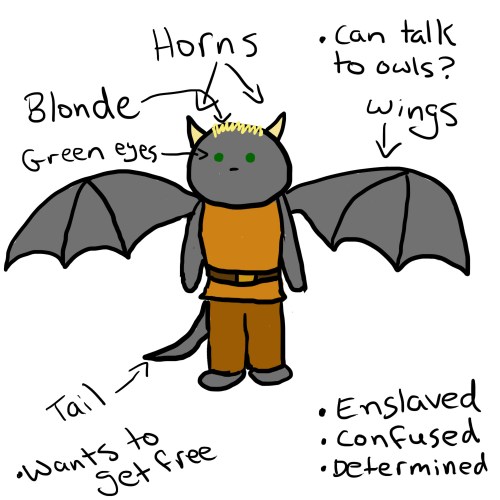
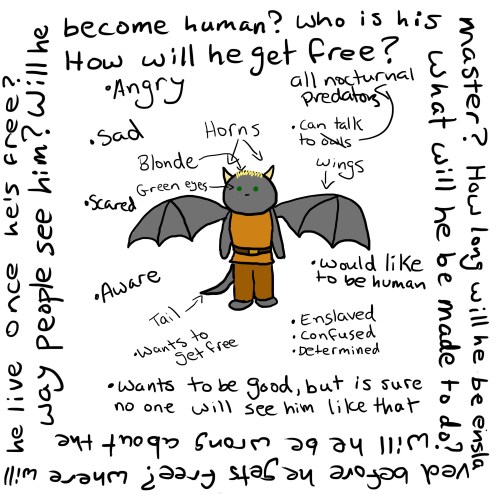
So there’s a little more.  He’s blonde now, and he has green eyes.  I didn’t know either of those things until I wrote about him looking at himself in the mirror for the first time.  And the talking to owls thing, yeah…decided that one on a whim.  It worked out really well once I got further in the book, which brings me to:

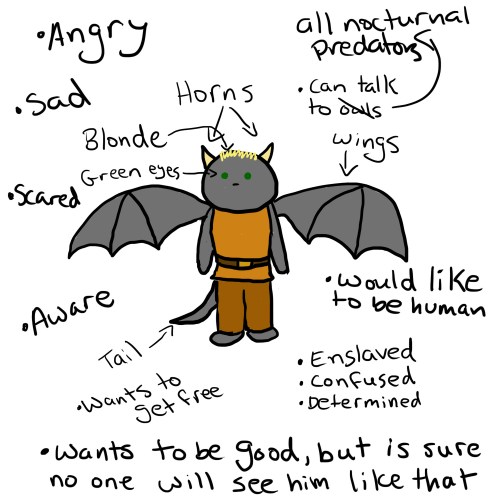
So now I’ve got a pretty well-rounded character.  By now, I’m really into the book, and I know a lot about him.  You may also notice that this picture has a lot more words in it than the first one.  But it’s also important to remember that all of these things I know about him are constantly framed by questions, things I don’t know yet.  So in the next picture, he’s literally framed by questions.

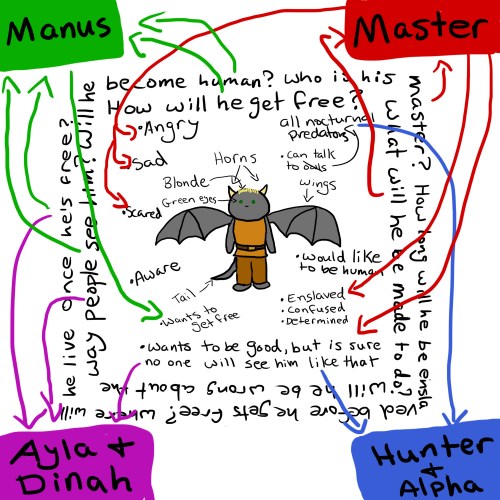
And then you have to remember that all of these questions and personality traits and feelings and words are often linked directly (or indirectly) to other characters in the book.  Which I have also drawn.

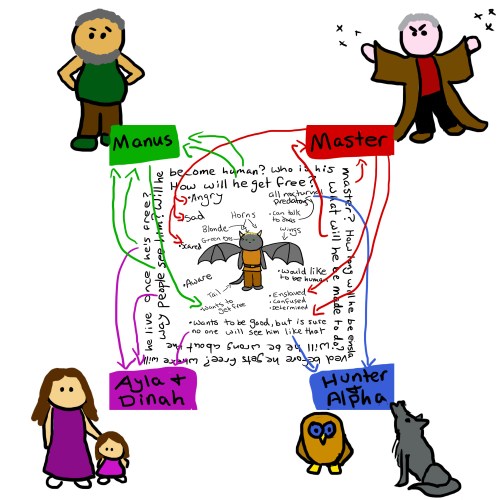
Believe it or not, there is some rhyme and reason to the direction of the arrows.  If a question is going to be answered by a character, then the arrow points to them.  If a character caused the question, or the feeling/emotion whatever, then the arrow points from that character to the corresponding word(s).  I mean, that’s not totally important.  This is just supposed to show how incredibly complicated character development is.  In other words, I’m trying to prove without a doubt that I was epically wrong the first time I talked about this.  Oh and we’re not done by the way.  Because you have to remember that all those colored blobs aren’t just blobs, they’re other characters.

And all of those other characters, plus any number of others, need their own swirling mass of words, arrows, and relationships.  They all need to be developed just like I developed Serrafiel.  (Don’t worry, I didn’t draw out their developments, too.  That was the last picture)

In conclusion, you should definitely get to know your character as well as you might know a sibling or close friend, but don’t be afraid to use your writing to help you develop that relationship.

Word of the Day: Nascent (adj) – beginning to exist or develop

2 Comments

Filed under books, writing