Tag Archives: comic

Am I Being Right or Stubborn: A Guide for Writers

I got my editorial letter! This is the second editorial letter I have received in my life, but I don’t remember if I talked about it or explained it back when Hellbound was almost close to almost being considered for publication. That version of events is too depressing to talk about anyway, so I thought I’d do a post about editorial letters that is positive and happy! But then I remembered John Green already did a great explanation of editorial letters about thirteen years ago on his YouTube channel.

(Speaking of YouTube, I have released two new videos since my last post.)

Everyone can help me thank John Green for saving me time by watching this video (don’t worry it’s short):

That being said, I wanted to explain the editorial process in broad terms real quick. You see, editing a book is an upside-down pyramid. It starts with broad strokes, big sweeping changes, and generalized feedback. Then it moves on (when your editor is satisfied that it can move on) to narrower, more focused changes.
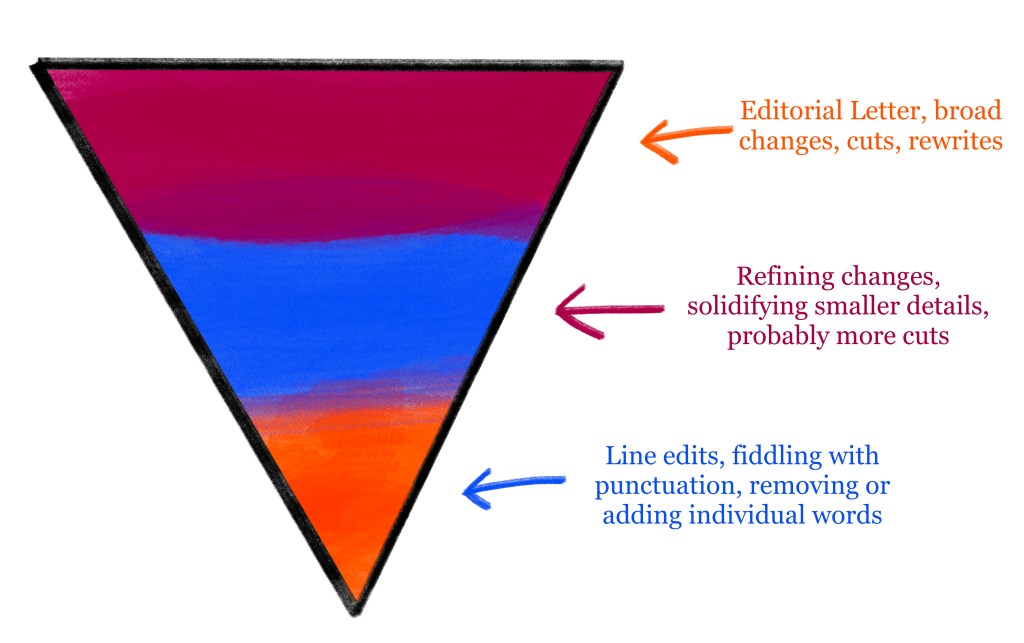
A lot of people imagine book editing as the editor getting out their red pen (or writing utensil of choice) and marking up the manuscript. But you can’t do that for the first edit because the markup would literally coat the text of the book itself. This would inevitably lead to a mental breakdown on the part of the author, and while we authors are quite familiar with the art of the mental breakdown, healthcare professionals do discourage having more than two or three a year. It takes a while to get down to the nitty-gritty of line edits down there at the point of the pyramid.

What’s really exciting for me is that I am only familiar with the top sections of the pyramid! I can’t express how much I am looking forward to discovering parts of the publishing process that I have not been through before. The thrill of the unknown! I just know that this thing is going to start feeling 1,000% more real once we start talking cover design, and I’ll be sure to update when I can so that you, dear reader, can follow along with me.

What I want to touch on real quick is an issue I’ve run into regarding the plot of my book. Falling for the Protagonist is a satirical novel, and therefore I felt that there was a certain amount of leeway I had vis-a-vis “explaining” the supernatural elements. In my mind, because it was satire, part of the point was that the magical stuff and the [REDADCTED TO AVOID SPOILERS] were not practically explained or reasonable at all. For me, that was funny. It fit the theme of the book, which is that romance novels typically bend over backwards to accomodate their happy and just worlds. The previous statement is not said with any kind of censure on my part; I read romance novels because they provide the comforting certainty of a happy and just ending.

But then literary agents started rejecting the manuscript because “there wasn’t enough explanation” of how/why the supernatural stuff happened. At first, I scoffed in an authoritative and haughty way. (I didn’t want you to miss that great pun back there, so I went ahead and emphasized it for you. You’re welcome!)
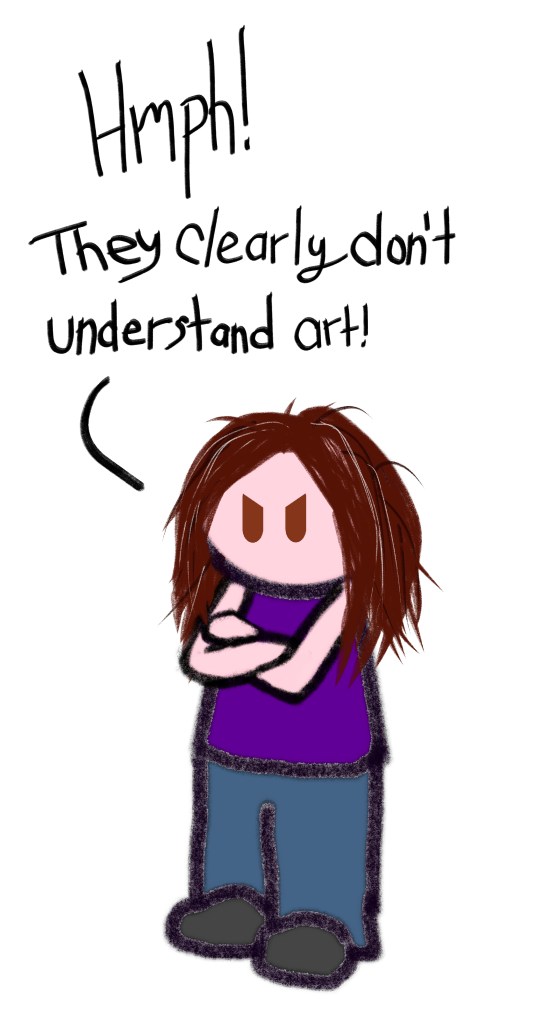
I changed my tune recently, however, when my lovely editor mentioned that we needed to work on better explaining the “rules,” and I was finally confronted with the fact that maybe it was time to kill my darling. In this case, I had to accept that what I thought of as a perfectly acceptable and on-brand element of the novel was clearly not hitting right when other people read it. A good rule of thumb: If some part of your vision isn’t translating well to readers (Even if it makes perfect sense to you!), it shouldn’t make it to the final draft.

The problem many writers run into when encountering other people’s suggestions is that it’s sometimes hard to know when to stand your ground, and when to accept that you need to make changes. Sometimes you get a lot of feedback, and some of it is contradictory. Which do you listen to, if any? If you push back, are you doing so because you are confident in your writing and your concept? Or are you accidentally (or purposefully; no judgement) being a stubborn artiste who refuses to back down?

As with all things creative, there is no single right answer. It’s one of the most frustrating things about being creative sometimes. Other times, it’s a gift. (For example, the fact that good art can be achieved in any number of different ways is freeing for those who want to explore unusual or unexpected artistic avenues.) For me, I have recently discovered that I should probably sit up and pay attention when multiple professionals in the industry are saying the same thing. It’s hard to keep claiming I’m in the right when literally no one agrees with me. Not even my inner goddess!
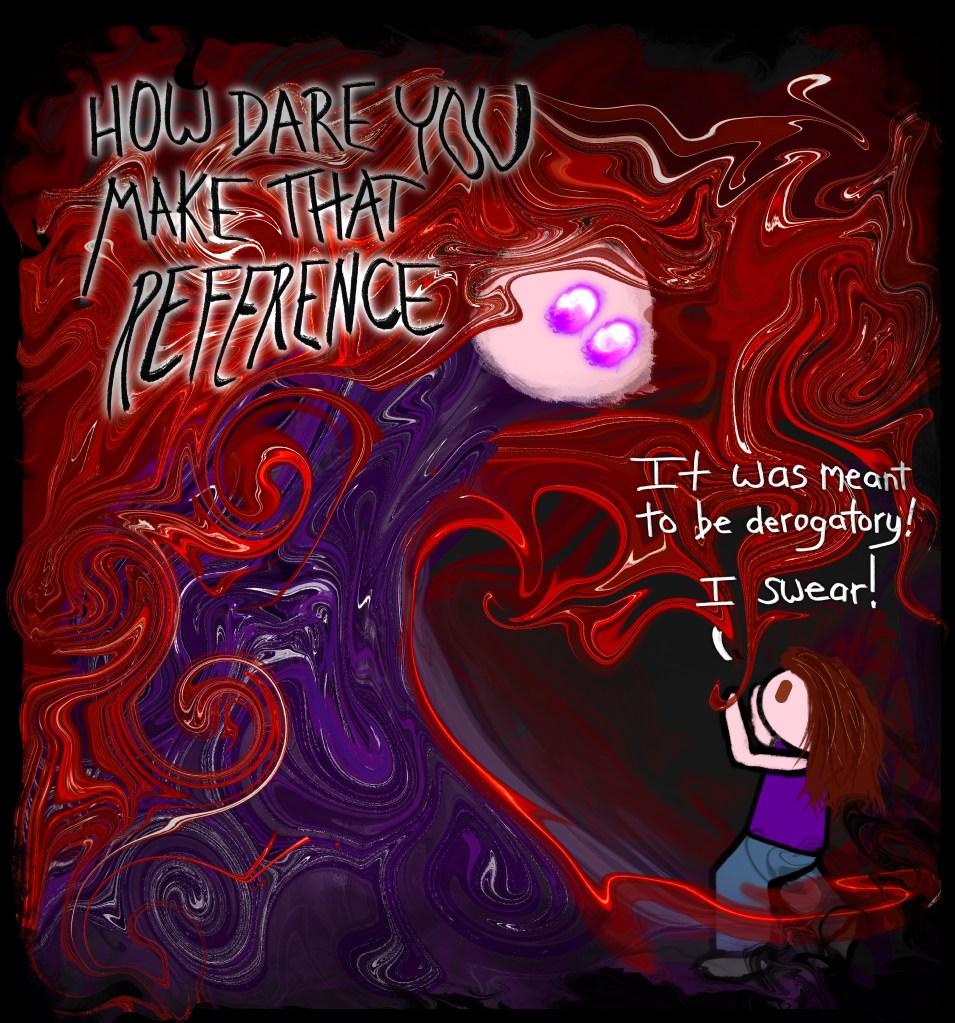
I typically go through some variation of the stages of grief when I have to change something that I was willing to defend for so long, but I have trained myself to get to the Acceptance stage pretty quickly.

In short (too late, I know), you don’t have to listen to everyone’s opinion, but if you get the same advice consistently from people with the credentials to back it up, it may be time to throw in the towel.

I will conclude on an optimistic note, which is unusual for me, but apt in this moment. If you are an aspiring writer, I want you to remember this: Many literary agents rejected my book because of this issue. They didn’t see the manuscript as worth representing because they couldn’t get past this obstacle. I sure did get discouraged! Looking back on it, I’m glad those rejections happened. Because the agent who decided that this plot issue wasn’t a deal-breaker for her is clearly the person I was meant to be working with. Same goes for my editor. My manuscript wound its way through the agencies and publishing companies until it found the right people for its needs. A lot of boilerplate rejections contain language along the lines of “it wasn’t a good fit.” It’s a trite phrase, but I’d like you to consider that it is also 100% truthful. You do not want someone representing you and your work if they didn’t feel that “click” when they read your manuscript.

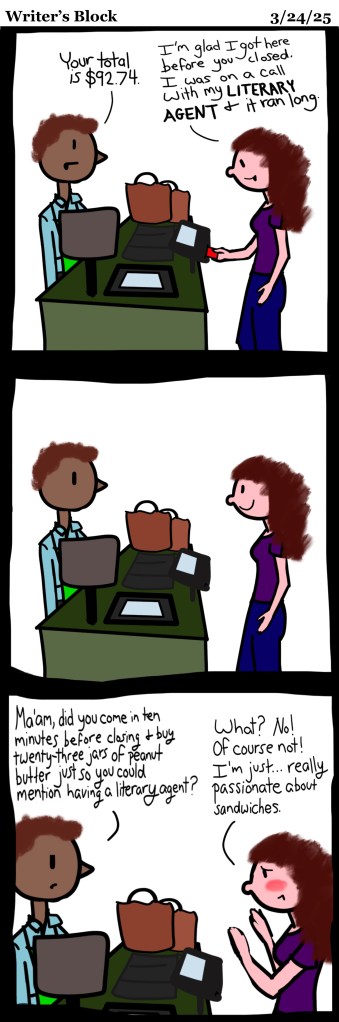
And, yes, I have been finding ways to work “I have an agent and/or editor” into everyday conversation as much as possible. I imagine I’ve become absolutely insufferable, but I just can’t help myself.
Leave a comment

Filed under books, publishing, writing

Words and Other Things

My best friend, Liz, and my best-friend-in-law, Martyn, loaned me a bunch of books the other day.  I just finished one of them.  House of Leaves by Mark Z. Danielewski is a book about a guy who finds a book written about a documentary that doesn’t exist, that features a house that doesn’t exist, that was filmed by a man who doesn’t exist.  House of Leaves is a work of fiction, so technically if you read it, you are reading a book about a guy who doesn’t exist, who finds a book that doesn’t exist, written about a documentary that doesn’t exist, which features a house that doesn’t exist, that was filmed by a man who doesn’t exist.

You should read it.  It’s pretty good.  But very intense.  Not for the young of heart or the young of age.  Ye be warned.

The next book is The Gargoyle, by Andrew Davidson.  I’m still working on it, but so far as I can tell it is about a porn star who gets into a terrible car crash after combining cocaine, bourbon, and driving.  The crash results in lots of fire burning him all over his body, and then he has a chat with a crazy lady while in the hospital.  The chat is the thing I wanted to quote here, because it made me giggle with disproportionate glee.

I indicated the little statue on the bedside table.  “I like the gargoyle.”

“Not a gargoyle.  It’s a grotesque.”

“You say oyster, I say erster.”

“I ain’t gonna stop eating ersters,” Marianne Engel replied, “but that’s a grotesque.  A gargoyle’s a waterspout.”

“Everyone calls these things gargoyles.”

“Everyone’s wrong.”

The Gargoyle, pg. 81

See?  It proves something that was never called into question in the first place.  I once did thirty seconds of research on Wikipedia and now, years later, I’m reading a book that confirms my research and I’m all, “Yay!  This makes me happy.”  I just thought I’d share.  It’s a good read so far.

Finally, my computer broke recently.  I have the worst luck with computers.  But this time I don’t mean it crashed or it got a virus.  I mean it literally broke.  It started coming apart at the seams.  It’s currently being held together with duct tape and binder clips.

So I got a Mac.

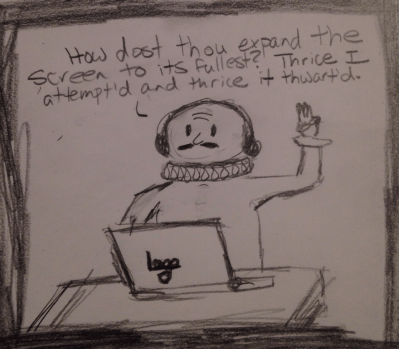
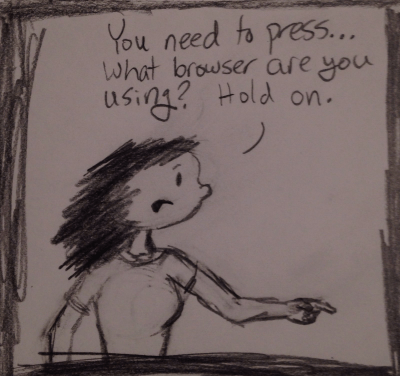
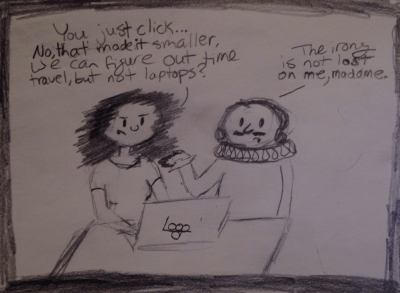
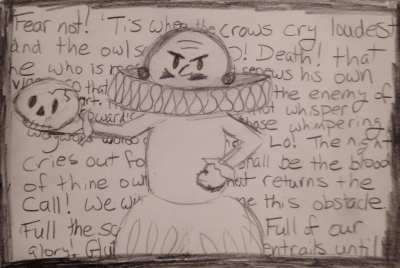
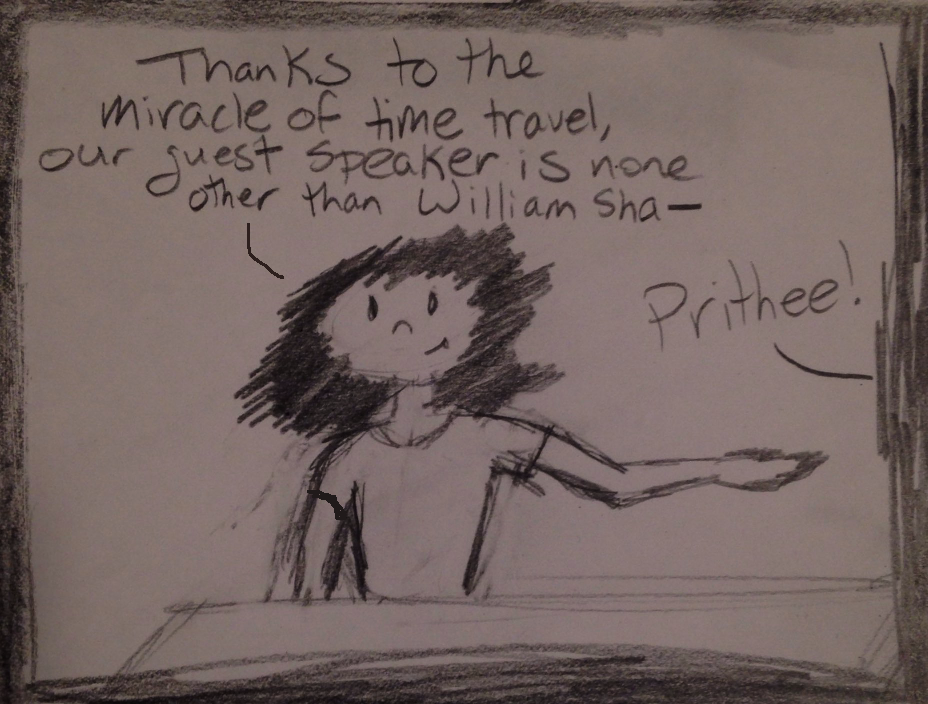
Good news: I came up with a new comic idea.  I was inspired by English class and Shakespeare, since lately I’ve been working toward getting my teaching certification so I can teach high school English.  Without meaning to, this comic became a bit of an homage to Kate Beaton’s comic, Hark!  A Vagrant.  Though it was not intended, I am in no way sorry.  Beaton’s work is some of the funniest I’ve ever seen.

Bad news: My copy of Photoshop Elements is for PCs only.

Results: I drew the comic and then took pictures of each panel.  Enjoy!

Writer’s Block
11/11/15

WB Panel 1_1
WB Panel 1_2
WB Panel 1_3
redo 2_1(1)
WB Panel 1_5
WB Panel REDO

Leave a comment

Filed under books, Comic, Humor, reading, writing

Defining a Genre

If you’ve been keeping up with my last few posts, you’ll know that I’ve been working on revising a book entitled Grotesque.  This book has been with me since 2012.  It has come so far since its first draft, but it’s not quite ready to be sent out to editors.  Why?  Because, as my agent, her interns, and I discussed, the book was hovering in an uncomfortable space between two genres.  It had adult themes and characters, but still read like a Young Adult novel.  In order to revise it, I had to take a step back and ask why the narrative voice wasn’t working, why it still sounded like it was aimed at teenagers.

Through extensive discussions with my husband, my best friends, and my siblings, I discovered that I was never going to be able to revise the current draft of the book to read more “adult.”  Why?  Because the content, structure, and plot of the novel were always going to be too YA.  No amount of aging up the narrative voice was going to change that.  At best I could have ended up with a YA novel that read with an incongruously adult voice.

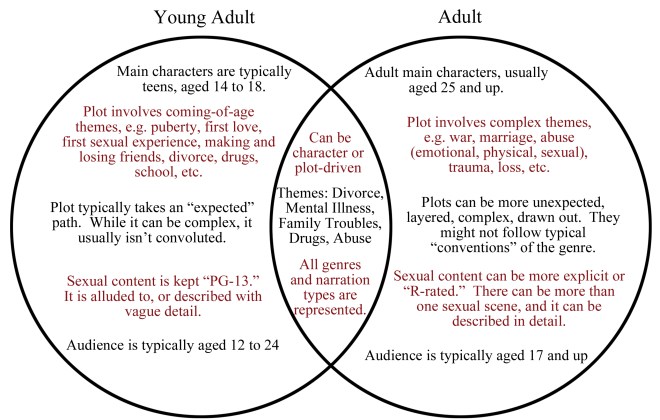
This is how I decided to address the problem:  I gutted the book.  Took out the YA content and upped the ante.  I’m expanding the world, going into more details with regards to history and characters, raising the stakes.  And it’s working, though I’m only a few pages into the new draft.  My purpose for writing this post was to offer a quick, easy glimpse at the difference between a YA novel and a plain ol’ adult novel.  Here’s a handy Venn diagram:

Venn Diagram

You’ll note that I use a lot of words like “typically” and “usually.”  Why?  Anyone who knows me knows I hate blanket statements.  Obviously each genre has its own conventions – otherwise it wouldn’t be a genre – but there are exceptions to every rule.  The Elegance of the Hedgehog is a book that I would classify as “Adult” but one of the main characters is a twelve-year-old girl.  Similarly, Sarah Dessen has written a Young Adult novel about relationship abuse, which might be considered by some as an “adult” theme.  As for audience, there’s no set age-limit.  Adults read YA all the time.  Younger readers can find adult novels that they enjoy, or they might be exposed to adult novels through school.  I read Cold Mountain when I was thirteen years old (Summer reading assignment), and believe me that book is not YA.  It’s the Odyssey of Vaginas and it made me supremely uncomfortable.

The point I’m trying to make here is that Grotesque had elements of both genres.  Oftentimes it comes down to the way a story is approached.  You’ll note in the middle section of the diagram that there are several themes mentioned that could belong to either side.  The difference is that an adult novel will approach a theme of sexual abuse differently than a Young Adult novel.  I don’t know why I always capitalize Young Adult, but not adult.  Just go with it.

With that in mind, I began rethinking GrotesqueGrotesque deals with a main character who has only been alive for a few weeks, yet his body is that of an adult… monster.  He’s an adult monster.  His love interest is an adult with a child of her own.  Interestingly, a common theme in YA is the transition from childhood to adulthood.  This theme is present in Grotesque, but in a different way.  Again, it’s all about how the content is approached.  The statue that comes to life starts out with the mind of a child, but he is exposed to the horrors of the world, and that causes him to age rapidly.  He is overwhelmed by the complexity of life, the gray areas of morality, etc.  These are adult quandaries.  And so that is the direction I am taking.  I am going all in with this.  We’ll see how it turns out.

Can you believe I did a comic?  It’s been forever, right?  Enjoy!

Writer's-Block-Strip-45

1 Comment

Filed under books, Comic, Humor, writing