Tag Archives: comic

He Said/She Said

So here I am again.  I’m preparing to go back to Los Angeles after a wonderful semester abroad, and I’ve decided to take time out of my busy (read: not at all busy) schedule to blog.

Today’s post is all about the nuances of dialogue.  I have this motto/saying/whatever that I came up with a while ago.  It goes like this: Writing is the easiest, safest way to play God.  And it’s true.  Not only do you create entire worlds, populate those worlds, and control the course of events, but you also put words directly into people’s mouths.  The best part is that there’s absolutely no pressure.  If you screw up, or kill somebody, or end the world, you’re not disappointing anybody.  Your characters aren’t exactly going to rebel.  But if you want any real-life readers, you’re going to have to be a pretty competent deity.  No pressure or anything.

Dialogue is a sensitive topic.  You’re given this power to dictate what each and every character is going to say, but at the same time, you have to be aware that we can never predict what people are going to say in real life.  Dialogue at its best will never go beyond mimicking real life really, really well.  And that’s fine.  If your dialogue didn’t take a little literary license well then…it wouldn’t be literary.  It’s still easy to mess up, though.  Trust me.  I have experience.  Ever written a character of the opposite sex?  Ever caught yourself writing that character’s dialogue like he/she is the same sex as you?  I have.  Being female, I found it really hard to get into the male mindset.  Especially when I was a thirteen-year-old girl writing a teenage boy.  He was constantly being emasculated when he spoke, and I didn’t even realize it.

There are other errors you can make, too.  When one character says something, the other character’s response has to be appropriate.  I know this seems like it’s obvious, but it is really difficult to get right sometimes.  Below is an example of an “inappropriate” response.
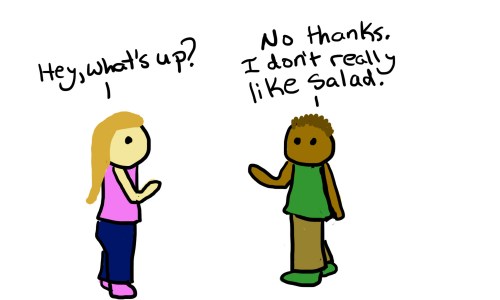
The only way this conversation could be made appropriate would be if you created a scenario to fit it.  For example, the guy could have misheard her.  Or he could be desperately trying to avoid her.  Any number of things could make it work, but on its own without any context, it doesn’t.  This is, as usual, an extreme example.  But when you’re reading through your sections of dialogue, you really do have to ask yourself if the conversation feels real.  This is when that whole “Listen to your gut” thing comes in handy.  If something doesn’t feel right about the conversation, then something’s probably not right.

Usually, when I have a problem with inappropriate responses, it’s because I’m trying to rush the conversation.  I know where I want the characters to end up, and it’s going to be far more interesting than this conversation, so I just kind of…push it a bit.  And it ends up reading something like this:
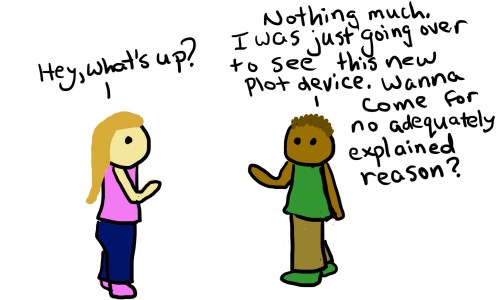
Then I have to go back and slow things down a bit, make sure their conversation reaches A, B, and C before they get to D.  Then there are dialogue tags.  Now those are a bitch to get right.  I really hate them.  If left unchecked, you can have a conversation that goes like this:

“Hey, I’m drinking some coffee,” she said.

“I noticed that,” he said.

“I like pointing out the obvious,” she said.

“I am going to leave this room now,” he said.

Note the overabundance of he said/she said.  Breaking up dialogue tags so that you don’t have too much repetition can get tough.  Usually, if it’s just a conversation between two people, you can just drop the tags altogether like so:

“Hey, I’m drinking some coffee,” she said.

“I noticed that,” he said.

“I like pointing out the obvious.”

“I am going to leave this room now.”

Or, if you like, you could switch things up a bit:

“Hey, I’m drinking some coffee,” she said.

“I noticed that,” he muttered.

“I like pointing out the obvious!” she shouted.

“I am going to leave this room now,” he whispered, eyes darting towards the door.

But this is all pointing out the obvious, which is why I didn’t spend too much time on it.  I know this post is long, but I want to say one more thing:  Often, when writing dialogue, I get into this groove where the conversation flows, feels real, and takes the right amount of time.  The problem is that when I get into that groove, I don’t stop to switch perspectives based on who’s talking.  In other words, it’s like I’m writing a conversation between myself and myself, where everything that’s said is what I would say.  So, my final note is: Not only do you have to make the dialogue appropriate, but you have to make it appropriate to each character, too.  “Hey, what’s up?” Sure, someone could say that.  Hell, people have said that.  They’re probably saying it right now.  But would the Queen of MadeUpLand say that?  Maybe not.  Just something to think about.

Word of the Day: Diatribe (n) – a bitter, sharply abusive denunciation, attack, or criticism
Leave a comment

Filed under books, Grammar, writing

Make with the Wooing Already!

Today’s post is about romance.

There are so many elements to think about when creating a work of fiction that it’s not even funny.  But I want to focus on romance because it does come up a lot, and I think it’s one of the trickiest things to handle.  I’m having trouble putting my thoughts into words for this one, so bear with me.

Romance is an element in a lot of novels. Some people read books specifically to follow characters on their romantic journeys. Heck, there’s an entire genre dedicated to it.

Here’s the problem: Because romance is so prevalent in several genres of literature, it becomes very hard to bring something new to the topic.  In other words, it’s hard to make your characters’ love story unique.  Now, it helps that your story as a whole is unique. (If it isn’t, then see me after class)  With a unique story comes a unique romance.  But you still need to approach it carefully.

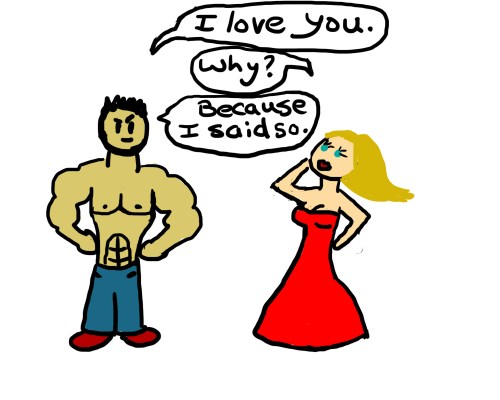
What you don’t want in your story is a muscled-up, ruggedly handsome, personality-less man falling in love with a gorgeous, buxom, personality-less woman whose hair always seems to be blowing in the wind.  Then you get this:

The problem with the above scenario is that they are in love for superficial reasons.  This is, of course, an extreme example.  But my point is that the love should never come from you, the author, telling the reader that these two characters are in love.  No, the love should come directly from the characters.  I hope that makes sense.  Remember how I mentioned following your gut?  If your gut is telling you that this relationship you’ve created isn’t working, then it probably isn’t.

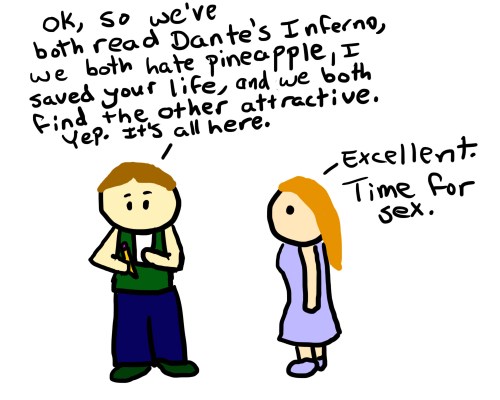
You can’t fix the above problem by fabricating reasons for the two characters to be in love, though.  It’s not as simple as going back through the book and inserting some random things that they have in common.  Then, at the end of the book, it’ll kind of seem like your characters are going through a checklist of things that represent their love.  Like this:

What I’m saying is, it’s not enough that they have some stuff in common.  And it’s definitely not enough that he’s saved her life.  Then you have the whole knight-in-shining-armor scenario where the princess falls in love with her savior because she’s pretty much obligated to.

So what does that leave us with?  Well, my advice is that you develop each character’s personality separately.  I think a lot of the time, the problem stems from that whole “Romance is expected” thing I mentioned earlier. You have this well-developed main character who needs a significant other, so you create that extra character for the sole purpose of having your main character fall in love with him/her.  Instead of doing that, remember to develop your love interest’s character beyond the romance.  Give them a back story and a purpose in the plot besides needing rescuing and/or being hot.

I hope that helps.  I might expand on it later, if I feel like it.

Word of the Day: Amorous (adj) – Inclined or disposed to love, especially sexual love.

2 Comments

Filed under books, writing

Oh yeah, and…

Jeez I’m posting a lot recently.  Don’t read too much into it (Ha! Reading pun) I’m not going to be able to keep this up.  I just keep forgetting stuff.  I have no idea how to organize this post, so I’m just going to list some stuff:

1 – I was thinking about how some people on this thing called YouTube make abridged versions of cartoon shows, and that got me to thinking that I should make abridged versions of books.  I don’t actually know if I’m ever going to do that, but it did lead me to draw this comic that is Twilight (all four books) abridged.  So I’ll share it with you:

2 – Now that I’ve done that, I have to explain a bit.  I always tried to avoid openly bashing Twilight because enough people already do that, and because there are still a lot of people out there who love it.  And God forbid someone insult something that they like. So I figured if I posted this, I would have to offer some objective reasons why the series is really very poorly written [Edit 5/29/13: I am fully aware that the list below is not as objective as I would have liked.  I’m just really bad at keeping my opinion out of things.  Sorry about that.  I still feel the points are valid].  I would also like to point out that Stephenie Meyer wrote another book – The Host – that is incredibly good.  I don’t remember if I put that on the Books I Recommend page, but I’ll be sure to get it on the list after I’m done with this post.  So, why is Twilight bad?  I will list a few of the biggest reasons, though this is in no way a comprehensive list.

  • Bella Swan is a Mary Sue.  I’ve talked about the Mary Sue before, and when I thought about my definition, I honestly just tried to describe Bella.  And here’s why: No fewer than three boys compete for her affections.  All three of them even ask Bella to a dance that is supposed to be a girls-ask-guys thing.  Then there is the vampire boy who decides he loves her because he can’t read her thoughts, which leads me to…
  • Edward is a controlling, manipulative boyfriend who is also a stalker.  Yes, it’s been said before, and I’ll say it again.  He sneaks into her room to watch her sleep.  He’s done it for months before they even started going out…or mooning at each other, or whatever it is they do.  Then there is the fact that, as I recall, Edward does things like break Bella’s car so she can’t go visit her werewolf friend, Jacob.  That’s actually not okay.  Then there’s the whole second book where he decides that she’s not safe being involved with him so, having decided what’s best for her (again), he breaks up with her, removes every last trace of himself from her life, and uproots his family, moving them far, far away.  Which brings us back to…
  • Bella’s symptoms after losing Edward are not unlike PTSD (Post Traumatic Stress Disorder).  She stops connecting with her family and friends, moves through life like a zombie, and has night terrors.  For months.  And then, diverging from the PTSD thing a little, she realizes that she hallucinates her boyfriend if she does dangerous stuff.  So what does she do?  Well, desperate to see Edward again, she proceeds to approach a group of people who might be rapists, go on a joyride with one of these would-be rapists (That’s not a euphemism.  They just ride a motorcycle), manipulate Jacob into helping her build her own motorcycle just so she can ride that and nearly die on it, and jump off a cliff.  This, again, is not okay.  What it’s supposed to be: A sign of her true love.  What it actually is: Crazy.  What message it sends: Girls, especially the young, impressionable ones, please remember that your boyfriend is the only thing worth living for.  K thnx.
  • She uses “chagrin” too much.  Not Bella.  Stephenie Meyer.  It’s like…it must have been on her Word-of-the-Day calendar when she started writing the book or something, because she really does use it way too much.
  • I could go on forever.  I think Cracked sums it up really well, so if you need more, go ahead and read this: http://www.cracked.com/funny-36-twilight/  I agree with everything they say.  Also it’s hilarious.  Okay, not to confuse you, but we’re going to go back to that numbered list now.  Remember how we started with that?

3 – I realized that I talk a lot about my own writing in this blog without ever sharing any of it.  I feel like that isn’t good, because how do you know my writing isn’t crap?  I mean, I feel like my advice is still sound, but you could be reading advice from a hypocrite!  Like, I could be a terrible writer who is writing about how much she hates terrible writing!  And that just won’t do.  So I suppose I’ll have to start posting writing samples.  I won’t do it today since this post is already really long, but I will do it eventually.  That way you can see (I hope) that my writing isn’t crap.

4 – The End!

Word of the Day: Anoesis (n) – a state of mind consisting of pure sensation or emotion without cognitive content.

Huh, that Word of the Day is more relevant than I thought.  Also, I want to do this one:

Word of the Day Part II: Chagrin (n) – a feeling of vexation, marked by disappointment or humiliation.

2 Comments

Filed under books, writing