Tag Archives: fantasy

Grotesque Success

Phew!  After many grueling days of procrastinating, I finally managed to:

  • Rewrite the first half of Grotesque.
  • Edit the second half of Grotesque to accommodate the rewrites.
  • Reread Grotesque twice in order to edit, proofread, and check for continuity errors.

It’s finally done.  And I am so much happier with the result than I thought I’d be.  It’s honestly very difficult to write a book without rereading at all until you’re done, because the whole time you’re writing, you’re thinking…

Book Ruiner

My fears were assuaged after my first read-through of the completed draft.  I’m not exactly going to post a compare-and-contrast look at the old manuscript and the new one, but here’s a list of problems I addressed:

  • Historical inaccuracies
  • Forensic inaccuracies
  • Pacing problems
  • Repetitive/formulaic plot
  • Unresolved subplots
  • Underdeveloped characters (namely the villain and love interest)
  • Unbelievable scenarios (Grotesque waking up with instant knowledge of the world around him, ability to walk, talk, eat, etc.)
  • Other things as well, probably.

What I want to talk about in this post is the method I used to bring the changes I wanted to see into fruition.  My friend Evelyn taught me a method of outlining called “story beats.”  It’s my kind of outlining because you literally just write a numbered list of things that are going to happen in the book, in the order that they happen.  You can use casual language, and you can write out details that will help you to write the book, even if those details are never explicitly stated in the manuscript.

I’d like to provide an example from the story beats I wrote out for Grotesque, so what you’re going to see is two story beats (written in block quotes so you can identify them easily) and then the corresponding section of book.  It’s amazing how much you can get out of just one paragraph of quick description of a scene.  The text of the book sample is going to be in italics because this part of the book happens to be in all italics.

2. Bastien returns home after a long day, ignores his parents as he goes straight to his room. He opens and closes the door very quickly. His room is strewn with books, and there is a large shelf stocked with potion ingredients. A small toy knight is sitting on his bed waiting for him. When it sees him, it jumps up and down, making tiny clanking noises. Bastien urges it to hush and calm down. His parents can’t hear what he has done because it was illegal.

3. Flashback: Bastien remembers going before the council. He has been researching the art of creating life for years, and he believes he can master it. He believes that with the right technique, certain objects could be made to understand and carry out tasks, maybe even help fight should another war begin. Some of Bastien’s cold ruthlessness begins to shine through as he talks. The Council is outraged by his speech and they tell him if he ever attempts anything like that, he will be banished or jailed or something.

That job had taken much longer than he had hoped. The moon and stars were shining brightly from the inky black sky as he walked home.

“Sweetheart, you’re back late,” his mother said as he pushed his way through the front door.

Bastien didn’t even glance her way as he headed to his room. He slipped inside as quickly as possible, shutting the door firmly behind him.

Little Lance was sitting on the bed, his tiny metal feet dangling over the edge of the mattress. He jumped up when he saw Bastien, ran over to him, bounced excitedly. Bastien tried to shush him. Little Lance was small – his head barely made it to Bastien’s shin – but his every movement resulted in metallic clanking that was loud enough to draw suspicion.

“Hush now,” Bastien said, patting the knight’s tiny helmet to calm him. “We can’t let Mother and Father hear you. Why don’t we do some quiet reading?”

The knight nodded its head excitedly, its miniscule visor flapping up and down with the movement. Bastien lifted him up and put him on the desk. The knight used his miniature lance – for which he’d been named – to help him balance as he crossed his legs and sat down. Bastien took off his robe and hung it by the door. He looked at the gold bands on the sleeves and the crown that was embroidered onto the right shoulder. A symbol of his rank. He was one of the most important crafters on the council. But it didn’t matter. It hadn’t mattered at all in the end. When he’d gone to them, asked them to listen to him.

♦     ♦     ♦     ♦     ♦

“Manus knew it, too,” Bastien had said, referring to the man who had trained him in this trade. “We are taking on too much responsibility, Head Councilman. Many people here work the jobs of three men. I have been studying this subject for years. I can do it. Think of the possibilities!”

“That is enough, Councilman Garrison,” said Head Councilman Stefan Wiel. “Just saying these things out loud borders on illegal. You have been honored with the position of Royal Healer. Your lack of gratitude is disgraceful.”

“Why should I be grateful for a job that was forced on me?” Bastien demanded.

Stefan’s eyes had gone cold. “You will do a job that is worthy of the crown on your shoulder, or you’ll be stripped of your title and your council status. We will leave you with nothing. Do I make myself clear?”

♦     ♦     ♦     ♦     ♦

Bastien let the memory fade as he reached out and ran his hands over the robe that had been made just for him when he was inducted into the council.

“I don’t know how much longer I can do this,” he said, turning to Little Lance.

The knight cocked his head at him. Bastien sighed and shook his head.

“You wouldn’t understand. Don’t worry about it.”

[End book passage]

There you have it.  Hopefully you were able to see the difference between a story beat and the polished writing that comes out of it.  I highly recommend this method because it helps to prevent writer’s block before it even happens.  You set up the entire plot ahead of time, and it’s much easier to edit and tweak the story because instead of changing an entire book you’re just deleting/editing/moving a bullet point.  Over all, this method makes it much easier to put words to paper.  I am going to use it from now on.  That’s right.  I’m finally going to start outlining.  Hell probably just froze over.

That’s all!  I’ll write again soon.
1 Comment

Filed under art, books, Humor, writing

Free Sample

Welp, I finished editing Grotesque.  Before you go about congratulating me, I want to define “finished” for you:

Finished [ƒǝƞ-œŒ- ñÿď] adj – At a point where a book can be sent out for initial critique, where the book meets at least two of the following three criteria: 1. Is legible  2. Is in a language that all or most of the readers know  3. Obeys some rules of grammar

So yeah.  It’s not done.  Not by a long shot.  So I want you to keep in mind that the small sample I’m about to provide is completely unedited.  It will definitely change at least once before the month is out.  I can guarantee that.

But that’s okay!  Because all I really wanted to show you was some of the ways the book has already changed.  So I’m going to take a risk and compare the old and new introductory passages (which is only a risk because I am not sure at this point if my beta readers are going to like the new intro at all), as well as one other excerpt taken from the end of Chapter One.

For those who need a bit of a refresher on Grotesque, you can click here to go through my favorite post about it.  Or you can click here to go to the post in which I describe my inspiration for it (and then apparently provide the entirety of the first chapter, but you don’t have to read that).  Or you can go really crazy and click on both those links.

Okay, so here we go.  I’m going to put all passages in blockquotes so that they’re easy to differentiate from like…this writing I’m doing right here.

Pre-rewrite intro:

I awaken for the first time on the ledge of a tall building, the ground too far below for comfort. Above me is an inky black sky full of bright stars, a large moon, and a few wisps of gray cloud. The words for these things come easily to me, in a language that floods my mind, though I don’t know where it came from.

New intro:

Cold

Falling

Gasping

Breathing

In

Out

Flailing

Grabbing

Holding

Balance

Nerves tingling.

Heart pounding.

Stuttering breaths, in and out.

What am I doing?

A cold breeze dries the sweat on my forehead.

Where am I?

Sitting on a ledge, gripping onto something to keep myself steady, beneath an inky black sky dotted with stars. The moon is bright, illuminating a few wisps of gray cloud, and the ground beneath me which is too far away for comfort.

So why’d I change it?  Well, the first intro honestly wasn’t very captivating.  It also felt kind of forced and clunky to me.  With the new introduction, I wanted to try to encapsulate what it really would feel like to suddenly be alive for the very first time ever.  Once again, not sure if my readers (i.e. close friends and family) are going to like it.  It might change.  But this illustrates the direction I wanted to take it in pretty well.

Next we’ll look at a little further down in the same chapter.  This is from the old version:

“I brought life to you because I need some help.”

“Doing what?”

He shrugs.

“This and that. I have rather ambitious plans for my future, and I knew I wouldn’t be able to accomplish my goals without help. So I risked weakening my powers some in order to give you life.”

“What if I don’t want to help you?”

“Oh, you can’t refuse. You’re enslaved to my will. You will have to obey any and every command I issue to you.”

He is so matter-of-fact about it, but I find I am not nearly as calm. I feel anger and frustration rising in my gut as the meaning of his words sinks in.

“So you brought me to life just to use me as a slave?”

“Yes.”

“I think I’d prefer to be a statue…or free.”

The man snorts out a laugh.

“And what would you do with your freedom? Do you really think people would accept you into their homes? Into their lives? You’d be hunted down and slaughtered on sight.”

I feel my throat tighten, cutting off further words. He is right, of course. This had all been part of his plan to keep me under his control.

“Besides,” he continues. “You can’t be free. Not until I’m dead. And don’t get any ideas. You cannot disobey me.”

Well, this is a solution to one problem at least. I raise my hand and slash my claws across the man’s throat. His blood spills quickly, and he collapses to the floor. The bastard hadn’t ordered me not to kill him, so I wasn’t disobeying anything by doing so.

And this is that same scene from the new version:

He shrugs. “This and that. I have rather ambitious plans for my future, and I knew I wouldn’t be able to accomplish my goals without help. So I risked weakening my powers some in order to give you life.”

“Why should I help you?” I ask, genuinely curious.

“Because I’m going to tell you to,” is the reply. “You can’t refuse. You are bound by my will, and will continue to be until such time as I meet my inevitable, but unfortunate end.”

“So you created me to be your…slave?”

Slave. The word whispers itself in my ear, its significance bubbling in my mind. Bad. Not free. Trapped. Suffering.

I am pretty sure I don’t want to be a slave.

“Don’t look so concerned,” the man says, chuckling. “You will be happy to serve me. Your only purpose in life will be to please me. You will see that everything I do is for a greater cause.”

At first his words don’t seem all that reassuring, but suddenly I can see his point. What’s so wrong with being a slave? I’ve been promised security. And this man hasn’t given me reason to believe he has bad intentions. Surely this will be a good thing. I can’t wait for his next order so that I can show him how obedient I can be.

I smile.

Hopefully you can see how different this scene has become.  Thanks to my friend Micah’s suggestions, I added a new layer to Serrafiel’s character arc by forcing him to be happy with his position in life, rather than giving him a sense of morals right off the bat.  If he were truly new to life, he wouldn’t immediately know what was right or wrong.  He’d be like a two-year-old.  And that made his arc more interesting (in my humble opinion).  Because he has to grow up very, very fast.

Also, because I just realized that not everyone will read the name with the Spanish pronunciation, Serrafiel is not pronounced “Sarah-feel.”  It is pronounced “Seh-ra-fee-EL.”  That’s the best I can do for a pronunciation guide.  In case you didn’t notice when you were reading earlier, I’m not so good with the symbols and such.

And that’s it for now!  Hope you like the sneak peek at the changes I made.

Lots of words for you to read today, huh?  How about I reward you with…

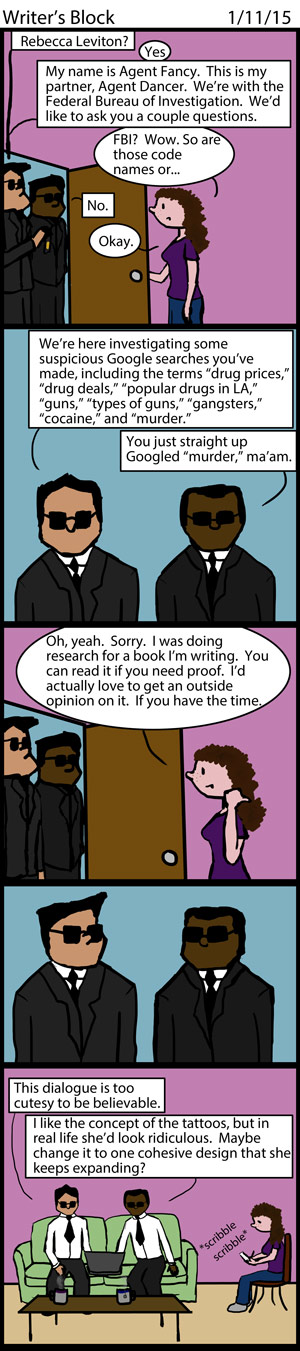
A NEW COMIC!!

Writer's-Block-Strip-44

2 Comments

Filed under books, Comic, Humor, writing

The Swirling Vortex of Doom (AKA Character Development)

Remember how I was talking about how very wrong I was in my first few posts?  [EDIT 3/13/21: These posts have since been unpublished due to being blatantly wrong and insulting.] Yeah, I remember now that there’s something else I wanted to clear up besides how sorry I am – What I wrote about character development.

My methods for getting to know your character?  Sound.  Good enough anyway.

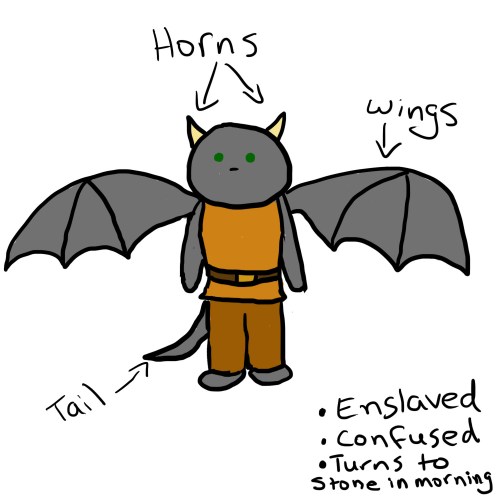
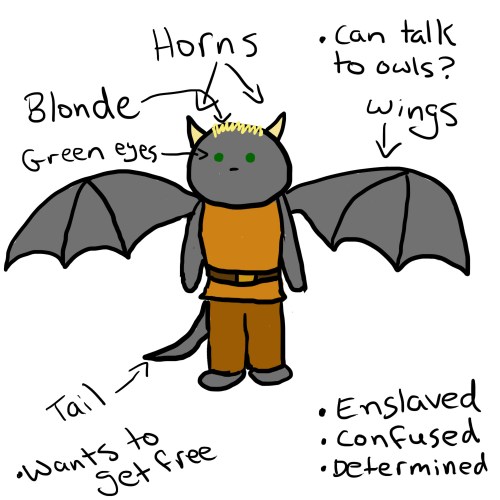
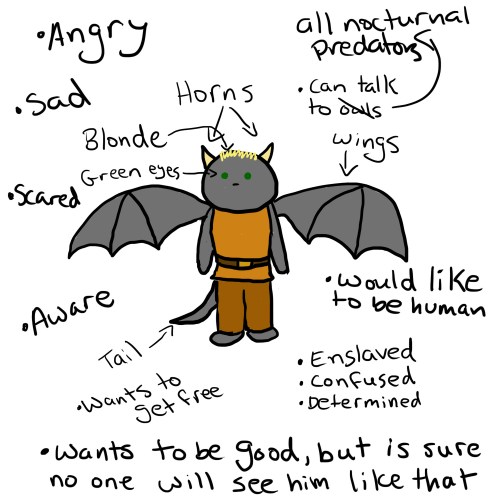
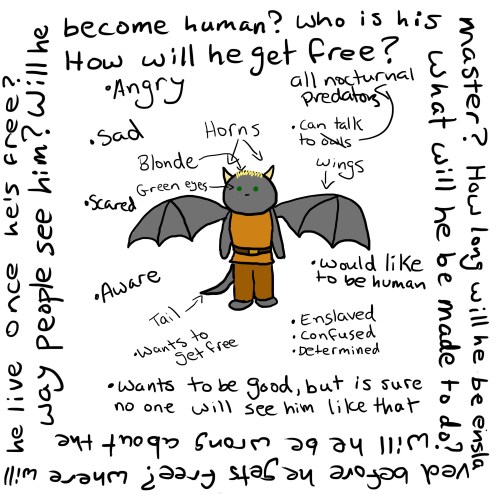
My timeline for getting to know your character?  WRONG.  I made it seem like you had to know everything there is to know about your character before you even start your story!  No no no!  I don’t even think that’s possible.  Even if you have an absolutely super special intimate relationship with your character before you start writing, and you think you know all there is to know, I’m still pretty convinced that something about that character is going to change once you start writing.  And that’s the whole point!  It’s supposed to change!  If your writing isn’t teasing out more and more little things about your character that you didn’t even think about before you started, then maybe you’re not doing it right.  To illustrate this point (literally) I painstakingly drew my character development process for Serrafiel.

First, we have what I knew about the character before I started writing:

Yeah, that’s about it.  So I ask you: Does this look like a fully-developed character?  The answer is no.  So I had that, and then I started writing and, after a chapter or two, I got this:

So there’s a little more.  He’s blonde now, and he has green eyes.  I didn’t know either of those things until I wrote about him looking at himself in the mirror for the first time.  And the talking to owls thing, yeah…decided that one on a whim.  It worked out really well once I got further in the book, which brings me to:

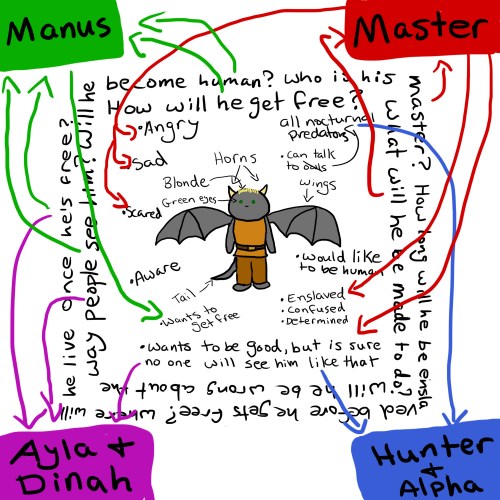
So now I’ve got a pretty well-rounded character.  By now, I’m really into the book, and I know a lot about him.  You may also notice that this picture has a lot more words in it than the first one.  But it’s also important to remember that all of these things I know about him are constantly framed by questions, things I don’t know yet.  So in the next picture, he’s literally framed by questions.

And then you have to remember that all of these questions and personality traits and feelings and words are often linked directly (or indirectly) to other characters in the book.  Which I have also drawn.

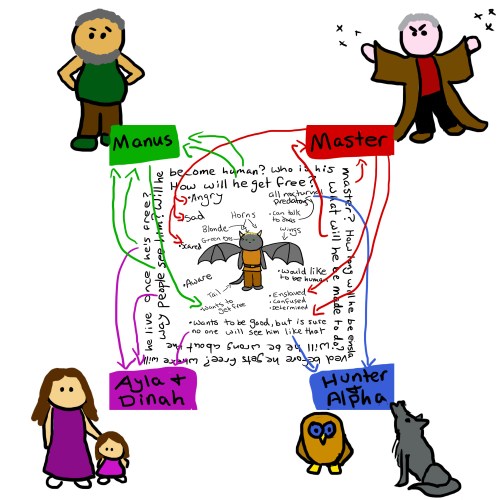
Believe it or not, there is some rhyme and reason to the direction of the arrows.  If a question is going to be answered by a character, then the arrow points to them.  If a character caused the question, or the feeling/emotion whatever, then the arrow points from that character to the corresponding word(s).  I mean, that’s not totally important.  This is just supposed to show how incredibly complicated character development is.  In other words, I’m trying to prove without a doubt that I was epically wrong the first time I talked about this.  Oh and we’re not done by the way.  Because you have to remember that all those colored blobs aren’t just blobs, they’re other characters.

And all of those other characters, plus any number of others, need their own swirling mass of words, arrows, and relationships.  They all need to be developed just like I developed Serrafiel.  (Don’t worry, I didn’t draw out their developments, too.  That was the last picture)

In conclusion, you should definitely get to know your character as well as you might know a sibling or close friend, but don’t be afraid to use your writing to help you develop that relationship.

Word of the Day: Nascent (adj) – beginning to exist or develop

2 Comments

Filed under books, writing