Tag Archives: writing

Strong Concepts

I’ve been thinking a lot lately about the term “strong concept.” It is at once easily definable and as inscrutable as Big Foot’s daily schedule. What makes an idea a strong concept? I hope everyone will agree with me when I say: Every strong concept is an idea; not every idea is a strong concept.

Lately, due to developments that I can’t talk about yet (but OH BOY get ready!), I have been mentally poring through my seemingly unending list of book ideas and trying to figure out which ones can actually be made into a solid story with a beginning, a middle, and even an end.

Something I’ve come to understand is that I often have ideas for scenes that really rock my socks, but just because I have a good scene in mind does not mean that there is a world outside of that moment. It doesn’t mean the characters in the scene are three-dimensional. One good scene certainly can’t carry an entire book. (Unless, I guess, that book was written by Stephenie Meyer. Even then, if I had been given the chance to edit Twilight, it would have turned out differently.)

For example, I have this one scene in my head. A woman walks into a PI’s office and enlists his help to find the man who is going to kill her… at some point in the future.

The backstory for the scene is in my head, too, so I guess it’s really two scenes. See, the woman has a very specific psychic ability–the first time (and only the first time) she touches someone, she gets a brief glimpse into that person’s future. She can’t control what she sees, how long the vision is, or even how far into the future she sees (could be a day, a year, ten years, or any other length of time). One day, she bumps into someone at a coffee shop and the glimpse she gets of his future is terrifying because she sees herself from his perspective as he’s about to stab her. By the time she recovers from this vision, the guy is long gone, and she only has a vague idea of what he looks like. Even worse, she can’t help but shake the feeling that he’d orchestrated that contact, like he’d known exactly what would happen to her and exactly what she’d see. Hence, hiring a PI to help her find him before he finds her.

But… then what? Who is this woman? Who is the PI? Do I even know how PIs work? I mean… I watched Jessica Jones and read The Dresden Files as well as Nora Roberts’ Hidden Star. So… no. No, I don’t know how PIs work. Do I know how to write a competent mystery? I mean… Hellbound has one. But I can’t say I went about constructing that particular mystery in a structured and logical way. Plus, the building blocks of that one were relatively simple. A mystery for adults? One that has to carry an entire novel and involves psychic phenomena? That might be out of my wheelhouse.

Is this a Strong Concept? Hmm… no. I don’t think so. Could it be? Okay, yes. It certainly could be. With some real work put into the setting, the characters (including the villain!), and the plot, I think it could transform into a Strong Concept. But right now, it’s an idea. And I’m not sure it’s an idea that merits the work it would take to make it into a Strong Concept.

Here are some questions I ask myself when I’m trying to determine if I have an Idea or a Good Idea:

  • Why do I want to tell this story? Is there a message the events and characters I’m toying around with will send? Is there something that a stranger could gain from reading about these people and events? Some sort of anchor in the real world and the Human Condition? Along similar lines…
  • Whom am I telling this story for? (It’s tempting to write an entire book just for myself that speaks to my own needs and grievances and hopes and dreams. But my biggest goal is to write for an audience, so if I find myself saying, “I want to write this for me”, I shelve the idea.)
  • What are the characters’ personalities like? Are they more than just cardboard cutouts that I’m moving around from scene to scene?
  • Can I write this book? Do I have enough knowledge and experience to make this story believable? Or will I come off as ignorant and incompetent as I attempt to play in a space I’m completely unfamiliar with?

Feel free to weigh in. What makes an idea a Strong Concept? And what makes you hit Pause and go back to the drawing board?
Leave a comment

Filed under books, Humor, reading, writing

I Don’t Want Your Protagonist to Be Me

Have you ever put a book down without finishing it because you find the main character(s) insufferable? I found myself doing that with an enemies-to-lovers romance I picked up the other day, and I had to ponder for a while why I had found it so intolerable. The book switched between the two love interests for narration, starting with the female lead. (I’m not going to name the book or author in this post because there’s no need to trash an indie author, y’know? She self-published. Good for her.)

The female lead spent the first two chapters complaining about literally everything in her life. Her car. Her job. Her own inability to arrive anywhere on time. Her coworkers. Her customers. The new owner of the restaurant she works at (who happens to be her love interest). She’s just this fountain of negativity from page one.

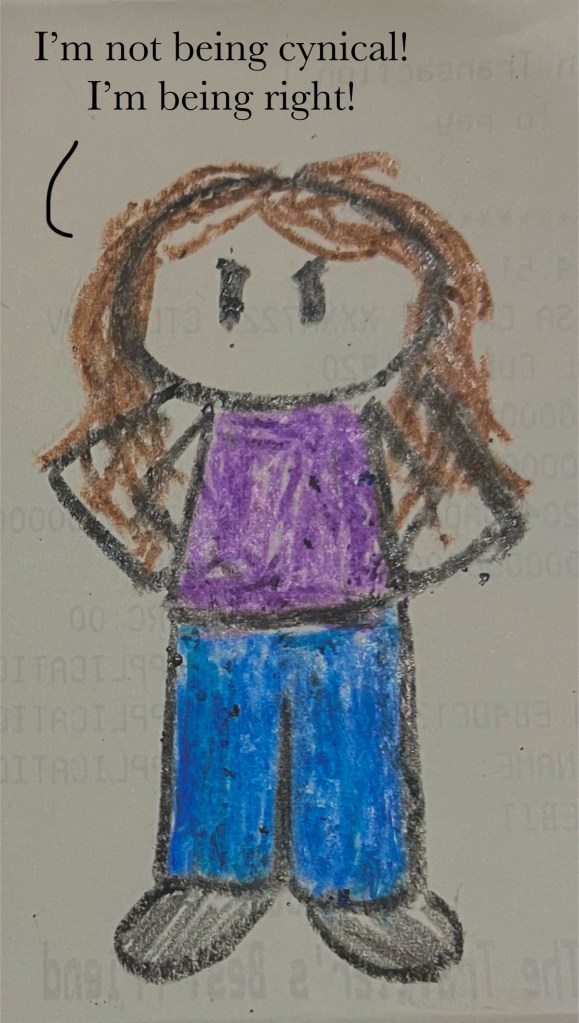
But the thing is… she’s just like me. Cynical. Sarcastic. Negative. Grumpy. Prone to complaints.

Mini Bex looking angry and saying "I'm not being cynical! I'm being right!"
I’m at the airport so I have to illustrate my blog however I can.

So why don’t I like this character? She’s just like me, so I should be able to see myself in her and relate to her, right? I’ve even had some pretty terrible experiences as a server, so this should be right up my alley.

This truly baffled me even as I put the book down, knowing I’d never pick it up again. But after a long discussion with my loving husband, I managed to weed out the truth.

I don’t want your book’s protagonist to be me. I don’t want the book to be a mirror. I don’t want to feel interchangeable with the protagonist.

I want to be friends with your protagonist.

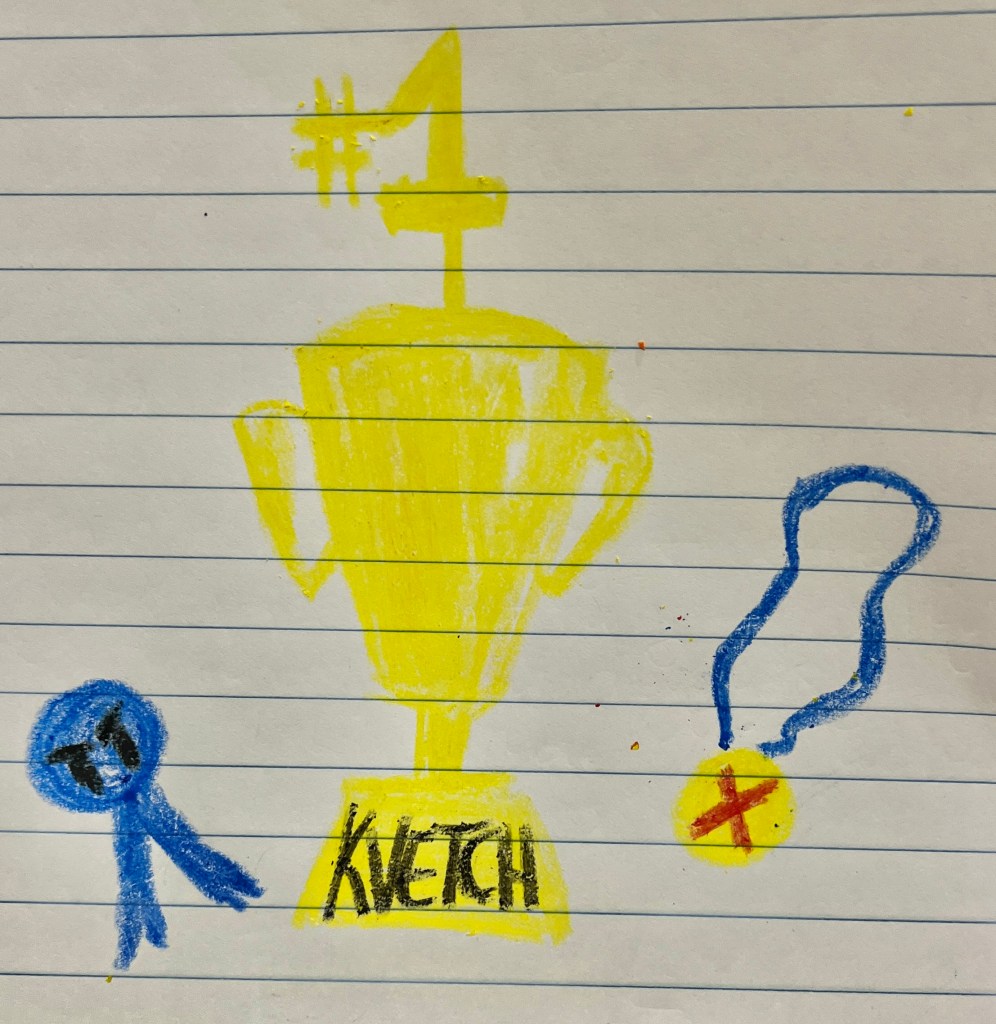
That’s the difference. It seems like not much would change. After all, many of my friends are cynical and sarcastic, too. But if I meet someone for the first time and they spend the entire time they’re around me complaining until their lips turn blue? Yeah, I probably won’t end up inviting them to grab coffee later. I don’t even complain until my lips turn blue on first meeting someone, and I’m a champion complainer. I have the awards to prove it.

A drawing of a blue ribbon, a trophy, and a medal, all dedicated to being good at complaining.

Although, the trophy could be shinier. And the blue ribbon is made out of really cheap material. Come to think of it, the awards ceremonies always go on too long. I wish they’d cut out one of the speeches. Just one. Is that too much to ask??

The fact of the matter is, it seems (emphasis on seems; I’ll never know for sure if this is true) the author of this book had some personal feelings to vent RE: working in a service industry. Those problems and complaints might be universal, but it all has to do with presentation. Many forms of media are sought out for their ability to provide some kind of catharsis. But when you’re writing fiction based in any way on your own negative experiences, you have to ask yourself: Who is this cathartic for? Me or my thousands of potential readers?

If the answer is just you, maybe some ideas need more workshopping. You have likely had negative experiences that are relatable to the masses–air travel gone wrong, serving a demanding customer at a store, Thanksgiving dinner–but just having your character lament being in one of those situations over the course of many pages does not automatically make them relatable. (And yes, at this point I have become aware of the irony going on here. I am spending this entire blog post complaining.)

I will reiterate: Your protagonist should not be a reader-surrogate. Rather, they should be someone the reader wants to be friends with. After all, what is the reader doing if not hanging out with your character(s) for dozens of pages?

The exception that proves the rule is, of course, Catcher in the Rye. (American Psycho was too obvious to use in this case. Plus, who am I to judge if you like Patrick Bateman’s style?)

I want to talk about the concept of “saving the cat,” and how all this relates to some edits I need to make to one of my own books, but I’ve already gone on too long.

Next time!

Leave a comment

Filed under books, writing

Infinitely Excited

Sometimes I tell myself that I have bitten off more than I can chew RE: hobbies and crafts. I write books, I take pictures, I podcast, I do glass art, I make TikTok animations. Basically, I’m the type of person Linktree exists for. I tell myself I don’t have enough time in the day for all these things, that I’m stretching myself too thin, that I can’t expect to master any one thing if I can’t give it the time and focus it requires.

But then I tell myself… So what?

I’m having fun. I’m always excited for something new. If I get bored or, or too tired to do, one thing, I have a long list of other diversions to choose from. We creative types are often told by ourselves and/or others that we should um… not be creative types.

There’s no money in it. It’s a waste of time and energy. You’ll never get recognition.

Something like that.

For what it’s worth, I want you to just go for it. Get excited for stuff again and again and again. I kinda hate that the phrase YOLO got tarnished so quickly with strange and negative connotations because I do see the wisdom in it. Let’s put it another way: If not now, when?

Or as Shakira in the form of a cartoon Gazelle put it: Try everything.

Only don’t actually try everything. There are things out there that are unsafe to try and can have terrible consequences. Robbing banks. Doing certain hardcore drugs. Publicly supporting OR decrying Taylor Swift.

But if you’ve always had a yen to try whittling wood or playing chess or bungee jumping or composing music, what’s to stop you from looking into that? Time? It’s a hobby. You set your own hours. There’s no time clock here. Dedicate however much time you want. You’re in charge.

Money? YouTube has tutorials in everything.

Or you could be like me and just learn by haphazard and disorganized experimentation.

My point is, get excited. It’s fun and fulfilling in its own right to pursue a craft or hobby, and you don’t have to stop at one. The flip side of that is you don’t have to feel guilty for losing interest in a pursuit that doesn’t grab you like you thought it would. Pat yourself on the back for trying something new and move on. Don’t weigh yourself down with guilt or self-deprecation because you didn’t “see something through” (whatever that entails). If the spark isn’t there, it isn’t there. Sticking with a hobby, craft, or profession simply because you feel obligated to put a significant amount of time into it would be like continuing to date someone you don’t particularly like because you feel bad breaking up with them after only two dinners.

In fact, I like this analogy a lot. Let’s go with it. Finding new hobbies is like dating. Date new hobbies as often as you like. Some people are in monogamous relationships (i.e. they have one hobby that they commit to) and others have open relationships or engage in polyamory of some sort. Whatever works for you is what you should pursue.

So go get excited about something!

Leave a comment

Filed under writing