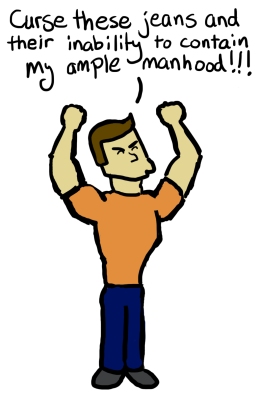
Grotesque Success

Phew!  After many grueling days of procrastinating, I finally managed to:

  • Rewrite the first half of Grotesque.
  • Edit the second half of Grotesque to accommodate the rewrites.
  • Reread Grotesque twice in order to edit, proofread, and check for continuity errors.

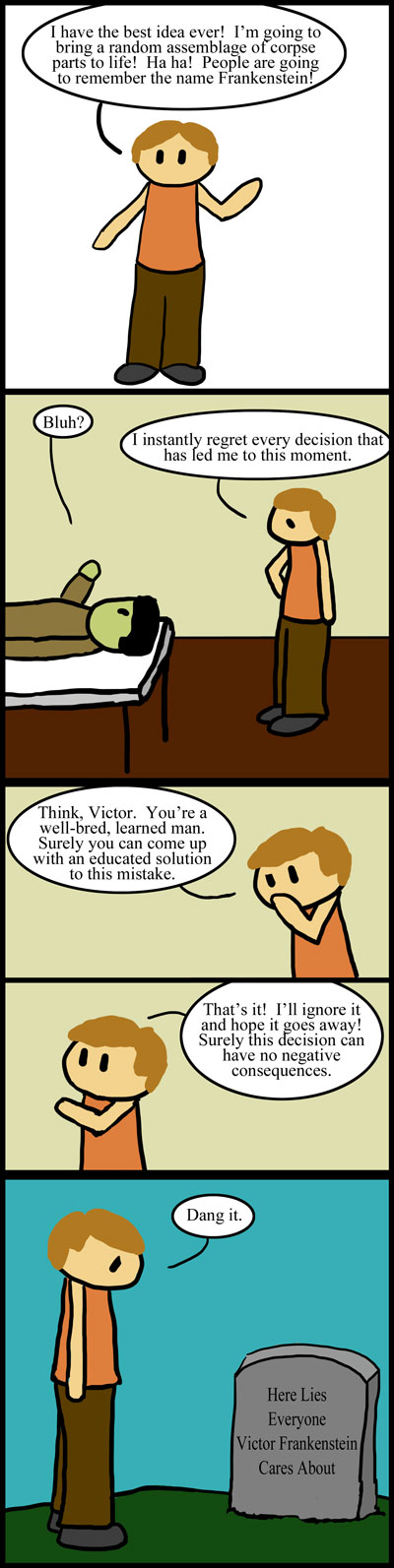
It’s finally done.  And I am so much happier with the result than I thought I’d be.  It’s honestly very difficult to write a book without rereading at all until you’re done, because the whole time you’re writing, you’re thinking…

Book Ruiner

My fears were assuaged after my first read-through of the completed draft.  I’m not exactly going to post a compare-and-contrast look at the old manuscript and the new one, but here’s a list of problems I addressed:

  • Historical inaccuracies
  • Forensic inaccuracies
  • Pacing problems
  • Repetitive/formulaic plot
  • Unresolved subplots
  • Underdeveloped characters (namely the villain and love interest)
  • Unbelievable scenarios (Grotesque waking up with instant knowledge of the world around him, ability to walk, talk, eat, etc.)
  • Other things as well, probably.

What I want to talk about in this post is the method I used to bring the changes I wanted to see into fruition.  My friend Evelyn taught me a method of outlining called “story beats.”  It’s my kind of outlining because you literally just write a numbered list of things that are going to happen in the book, in the order that they happen.  You can use casual language, and you can write out details that will help you to write the book, even if those details are never explicitly stated in the manuscript.

I’d like to provide an example from the story beats I wrote out for Grotesque, so what you’re going to see is two story beats (written in block quotes so you can identify them easily) and then the corresponding section of book.  It’s amazing how much you can get out of just one paragraph of quick description of a scene.  The text of the book sample is going to be in italics because this part of the book happens to be in all italics.

2. Bastien returns home after a long day, ignores his parents as he goes straight to his room. He opens and closes the door very quickly. His room is strewn with books, and there is a large shelf stocked with potion ingredients. A small toy knight is sitting on his bed waiting for him. When it sees him, it jumps up and down, making tiny clanking noises. Bastien urges it to hush and calm down. His parents can’t hear what he has done because it was illegal.

3. Flashback: Bastien remembers going before the council. He has been researching the art of creating life for years, and he believes he can master it. He believes that with the right technique, certain objects could be made to understand and carry out tasks, maybe even help fight should another war begin. Some of Bastien’s cold ruthlessness begins to shine through as he talks. The Council is outraged by his speech and they tell him if he ever attempts anything like that, he will be banished or jailed or something.

That job had taken much longer than he had hoped. The moon and stars were shining brightly from the inky black sky as he walked home.

“Sweetheart, you’re back late,” his mother said as he pushed his way through the front door.

Bastien didn’t even glance her way as he headed to his room. He slipped inside as quickly as possible, shutting the door firmly behind him.

Little Lance was sitting on the bed, his tiny metal feet dangling over the edge of the mattress. He jumped up when he saw Bastien, ran over to him, bounced excitedly. Bastien tried to shush him. Little Lance was small – his head barely made it to Bastien’s shin – but his every movement resulted in metallic clanking that was loud enough to draw suspicion.

“Hush now,” Bastien said, patting the knight’s tiny helmet to calm him. “We can’t let Mother and Father hear you. Why don’t we do some quiet reading?”

The knight nodded its head excitedly, its miniscule visor flapping up and down with the movement. Bastien lifted him up and put him on the desk. The knight used his miniature lance – for which he’d been named – to help him balance as he crossed his legs and sat down. Bastien took off his robe and hung it by the door. He looked at the gold bands on the sleeves and the crown that was embroidered onto the right shoulder. A symbol of his rank. He was one of the most important crafters on the council. But it didn’t matter. It hadn’t mattered at all in the end. When he’d gone to them, asked them to listen to him.

♦     ♦     ♦     ♦     ♦

“Manus knew it, too,” Bastien had said, referring to the man who had trained him in this trade. “We are taking on too much responsibility, Head Councilman. Many people here work the jobs of three men. I have been studying this subject for years. I can do it. Think of the possibilities!”

“That is enough, Councilman Garrison,” said Head Councilman Stefan Wiel. “Just saying these things out loud borders on illegal. You have been honored with the position of Royal Healer. Your lack of gratitude is disgraceful.”

“Why should I be grateful for a job that was forced on me?” Bastien demanded.

Stefan’s eyes had gone cold. “You will do a job that is worthy of the crown on your shoulder, or you’ll be stripped of your title and your council status. We will leave you with nothing. Do I make myself clear?”

♦     ♦     ♦     ♦     ♦

Bastien let the memory fade as he reached out and ran his hands over the robe that had been made just for him when he was inducted into the council.

“I don’t know how much longer I can do this,” he said, turning to Little Lance.

The knight cocked his head at him. Bastien sighed and shook his head.

“You wouldn’t understand. Don’t worry about it.”

[End book passage]

There you have it.  Hopefully you were able to see the difference between a story beat and the polished writing that comes out of it.  I highly recommend this method because it helps to prevent writer’s block before it even happens.  You set up the entire plot ahead of time, and it’s much easier to edit and tweak the story because instead of changing an entire book you’re just deleting/editing/moving a bullet point.  Over all, this method makes it much easier to put words to paper.  I am going to use it from now on.  That’s right.  I’m finally going to start outlining.  Hell probably just froze over.

That’s all!  I’ll write again soon.

1 Comment

Filed under art, books, Humor, writing

The Art of Criticism?

Since my last post, I think I figured out what inspired me to want to talk about criticism.  But I’m only 90% sure.  However, since the post has to do with a book that has “tiger” in the title, and I just so happen to have finished a tiger painting, I figured I might as well go for it.  It’s nice to get a cohesive theme going every once in a while.

If you are unfamiliar with my latest hobby, you can click back to the post before this one.  A couple people have suggested I open an Etsy shop, but I’m not sure yet.  My last Etsy shop didn’t go over so well, but maybe this time it’ll be different?  My father requested a tiger, so I did one up for him.  Here’s the progression of the tiger from start to finish:

Tiger 1 Tiger 2 Tiger 3 Tiger 4

And now the book I want to talk about

I will admit that the cover art was a big part of the reason why I bought this book.  Don't you go telling me that thing about judging books and covers.  Covers are meant to be judged.  That's the whole point of them.  You shouldn't judge people by their appearance, but books aren't going to get their feelings hurt.

I will admit that the cover art was a big part of the reason why I bought this book. Don’t you go telling me that thing about judging books and covers. Covers are meant to be judged. That’s the whole point of them. You shouldn’t judge people by their appearance, but books aren’t going to get their feelings hurt.

Tiger’s Curse by Colleen Houck.  This is an unusual review because I have to admit I only read the prologue and the first two chapters, so I’m not going to be talking about the book as a whole.  What I want to talk about (and what I think I wanted to talk about back when I started reading this book) is the importance of first impressions.

In my opinion, the first thing that a reader is going to ask when they start a book is something along the lines of “Why should I care?”  It’s been my experience as a reader that if I don’t have that question answered by the end of the first paragraph, I lose interest very quickly.  Now, that doesn’t mean that I instantly care about the characters of the books I do like, but the book offers me something in return.  It says, “You might not know why you should care yet, but I am going to give you a reason to keep reading.  I’m going to make you feel like you’re willing to find out why you should care.”  That’s why those first few paragraphs are so important.  They have to be compelling.  And Tiger’s Curse just didn’t compel me.  I was bored.

First of all, the book starts with the poem, The Tiger, by William Blake.  Not only is that ridiculously predictable, but this is not the only book that has used that poem in some way or another.  That poem is overused, in my opinion.  But that’s me nitpicking.  Let’s look at the opening paragraph, found in the prologue, which is titled “The Curse.”

The prisoner stood with his hands tied in front of him, tired, beaten, and filthy but with a proud back befitting his royal Indian heritage.  His captor, Lokesh, looked on haughtily from a lavishly carved, gilded throne.  Tall, white pillars stood like sentinels around the room.  Not a whisper of a jungle breeze moved across the sheer draperies.  All the prisoner could hear was the steady clinking of Lokesh’s jeweled rings against the side of the golden chair.  Lokesh looked down, eyes narrowed into contemptuous, triumphant slits.

So here’s my impression: I’m clearly supposed to care about the prisoner, but I don’t get his name.  Instead I get his captor’s name.  I don’t care about his captor’s name.  If the prisoner’s name is meant to be kept a mystery, that’s fine.  Don’t even give me the captor’s name then.  It’s not like that name means anything to me at this point in the story.

Second, look at all that excessive description!  I don’t care at all about the room they’re standing in.  I want to care about the prisoner, but I’m too distracted by the decor surrounding him to be able to.  The opening line alone is weighed down with globs of exposition that serve to inform, but not intrigue.  Don’t inform me about stuff until you’ve given me a reason to care about said stuff, okay?  There are way too many adjectives and adverbs.  Pillars tend to be tall.  You don’t have to point that out.  And I challenge you to narrow your eyes in a way that is both contemptuous and triumphant.  In my imagination, those two expressions are vastly different.  Plus we already know that he’s looking down “haughtily” so it makes “contemptuous” redundant.  And the fact that the throne is gold is mentioned twice!

Here’s how I would write it:

The prisoner stood with his hands tied in front of him, his stance proud despite his fatigue and the beatings he’d taken.  His captor looked on from a lavish, gilded throne, his eyes narrowed into contemptuous slits.  Immense pillars stood like sentinels around the room.  Not even a whisper of a jungle breeze interrupted the pervasive stillness.  All the prisoner could hear were his captor’s rings clinking steadily against the side of the throne.

So when do we find out the prisoner’s name?  That he has “royal Indian heritage”?  What his captor’s name is?  What his relationship to his captor is?  Well, this book is 403 pages long, so take your pick.  That information can come out anywhere, anytime.  In fact, the very next paragraph starts with “The prisoner was the prince of an Indian kingdom called Mujulaain.”  So why was it necessary for the first sentence to include any of that information?

In conclusion: What is the art of criticism?  Criticism should not be used to put someone down.  “Criticize” and “Insult” should not be used synonymously.  The former should be used for a purpose.  Critical analysis should lead to the betterment of the work.  And I guess I wanted to make that clear because I think a lot of people take and/or give criticism personally, myself included sometimes.  I’m not immune.

From as objective a standpoint as I can offer, this book starts out poorly.  And it is for that reason that I stopped after two chapters, and probably why I will not try to finish it.  It’s apparent that this book needed some more editing.  As you can see from this lengthy blog post, I’m not one to keep things brief.  But this is a more casual setting.  In novels every word must count, and you must make sure you do not overstuff your book with excess fluff.  Start out with “Why should my readers care?” and work your way out from there.

Books are meant to be about imagination.  It’s okay to use some description, but you shouldn’t be leading your reader around by the nose either.  “The pillow was small, soft, and pink, and it was hand-embroidered with an image of two koi fish by an elderly Japanese woman back in 1972.”  It’s too much!  Let your reader decide what a soft, hand-embroidered pillow would look like, okay?

I acknowledge that there are more factors that go into enticing and captivating a reader, but I think what I have just addressed is one of the biggest pieces of the puzzle.

That’s all for now!

Leave a comment

Filed under books, Humor, writing

Other Things I’ve Been Doing

After my last post displayed me sitting in a corner, gathering dust, I decided to showcase a couple other things that I’ve been up to.  That way I won’t appear quite so lazy.  Don’t get me wrong – I’m plenty lazy.  Just not that lazy.  Even I have my limits.

First, I made a teeny tiny change to my personal appearance.  Some may remember the picture below from this post.  I actually fixed it up a little bit since I know how to use Photoshop better now.  And by “better” I mean I learned what the smudge tool was.

meandme2

Well… now there’s an even bigger problem…

Me and Me 2

Yeah, I got a haircut.  Once every few years or so I get bored with looking like Cousin Itt, so I get all my hair cut off.  The problem is exactly what Mini Bex is saying above: I now look nothing like my adorable little doppelganger.  Other than her signature purple shirt, her only real distinctive trait is her long, messy hair.  So does that mean Mini Bex will be getting a haircut, too?

Haircut

Nah.  She’s just fine the way she is.  I’m pretty sure no one would recognize her if she had shorter hair.  They’d be all like, “Wow, is there a new character in this blog?  Follow up question: Did she steal Mini Bex’s purple shirt?  Follow up to the follow up: Did she murder Mini Bex for her purple shirt?”

So Mini Bex gets to keep her long hair.

What else have I been doing?

Art, of a sort.

It all started when I was doing some calligraphy practice using chisel tip markers.

Original Aliens

Then, days later, I accidentally set something wet down on top of the paper.  This led me to discover something neat, and I started adding more water.

Aliens

Then I decided to take it a step further and start doing this stuff on purpose.  I chose to work with a line of poetry that I saw back in high school.  I never Googled where it came from until now.  The top search was “The Love Song of J. Alfred Prufrock,” so I think that’s where it’s from.

Someone had used it for an art project.  They drew a picture of a person with their index finger hovering above a big red button, and they included the words “Do I dare disturb the universe?”  Those words always stuck with me.  So I did my own version.

Do I dare disturb the universe

Then I thought, “Why not take it a step further?”  So I started Googling some tribal tattoo designs for animals.  I started by making a tiger for my sister, which she put in an amazing frame:

Calligraphy Tiger

Then I made a dragon for my brother, which is also in an awesome frame right now:

Calligraphy Dragon

I did a horse for myself and an owl for my husband:

Calligraphy Horse

Calligraphy Owl

Then I decided to stop taking other people’s designs and start doing my own.  I’m really good at copying stuff, so when my sister-in-law requested a walrus, I drew one of my own.  Then I created my own tribal-inspired design for it, copied it with calligraphy markers and voila:

Calligraphy Walrus

To those artists out there who originally created the designs I used for the dragon, the horse, the owl, and the tiger:

I’m sorry I used your art without your permission and without crediting you.  I did not sell any of these drawings.  They were all gifts.  If it bothers you that you did not receive credit, please do send me an email and I will happily offer credit where credit is due.  Unfortunately it is hard to track down the original designer of a tattoo when said tattoo was found on Google Images.  I’m sure a person much smarter than I could do it, but I do not want to risk offering credit to the wrong person or website.

From now on, I will only be creating my own designs.  Now that I have the hang of it, I think I’ll be able to do a decent enough job.

Currently I’m working on a coyote, so I thought I’d show you the creative process now that I’m doing my own art.

Step 1: Sketch a coyote and his surroundings, then go over the lines with Sharpie to make them easier to trace.

Coyote 1

Step 2: Trace over the Sharpie coyote with pencil and begin developing shapes, rather than hard lines.

Coyote 2

Step 3: Go over pencil lines with Sharpie, eliminating the designs that don’t work.

Coyote 3

Step 4: Trace again, this time on parchment paper using a chisel tip calligraphy marker.  (In this case, multiple chisel tip calligraphy markers.  I find black creates the coolest effect, but sometimes a little color is nice, too).

Coyote 4

Step 5: Use paint brushes, a kitchen sponge, paper towels, and fingers to apply water.

Coyote Wet

Step 6: Wait for picture to dry.  Retouch certain lines and add last-minute details.

Coyote Dry

It’s a really fun pastime, though I must say it leaves its mark.

painted fingertips

On the sponge, too.

painted sponge

But my favorite part is looking at what happens to the paper towels I use.  This is the closest I’ve ever gotten to making art out of paper towels.

Paper Towels 1

Paper Towels 2

Paper Towels 3

So that’s what I’ve been up to!  Now you’re all caught up.

See ya next time!

P.S. I just glimpsed through my post with the flowchart from April, and at the very end I said something about wanting to talk about the “art of criticism.”  I must have had something in mind at the time, but for the life of me I can’t remember what that is.  If I figure it out, I’ll do a post on that next.

Leave a comment

Filed under art, books, Humor, poetry