Tag Archives: novels

The Unused Epigraphs (Part 1)

One of the things I was just asked for (at time of writing) was an epigraph for my novel, Falling for the Protagonist. I was also asked for my dedication and acknowledgments. Writing and submitting the acknowledgments was probably the closest I’ve come to being able to internalize the truth of being published. For a very long time, I held up “writing an Acknowledgments page” as some beacon of publishing, the thing that—above all else—would say to me, “Hey, Bex. You did it. You’ve made it.”

Needless to say, that was a big moment for me.

But I didn’t ever plan on putting an epigraph into my book. For those who don’t know:

Epigraph (N) – [in the context of books/literature specifically] A motto or quotation, as at the beginning of a literary composition, setting forth a theme

Still, the very mention of one sent my brain down the path of What If. As I found it fun to think about, I decided to come up with some quotes (and ask my friends as well). Since I never plan to “publish” the quotes we came up with, I decided to post them here for anyone who is interested. First, just the quotes. If you want to stop there, read the book, and decide for yourself what relevance these quotes have—cool. In fact, I’m supposed to encourage you to do that, I guess. I mean… other people buying and/or reading the book is important to me.

In fact, I think I’m going to make this a preorder hype post. Yeah, that’s what I’ve decided. So… go to my Linktree to find links to places to preorder Falling for the Protagonist or feel free to search for the book title (or Bex Goos) on your preferred bookseller’s website. Then preorder it! Support my dream!

But if you don’t care to do that, also cool. Or if you want to read the whole post, including my explanation, before reading the book, also totally cool. In short: Everything is cool. I don’t control you. I don’t even know you. Your autonomy is safe, and I shall never attempt to trample over your right to make choices for yourself!

Here are the quotes I came up with:

“Fiction is the lie that helps us understand the truth.” – Tim O’Brien, author of The Things They Carried

“We are never more creative than when we are at odds with the world and there is nothing so artistically destructive as comfort.” – Excerpt from Nerd Do Well, Simon Pegg’s autobiography

Here are the quotes my friends came up with:

“Truth is a matter of the imagination.” – Ursula K Le Guin, author of The Left Hand of Darkness

“Men are more interesting in books than they are in real life.” – Mary Ann Shaffer, author of The Guernsey Literary and Potato Peel Pie Society

The rest of this post will be about Quote 1 because this post is so long that I already had to scroll up and add “Part 1” to the title. Part 2 will be about the rest of the quotes. Hopefully. May have to add a Part 3.

Tim O’Brien wrote fiction about the horrors of the Vietnam War. I wrote a satirical romance novel about a woman who falls into a book and sends the main character into an existential crisis. These two things are not the same. But I will always remember my students’ shock, back when I was an (inept) English teacher, and I told them that The Things They Carried was fiction. I believe I told them before we started reading the book, but I felt a reminder was in order after they’d gotten through a chunk of it. They simply could not believe that what they had read was made up. It was so real! It felt like nonfiction! It led to some great discussions about the power that fiction has to help us hold up a mirror to real life. Fiction helps us confront and interact with truth. It’s sort of like how standup comics help people face reality by getting them to laugh at themselves. There are lenses through which we can observe ourselves and others. I wanted to use my work of fiction to do just that.

Just look at the (simplified) definition of satire I used to help my students understand it: Satire is used to highlight a flaw in order to raise awareness and/or incite change.

One of my main goals in writing FFtP was to draw attention to a glaring issue with real life: We are not treated to other people’s internal monologues, but some people still act like their motivations should be crystal clear. Some of the things that men pull off in romance novels would get men a face full of pepper spray in real life. Why? Because, in a book, the narrator is constantly letting us know, “Hey. Don’t worry. Both parties are totally on board with this.”

I am going to write out a summary of a very real novel in my own words. TRIGGER WARNING: Kidnapping, forced imprisonment, threats of sexual violence

After discovering the man she just married is a murderer with a history of criminal dealings, Holly Bardwell flees the marriage and the man in the dead of night. Her car breaks down somewhere in the Colorado Rockies, so she finds herself wandering through the mountains on foot, only to pass out in the snow outside a hunting lodge. One of the owners of the lodge, Adam Colter, discovers Holly and brings her inside. He nurses her back to health and introduces her to the co-owners of the lodge, his younger brothers, Ethan and Ryan. While Holly was unconscious, the three brothers decided that Holly was the one for them. For all of them. When Holly attempts to leave their (otherwise unoccupied) remote mountain lodge, they stop her and carry her back inside while she begs to be let go. Then they tell her the truth—that they all intend to marry the same woman, and they have agreed that she is to be that woman. She will pleasure all of them. Carry their children. Be wife to all of them. It’s okay that they just met her twelve hours ago, because they know in their guts that she is meant to belong to them. She won’t ever have to worry about a thing because they’re gonna take real good care of her. She doesn’t have to leave. They don’t want her to leave. She’s going to belong to them forever.

How’s that going for you? I want you to know that you saw a Trigger Warning at the top of the paragraph that wasn’t there before I wrote the summary. I realized on rereading it that I should go back and add the TW. Because that summary was missing one very important line at the end:

Holly listens to the brothers explain how they want her to be their wife and live with them forever, and she is totally into it.

Yeah, this is the plot of Colters’ Woman by Maya Banks. It’s an erotic romance, not a thriller. Note the apostrophe placement in the title. Their last name is Colter, not Colters. She is all of their woman. And she loves it. She can’t wait to marry these three dudes and bang it out for the rest of their lives.

Changes the cadence a bit, doesn’t it?

Romance gives readers a chance to explore scenarios that would feel unsafe in real life because the narrator is there to say, “Yep. Totally into it.”

But what happens in real life when Person A thinks they’re in a romance and Person B doesn’t? Suddenly, the story is different. Now you’re looking at a person who feels entitled to another person’s attention, maybe even their affection. How the story progresses depends entirely on how Person A takes rejection, if they take it at all. Maybe Person A refuses to believe the rejection. Maybe they believe the rejection, but respond with anger or violence.

When only one person approaches an interaction as romantic, the entire interaction is anything but.

In my book, I wanted to highlight this entitlement, the way that an interaction can take on whole new layers of meaning when there is a disparity in the way the participants are experiencing it.

Yes, I wrote a fictional novel. But I wanted to use that fiction to showcase a piece of reality, namely that women (or anybody, really) can feel unsafe in a situation without ever being overtly threatened. They can feel unsafe even if the other person has absolutely no unsavory intentions at all. Because they are not privy to the inner monologue of this other person.

There are no narrators in real life.

By the way, I’m not the only one who noticed this strangely thin line between romance and horror! Check out this ingenious trailer for Red Eye (2005). Link included because the embedded video might not work.

I never saw the movie, because I’m not into the thriller/slasher/horror genre, but the trailer stuck with me, clearly. It perfectly encapsulates the disparity delineated above.

Nick DiRamio also showcased how easily an interaction in a romantic movie could be changed from romantic to creepy/horrific. All they did was change the background music. That’s all it took. I’m going to link to the video at the timestamp where this happens, but I do highly recommend watching the whole thing. Nick is hilarious.

This all led me to Tim O’Brien. He was my first thought when the idea of epigraphs entered my mind. His quotes about fiction are all top-notch. Yes, the book is made up. But there is reality reflected in the fiction.

I’ll post about the other quotes soon!
Leave a comment

Filed under Humor, publishing, writing

Did they have couches??

When I was in high school, I for some reason had the bright idea to write a Steampunk-ish novel called The Silk Top Hat Society. It was going to be an action/adventure with a touch of magic and mystery in which a group of old-timey people come across several magical silk top hats, each of which would give the wearer a specific otherworldly ability. I believe there was super speed, invisibility, super strength… maybe teleportation or something.

I decided to write this novel… despite not knowing a single damn thing about history other than like… George Washington did exist at one point, but he’s definitely dead now. To give people an idea, I often say, “I’m so bad at history that I can’t remember what I ate for breakfast this morning.” My “research” for this novel was various movies and TV shows I’d seen (historical accuracy unconfirmed, but definitely unlikely) as well as my best friend, Liz. This led to one of the more memorable exchanges I had with her using the relic known as AOL Instant Messenger or AIM during which I type-shouted at her, “Did they wear hats??”

I was thinking about how old-timey people often wore hats as a rule—not just the magical ones they encountered of a summer day, but like… regulation hats and bonnets that people are always wearing in things like The Crucible and Pride & Prejudice. But when did the practice of wearing hats start? When did it end? Did they wear them indoors and outdoors? Was it a hard-and-fast rule, or up to the preference of the individual? Those questions didn’t even take into account that the answers would definitely vary by country, and probably several other factors. I knew none of the answers to these questions, but I’d decided it was a good idea for me to write a novel that was set in a time period that occurred previous to “present day.”

Cut to… well… present day.

I find myself in the privileged position of not knowing what, if anything, I can share about my upcoming works. This has never happened before. I used to vomit my ideas onto this blog with abandon, sharing sample pages and intimate details of my writing process. Now that I AM GOING TO BE PUBLISHED, I’m pretty sure I can’t do that anymore. So I’m going to be really, really vague.

I like satire. The book that IS GOING TO BE PUBLISHED is satire. So was one of the other ideas I pitched to my editor. I had one more idea for a satirical novel beyond the aforementioned two, but I knew I could never write it because it was historical in nature. That, and I was concerned people would think I was cribbing from Nimona and Shrek. I wasn’t. The similarities occurred to me only after I came up with my book idea, but who wants to deal with the headache of smugly and self-righteously saying, “There’s no such thing as an original idea anymore” over and over again? Not me!

Anyway, since I thought it was a good idea, but a touch derivative and also WAY out of my wheelhouse to write (“Did they wear hats?” haunts me to this day), I made myself accept that it was only ever going to exist as a concept in my head.

For reasons I’m pretty sure I cannot get into, things changed, and I am now writing pieces of that book. Just pieces.

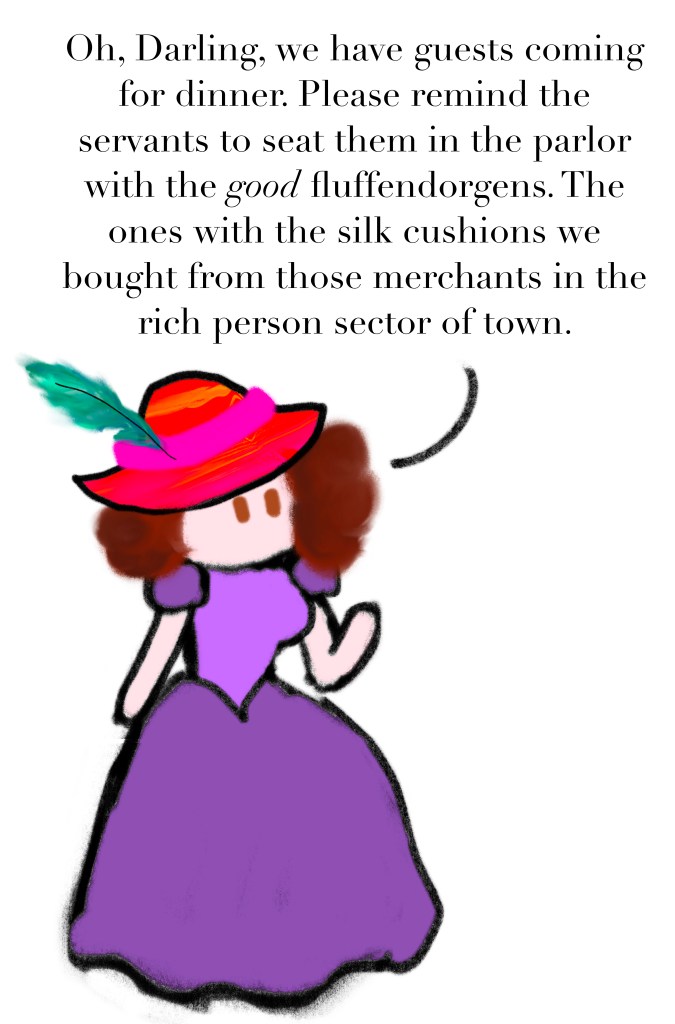
And it happened again! I was writing a scene that takes place in a sitting room, and was absolutely stymied by what words to use to describe what the characters were sitting on. Which means, you guessed it, I now have to scream into Google: Did they have couches?? (I suppose I could ask Liz again, but she is very busy opening a book shop and also it just wouldn’t be the same without AIM. RIP AIM.)

NOTE TO MY SISTER: I will absolutely be bothering you about this at some point. You’re just working full time and running after a freshly-walking baby. You’re probably not busy.

When was the couch invented? The sofa? The divan? What did people sit on to eat? To relax? To pray? What were the things they sat on made out of? Did rich people have more cushions than poor people? Did they have some sort of old-timey word for couches and chairs that no one uses anymore?

What the fuck is a settee??

Needless to say, I am not well-equipped to write historical fiction or any form of fantasy novel (fantasy novels always seem to have their roots in historical time periods from the real world). This will likely be my one and only foray into the genre, and I hope I don’t flub it too badly. I also hope that if I do flub it, you will find it in your heart to forgive me.

Now if you’ll excuse me, I’m going to go Google the history of couches.

Leave a comment

Filed under books, Humor, writing

My Twenty-Year Journey

Almost exactly twenty years ago, when I was thirteen years old and finishing up middle school, I wrote my first “book.” I put it in scare quotes because I’m sure the word count didn’t even approach 50,000, and also it was a book written by a sheltered thirteen-year-old horse girl with self-esteem issues. So it was by no means a good book. BUT it was the start of me wanting to write. I caught the bug, so to speak.

Incidentally, when I was teaching, I let my creative writing students read the first page of my thirteen-year-old self’s book and then roast me. You know, as a team-building exercise.

I don’t believe in fate or any kind of higher power. Or… I tell myself I don’t. But the fact that it’s been almost exactly twenty years… and I got this fortune out of a fortune cookie right after I started querying Falling for the Protagonist that said “Quiet faith will bring you boundless rewards soon”… Folks, I think my brain really wants to believe in fate.

Anyway, I have a literary agent now. And, folks (again), the impostor syndrome hit immediately. I didn’t even have a chance to let a single happy tear flow gently and poignantly down my cheek before my brain went numb with fear. It was a mental paralysis unlike anything I’ve ever experienced. What if I never wrote another book? What if I wasn’t as good at this as I thought? After all, I’d written many books in the past, and only two of them have been good so far. That’s not exactly a confidence-bolstering number.

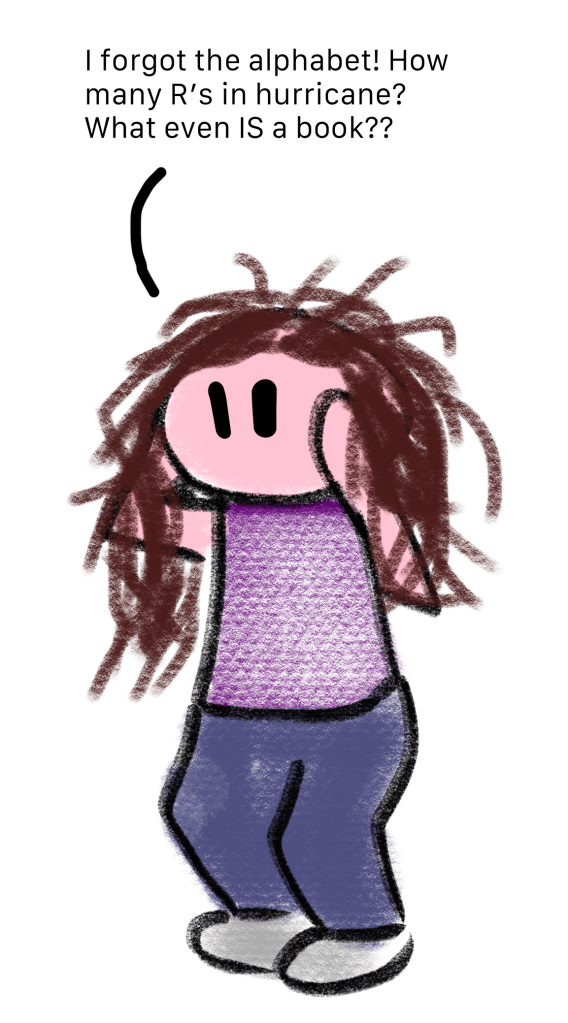
A very frazzled mini Bex yelling "I forgot the alphabet! How many R's in hurricane? What even IS a book??"

I’m not saying this to earn what I can only call congratulatory pity, where you’re both patting my back exuberantly and also murmuring, “You poor dear,” at the same time. I just want to be as honest as possible about my experience. I also caught the teaching bug a long time ago, so I’ve always wanted this blog to be at least somewhat instructive and informative in nature.

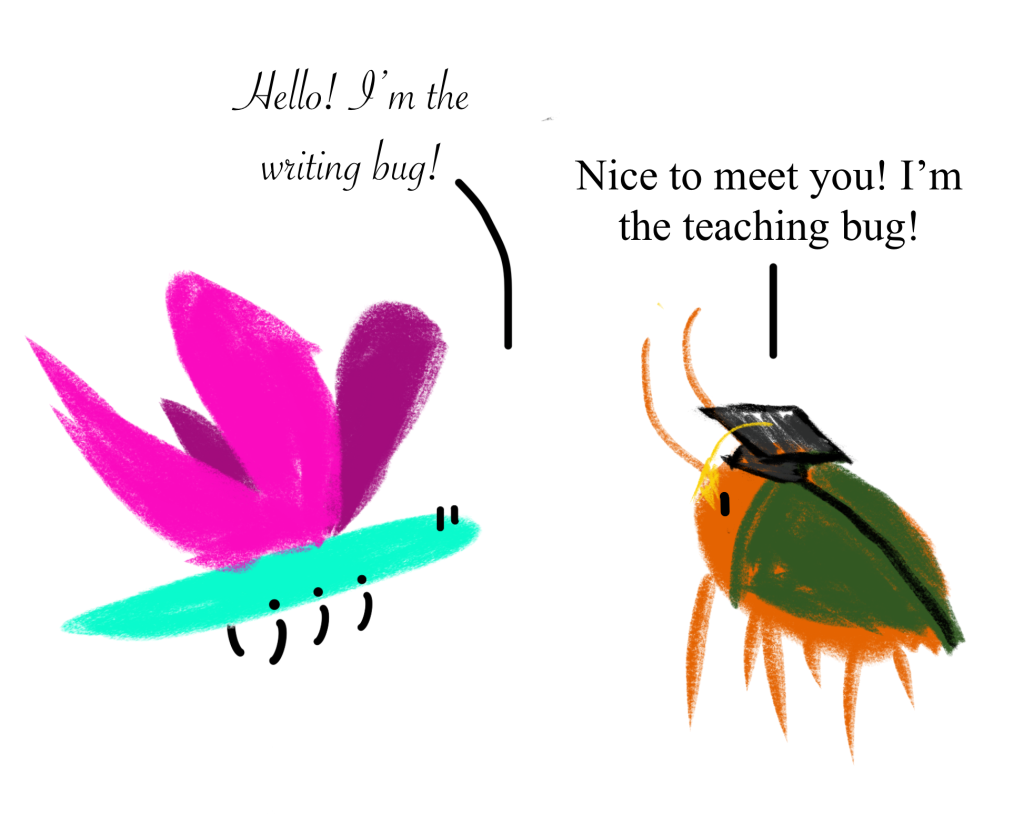
Two bugs introducing themselves to each other as the writing bug and teaching bug respectively.
(yes I know “bug” in this idiom refers to a germ or sickness, but that’s not fun to draw)

Fortunately, the happy did eventually make an appearance. And boy is it cool. This is just so cool, guys. I started this blog when I was nineteen years old (still somewhat sheltered and at least partially a horse girl), and my writing journey has been fraught with twists and turns. Though I started writing twenty years ago, I didn’t start thinking seriously about getting published until I was around sixteen. Still, that’s a long time to be trying without success. So in that other post when I said, “Hang therein“, I meant it! This industry is fickle and stressful, but there is no time limit on success.

So how did this happen? I queried over 40 agents, and as I said in the above linked Hang Therein post, the rejections started coming in. This is Normal and Expected, but of course it hurts! Especially since I believed in the idea with all of my Disney-Loving, Happily-Ever-After-Craving heart! But THEN one day in February, my younger son woke me up at like 5:30AM, and as I was doing the sleepy zombie shuffle downstairs to make him a snack, I checked my phone.

Kate Rizzo of the Greene & Heaton agency in London had requested the full manuscript. I was so sleepy that I genuinely had an experience that I’d previously thought only existed in fiction: I questioned if I was dreaming. To be fair, I had had dreams in the past where I’d gotten good news from an agent. (Waking up from those dreams sucks by the way.)

The last time I had an agent, it was because I had interned for her, and I hadn’t yet been diagnosed with ADHD. So when she offered me representation, I said yes immediately (Thanks, impulsivity) even though I didn’t think we’d be a good fit. I had no idea that I could tell her I’d think about it, query other agencies, etc. I do not mean to badmouth my previous agent! I am so grateful to her for giving me and Hellbound a chance, for believing in what we could do, and for doing the best job she could for the book. But we weren’t a good fit. It’s okay to admit to yourself that an agent doesn’t feel like a good fit to you.

Anyway! Kate had requested the full manuscript. This is something not every writer knows, so I will say it plainly: A full request is good news because you are potentially one step closer to the goal, but it is not a guarantee of representation. An agent can and will reject a full MS if they read through it and decide the book isn’t for them after all. Typically, if this rejection happens, you will get more than the boilerplate email template rejection. The agent will give you a critique or summary of their reasoning for rejection.

Anyway, it is very hard to be extremely happy while simultaneously preparing yourself for rejection. Especially when rejections from other agents are still rolling in. I started to ask myself, “What are the chances that all these other people are saying no, but this one person is going to say yes?” (Spoiler Alert: The chances are pretty good. Because, as far as I can tell, that’s often how finding representation works; in a sea of disinterested fish, you find that one fish who is interested.)

I managed to handle the wait, but I don’t think it was easy to live with me at the time.

You already know how this story ends, so I won’t drag it out. Kate read the book, we chatted, she offered me representation, I took some time to think about it (Take that, ADHD!), and then we chatted again. It was during chat number 2 when I accepted representation.

And now I have a literary agent 20 years after I wrote The Dreamcatchers Dream Walkers.

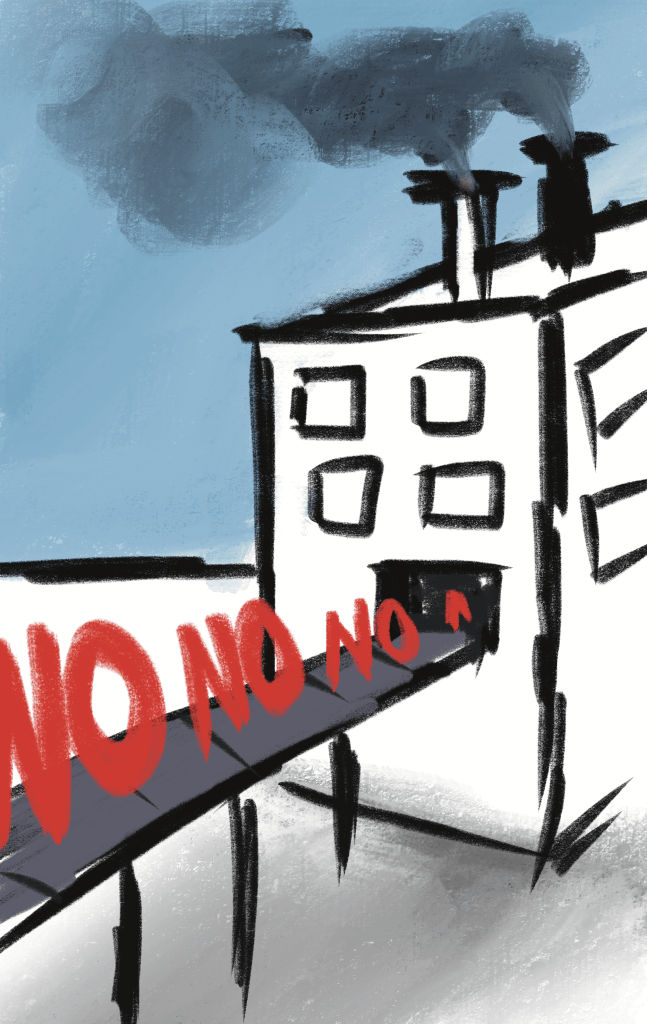
I swear I don’t mean to be a Debbie Downer, but I also have to point out that having representation is not a guarantee of publication. The entire publishing process is a rejection factory.

A factory pumping out the word "NO" over and over again on a conveyor belt.

I understand this well, especially after my journey with Hellbound, and I’m only pointing this out because I don’t want anyone out there to be like, “Congrats on getting published!” I’m not published yet, but I’m certainly not trying to bring the mood down by pointing that out. The mood is great. The mood is moodtastic. Because, regardless of eventual publication (or lack thereof), it is so exciting and wonderful to have someone believe in you and your work. And, hey, if not this book, Kate and I can try another one! I’m looking forward to documenting my progress through this blog. I’m glad I impulsively decided (Hm… okay, you win this one, ADHD) to start it back up even though no one blogs anymore. I like having a record of where I’ve been and what I’m doing writing-wise.

If you’ve read this far, thanks! Wish me luck!

Leave a comment

Filed under publishing, writing