Tag Archives: author

Let Me Count the Ways…

People are always asking me, “Rebecca, what do you do when you’re bored?”  And I answer by showing them this picture:

And then I usually start another blog post.

People also like to ask me who my favorite author is, and I can never answer.  The reason is that I have several favorite authors, and I like them all for different reasons.  So my next few posts are going to be dedicated to my favorite authors and why I love them.  There will be no particular order to the list, because I do really love these authors equally.  The numbering just helps me to organize things…and spend a needless amount of time drawing pictures.  Without further ado, let’s get to it!
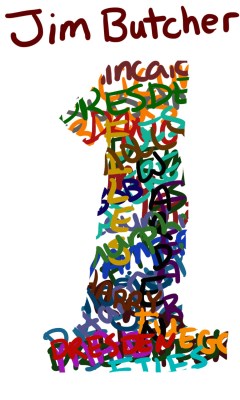
Don’t try to read the words in the number.  You will hurt your eyes.  I basically made them up of names, places, and other significant nouns from the books/authors I am honoring.  In this case, it’s The Dresden Files by Jim Butcher.  And yes, I am talking about one series, though Mr. Butcher has written other books.  The Dresden Files just happens to be my absolute favorite example of his work.  And here’s why:

Jim Butcher’s writing flows in ways that I’ve never seen before.  That’s not to say that other authors’ writing doesn’t flow.  It’s just that Jim Butcher’s has a very specific kind of flow that really gets under my skin and draws me in.  His main character, Harry Dresden, is the narrator, and I love Harry.  He captures you from the get go.  The narrative voice in these books is so distinct, it is really, really hard to remember that Harry is a fictional character.  He is sarcastic and witty, he is lovable, and he is fearsome when he has to be.  I’ve talked about these books before, and I’ve cartooned these books before, and I’ve given examples from these books before, so I really shouldn’t have to go into it too much.  One thing I haven’t talked about is the plot.  Butcher’s got a mind for it like no other.  The series is like a rollercoaster – it takes you for a crazy ride and you just have to hang on.  Add the plot into the mix, and suddenly you’re on that rollercoaster blindfolded, so you can’t see what twists and turns are ahead of you.  And Butcher is the one calling the shots.  It really is a thrilling ride, and I love every minute of it.
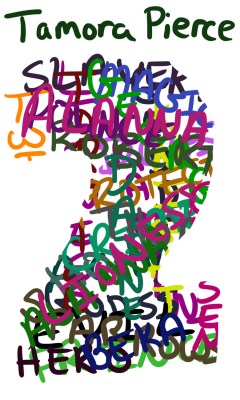
Tamora Pierce has so many things going for her.  I could talk all day about her amazing stories, her lovable characters, and her captivating narratives.  Don’t even get me started on her awesomely strong female characters who don’t take crap from anybody.  Not men, not royalty, and definitely not their snarky talking cat (but really, yes, the cat is probably right and they’ll realize that sooner or later and then they have to admit to it which is really frustrating because the damn cat gets so smug when you admit he’s right about something).

Nope.  Not going to talk about any of that.  Because I want to dedicate this post to the one thing that constantly amazes me about her.  Remember when I talked about the freedom of creating your own world?  Interestingly enough, I talked about it in the same post as I talked about The Dresden Files, linked above.  I might have mentioned my motto: Writing is the easiest, safest way to play God.  I stand by that.  If you create a world that is 93% active volcanoes, 4% rabid beavers, and 3% terrified people, then no one is getting hurt.  No one real anyway.  So it’s easy and it’s safe.  Comparatively.  But that easiness needs to be taken with a grain of salt, I think.  See, it’s really easy to write, “There once was a place where 900 people died every day from rabid beaver attacks alone.”  And it is jut as easy to delete that sentence, thus ending that world.  Here’s the grain of salt:  Compared to actually creating a physical planet that is populated by real people with real things, creating a literary world is quite easy.  That being said, if you want to do the literary world-creating right, then it is still a grueling, difficult process.  To make a real, believable, living, breathing world…well, let’s make a list of all the things you’d need.  (I’m going to try to go from big to small here)

  • Geography – Continents, oceans, etc.
  • Topography – mountain ranges, rivers, forests, deserts, etc.
  • Setting – Is this a fantasy world where flush toilets don’t exist and ogres carry princesses away from their castles?  Or is this a post-apocalyptic world where if you want food, you have to fight a radioactive chimpanzee for it using a spear you’ve fashioned out of cat bones and a tire iron?
  • Climate – Is it hot?  Humid?  Rainy?  Snowy?  How does that affect the resources that your characters have available to them?
  • Cities, states, countries, districts
  • Names – Everything needs a name.  Rivers need names, as do countries, states, cities, people, and any number of other things.
  • Politics – Monarchy, democracy, dictatorship, etc.  Not only that, but you need to decide which countries have what governments, what those governments are like, who’s feeling oppressed, who’s got a pretty good deal.  It goes on and on.  Politics are the hardest thing for me because I was never very good at grasping poly-sci.
  • People – Now you need to fill your world.  Figure out who’s ruling, who’s at war, who your main character(s) is/are.  This list goes on and on, so I’m just gonna leave it at that.
This is already making my brain hurt, and I don’t think this even comes close to being a comprehensive list.  But let’s move on to my point in talking about all this: Tamora Pierce does it.  And she does it in a way that leaves me in awe, because it all feels so real.  She covers every base, and some that you didn’t even think existed…which kind of screws up the baseball metaphor.  I often wonder how she keeps this entire world in her head and still remembers how to eat.  I mean, I have to assume that she keeps notes on these things so it’s not all stored in her brain, but still!  Respect.  That’s what I have for her.  Because on top of the amazing stories that are all interwoven so perfectly, and all those other things I said I could talk about but won’t for the sake of space, she has also created a very real world.  And she keeps track of it.  My hat goes off to her for that.
Real quick, I want to talk about why I’m writing about these things.  It’s because I think it’s important to be aware of why you like someone else’s work.  Because if you know why you like it, then you know what to emulate and what goal to strive towards with your own work.  Obviously I’m not advocating blatant plagiarism or ripping off famous authors or anything like that, but listing things like this does help to create a nice set of guidelines.  And it’s different for every person, so you should definitely think about who you like best and why.  When you’ve got the time.  Just a suggestion.  Stay tuned for more blatant sucking-up!
Word of the Day: Reverence (n) – a feeling or attitude of deep respect tinged with awe.

4 Comments

Filed under books, Humor, writing

Ode to the Unbroken

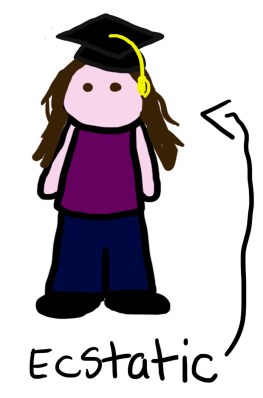
So tonight I return to Syracuse, New York for my final semester of college.  Yes, this May I will be graduating.

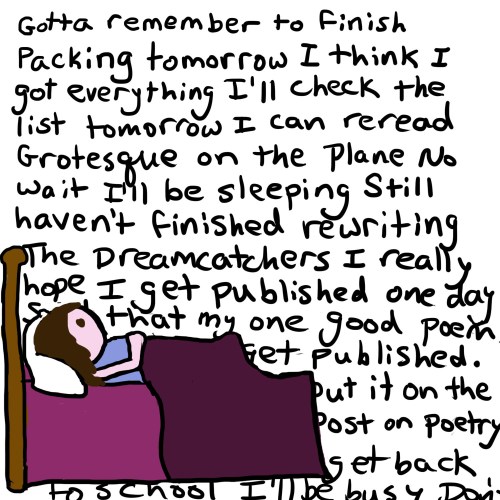
While I was lying in bed last night, not sleeping, I got to thinking about poetry.  I don’t remember why.  My brain is kind of unpredictable at the best of times, and it gets worse at night.  The moment I decide it’s time to drift off into a peaceful sleep, this happens:

Which is how I came up with the idea.  Then I wrote the whole blog post in my head, planned what I’m going to buy when I get back to school, thought about a million other things, and two hours later I finally fell asleep.

So poetry.  I don’t write poetry, and I don’t really read a lot of poetry.  It’s not that I don’t like it.  There are plenty of good poets out there – Shel Silverstein, Billy Collins, Emily Dickinson.  My favorite poem is “The Raven” by Poe.  I know I’m not the only one, but it can’t be helped.  I really do love that piece.  It flows.  It’s beautiful.  It’s eerie.  It’s just right for me.

In general, though, I tend to stay away from poetry.  For the most part, I think there’s something inherently wrong with being a Poet, because that implies that your job is to sit down and write poetry.  That means you’re making a conscious effort to make poetry happen.  You’re trying to create poetry.  And hey, maybe you’re really good at it.  But the problem is that when I read most poetry, it has that bitter aftertaste of Trying.  Even if that poem came from someone’s heart and soul, and they weren’t trying at all, and it just came to them one day while they were brushing their cat.  And then they titled their poem “The Cat’s Claw” and wrote about true pain that truly came from their cat’s claws as they tried to brush it.  I’ll still (probably) have trouble enjoying it.  And that’s all me, for the most part.  The only time it isn’t is if that person really was trying too hard, and sometimes that comes across to everybody.  Things like, “My heart fluttered like a butterfly caught in a storm,” might just have that forced effect no matter what you do.  But, as I said, I am the reason that I can’t typically enjoy poetry.  Doesn’t mean I hate poetry or poets or puppies or p…metaphors.  Just means that it’s not for me (usually).  I guess I just think that poetry should be spontaneous and…poetic, not commercial.  Not a career.  Natural, not forced.  And frankly I don’t think it’s for everyone.

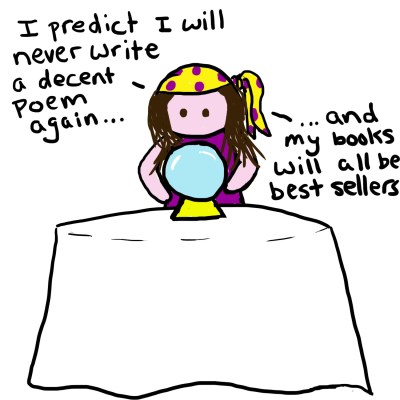
That said, I did write one poem in my life.  I approve of it because it came spontaneously and naturally.  Out of nowhere.  I just sat down at a computer, started typing, and a few minutes later, I had a poem.  It is the only good poem I’ve ever written, and it is probably the only good poem I will ever write.  I can’t say for sure.  I can’t predict the future.

So I decided to post my only good poem in this blog, so maybe I can actually share it with some other people.  It’s called “Ode to the Unbroken,” and I wrote it for my best friend in our junior year of high school.  She was going through some tough times, and I wanted to write something that would encourage her and also reflect her strength and perseverance, because she really is one of the most steadfast and self-sufficient people I know.  This is what I came up with:

Do not turn away

You say

And turn to face the day

C’est la vie and

Come what may

Just words

No meaning

Somewhere someone is screaming

For help, for answers, for a God

In the endless sky

And you refuse to cry

And that is why

The Earth

Turns its shadowy side

To you

The view

Is much better

From where I stand

He says

See a girl

Unbreakable

Undefeated

Stand up

Step Down

No

You scream

And when the world

Turns back

You open your arms

And embrace

A tear down your face

He is your friend

No moment apart can rend

The bond that you share

Somewhere someone is looking

Over a girl

Enduring

Achieving

Supporting

Receiving

Help only when needed

She has succeeded

– Rebecca Leviton 2/15/07

And that’s it!  Hope you liked it.  I certainly do.  Obviously.  But don’t expect to see any more!

Word of the Day: Ode (n) – a lyric poem typically of elaborate or irregular metrical form and expressive of exalted or enthusiastic emotion.

Leave a comment

Filed under books, Humor, writing

The Pinch and the Ouch

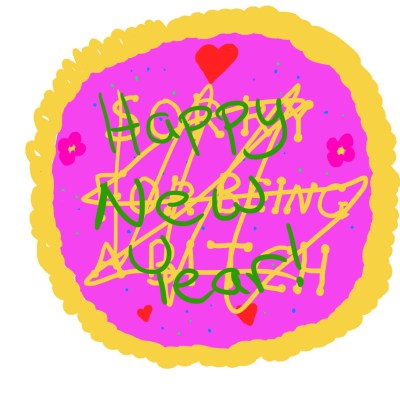
Hello!  Happy New Year!  2012 is gonna be great.  I just know it.  I made you all a Happy New Year cake, too!

What?  You didn’t eat the last one.  I didn’t want it to go to waste.

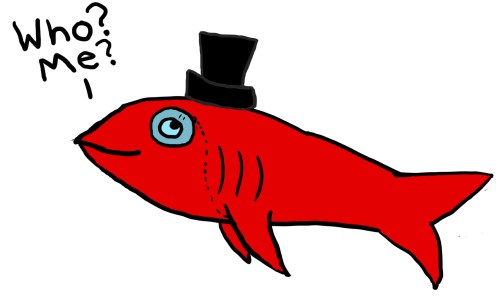
Now that that’s out of the way, I want to talk about two things today.  First, I will finish up my spiel about Chekhov’s Gun by doing a magic trick.  I am going to turn Chekhov’s gun into a fish, right before your very eyes!  And not just any fish.  A red fish.  Presto Magic-Wordo!  Chekhov’s Gun is now a Red Herring!

See, the thing about Chekhov’s Gun is that you have to make everything count.  Stuff has to be there for a reason.  At first glance, the Red Herring doesn’t seem to fit that description.  It’s not there for any reason.  It’s just a distraction.  But that’s just it.  Its purpose is the distraction.  For those who don’t know, a Red Herring is a term that refers to something in a story that appears significant, but isn’t at all.  The point of it is usually to distract the characters and the reader/viewer from the stuff that really is relevant.  It’s a common plot device, and it does add a lot to the story in its own way.  So the herring is a gun, it’s just a gun that’s never fired.  You can spend the whole play/movie/book/story thinking that the gun is going to be fired, only to find that the main character murders someone with a kitchen knife instead.  Like, Fred could be robbing Marco, and he could place himself in front of the gun on the mantle thinking that it was Marco’s only form of defense.  Then won’t Fred be surprised when Marco pulls his pocket-machete out and kills him!  The gun never got fired but it was really important!  See?  See?  I hope you do, because I don’t think I can spend any more time explaining this.

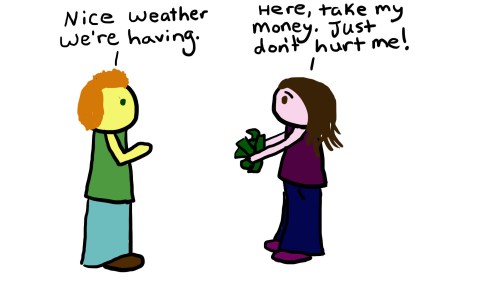
On to the next topic!  I was thinking the other day about something my high school theater teacher taught me.  She always said that in acting, the pinch has to justify the ouch.  Meaning if someone walks up and pinches you, and you say (without irony) “Oh God!  It hurts so much!  Someone please help me!  Call an ambulance!  I don’t think I’m going to make it!” then your “ouch” isn’t justified.  Turn that pinch into a gunshot wound, however, and the “ouch” is justified.  In short, you have to make sure the reactions make sense.  This applies to more than just acting.  It can also pertain to dialogue, action, and narration in a story.  Like so:

Little does he know, that’s not a wad of cash I’m holding.  It’s a head of lettuce.

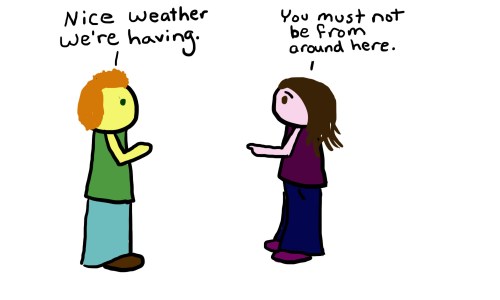
But the reason I’m pointing this out isn’t because I think people are making errors like the one above.  I’ve said before that sometimes I’ll rush scenes or dialogue in order to get to some important information, and this can often lead to some “ouches” that aren’t justified by the pinch.  Take this example:

My reaction isn’t that extreme anymore, but it still isn’t quite right.  A step or two is missing in this conversation.  Now it’s perfectly understandable to want to point out that a character is new around town.  Maybe the guy up there is your Neophyte.  (Remember my post about that?)  But jumping straight from talk about the weather to “Hey, you’re new” isn’t the way to go.  My response still isn’t justified.

The response, justified or otherwise, doesn’t have to come in the form of speech either.  If I’d said nothing in the above situation, or slapped the guy across the face, those reactions would have been just as weird.  So if you want them to get by, then sometimes you have to justify them with narration, which is perfectly okay.  Like, maybe he was saying one thing, and I was thinking that I’d never seen him around town before, and we both spoke at the same time.  Or I’m just an incredibly awkward human being.  Basically what I’m saying is that you should think about your story as a set of dominoes.  It’s a string of causes and effects that should flow along smoothly.  Unless (because there’s always an “unless”) your story is meant to be disjointed or disorienting or something like that.  That is all!

Word of the Day: Spiel (n) – a usually high-flown talk or speech, especially for the purpose of luring people to a movie, a sale, etc.; pitch

Leave a comment

Filed under books, Humor, writing