Tag Archives: query letter

Am I Being Right or Stubborn: A Guide for Writers

I got my editorial letter! This is the second editorial letter I have received in my life, but I don’t remember if I talked about it or explained it back when Hellbound was almost close to almost being considered for publication. That version of events is too depressing to talk about anyway, so I thought I’d do a post about editorial letters that is positive and happy! But then I remembered John Green already did a great explanation of editorial letters about thirteen years ago on his YouTube channel.

(Speaking of YouTube, I have released two new videos since my last post.)

Everyone can help me thank John Green for saving me time by watching this video (don’t worry it’s short):

That being said, I wanted to explain the editorial process in broad terms real quick. You see, editing a book is an upside-down pyramid. It starts with broad strokes, big sweeping changes, and generalized feedback. Then it moves on (when your editor is satisfied that it can move on) to narrower, more focused changes.
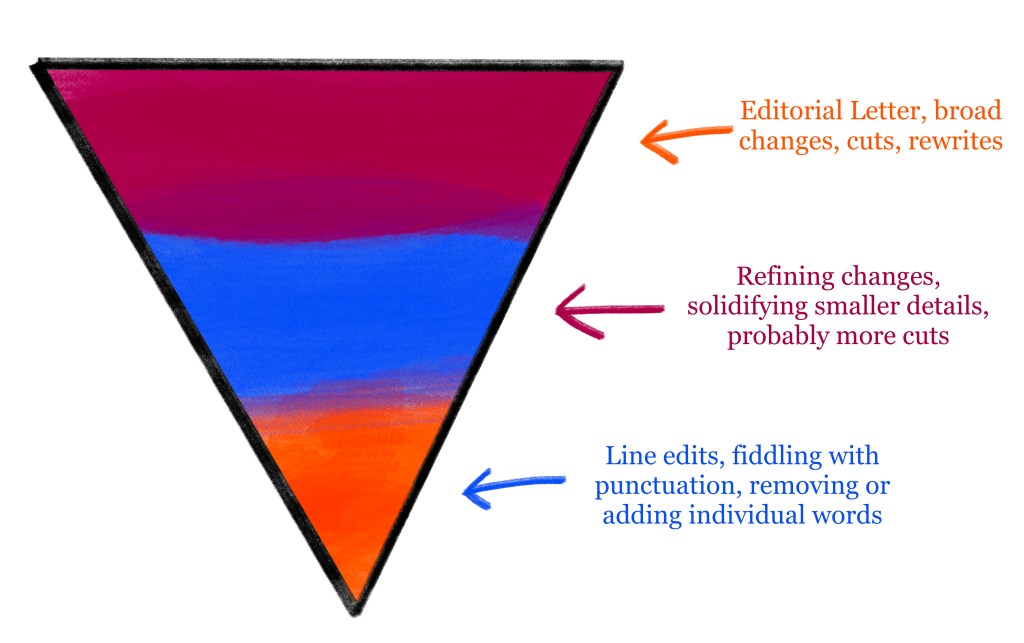
A lot of people imagine book editing as the editor getting out their red pen (or writing utensil of choice) and marking up the manuscript. But you can’t do that for the first edit because the markup would literally coat the text of the book itself. This would inevitably lead to a mental breakdown on the part of the author, and while we authors are quite familiar with the art of the mental breakdown, healthcare professionals do discourage having more than two or three a year. It takes a while to get down to the nitty-gritty of line edits down there at the point of the pyramid.

What’s really exciting for me is that I am only familiar with the top sections of the pyramid! I can’t express how much I am looking forward to discovering parts of the publishing process that I have not been through before. The thrill of the unknown! I just know that this thing is going to start feeling 1,000% more real once we start talking cover design, and I’ll be sure to update when I can so that you, dear reader, can follow along with me.

What I want to touch on real quick is an issue I’ve run into regarding the plot of my book. Falling for the Protagonist is a satirical novel, and therefore I felt that there was a certain amount of leeway I had vis-a-vis “explaining” the supernatural elements. In my mind, because it was satire, part of the point was that the magical stuff and the [REDADCTED TO AVOID SPOILERS] were not practically explained or reasonable at all. For me, that was funny. It fit the theme of the book, which is that romance novels typically bend over backwards to accomodate their happy and just worlds. The previous statement is not said with any kind of censure on my part; I read romance novels because they provide the comforting certainty of a happy and just ending.

But then literary agents started rejecting the manuscript because “there wasn’t enough explanation” of how/why the supernatural stuff happened. At first, I scoffed in an authoritative and haughty way. (I didn’t want you to miss that great pun back there, so I went ahead and emphasized it for you. You’re welcome!)
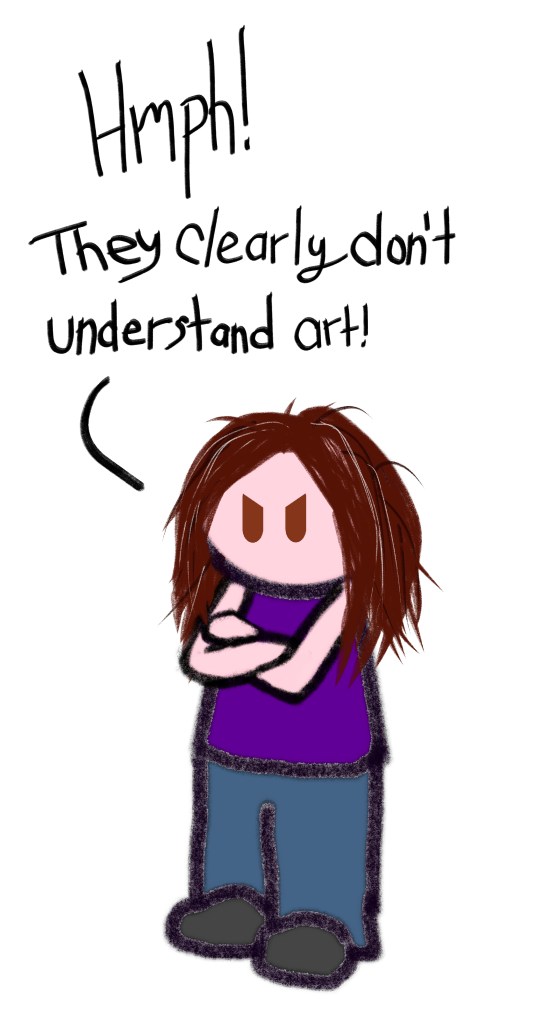
I changed my tune recently, however, when my lovely editor mentioned that we needed to work on better explaining the “rules,” and I was finally confronted with the fact that maybe it was time to kill my darling. In this case, I had to accept that what I thought of as a perfectly acceptable and on-brand element of the novel was clearly not hitting right when other people read it. A good rule of thumb: If some part of your vision isn’t translating well to readers (Even if it makes perfect sense to you!), it shouldn’t make it to the final draft.

The problem many writers run into when encountering other people’s suggestions is that it’s sometimes hard to know when to stand your ground, and when to accept that you need to make changes. Sometimes you get a lot of feedback, and some of it is contradictory. Which do you listen to, if any? If you push back, are you doing so because you are confident in your writing and your concept? Or are you accidentally (or purposefully; no judgement) being a stubborn artiste who refuses to back down?

As with all things creative, there is no single right answer. It’s one of the most frustrating things about being creative sometimes. Other times, it’s a gift. (For example, the fact that good art can be achieved in any number of different ways is freeing for those who want to explore unusual or unexpected artistic avenues.) For me, I have recently discovered that I should probably sit up and pay attention when multiple professionals in the industry are saying the same thing. It’s hard to keep claiming I’m in the right when literally no one agrees with me. Not even my inner goddess!
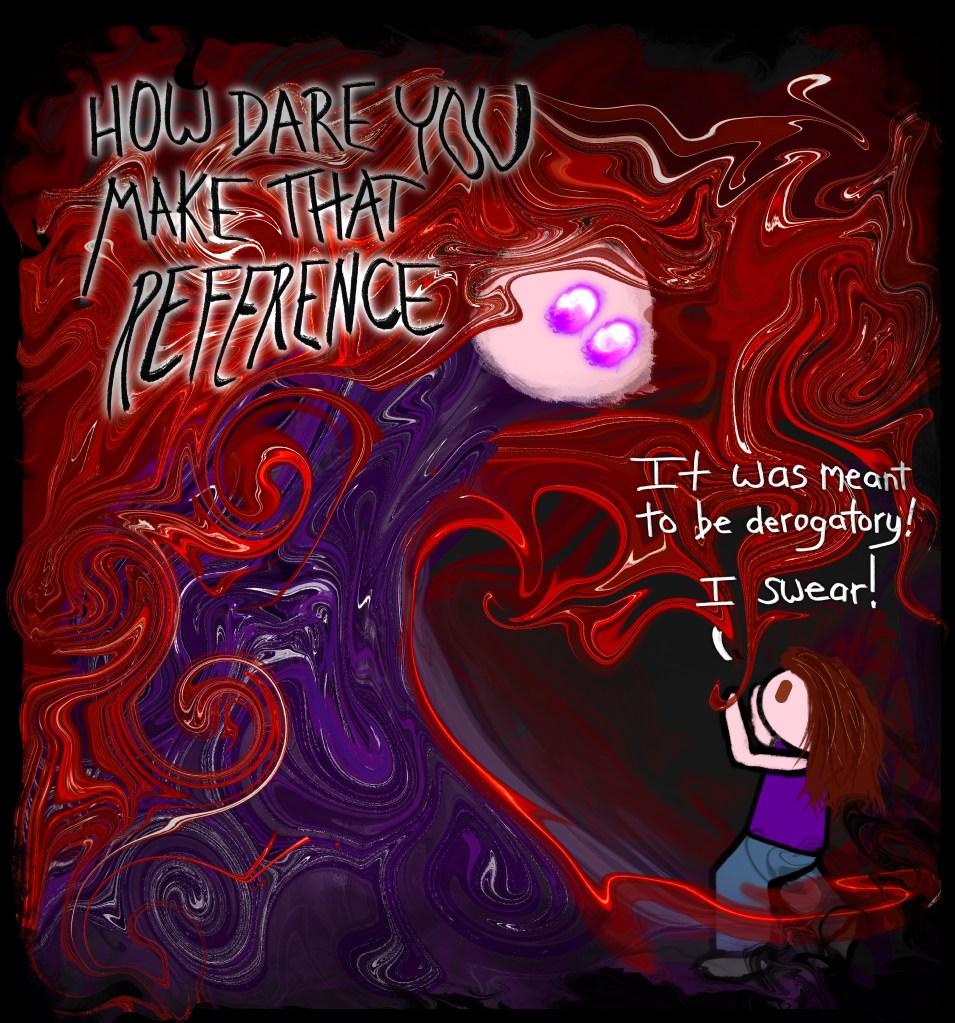
I typically go through some variation of the stages of grief when I have to change something that I was willing to defend for so long, but I have trained myself to get to the Acceptance stage pretty quickly.

In short (too late, I know), you don’t have to listen to everyone’s opinion, but if you get the same advice consistently from people with the credentials to back it up, it may be time to throw in the towel.

I will conclude on an optimistic note, which is unusual for me, but apt in this moment. If you are an aspiring writer, I want you to remember this: Many literary agents rejected my book because of this issue. They didn’t see the manuscript as worth representing because they couldn’t get past this obstacle. I sure did get discouraged! Looking back on it, I’m glad those rejections happened. Because the agent who decided that this plot issue wasn’t a deal-breaker for her is clearly the person I was meant to be working with. Same goes for my editor. My manuscript wound its way through the agencies and publishing companies until it found the right people for its needs. A lot of boilerplate rejections contain language along the lines of “it wasn’t a good fit.” It’s a trite phrase, but I’d like you to consider that it is also 100% truthful. You do not want someone representing you and your work if they didn’t feel that “click” when they read your manuscript.

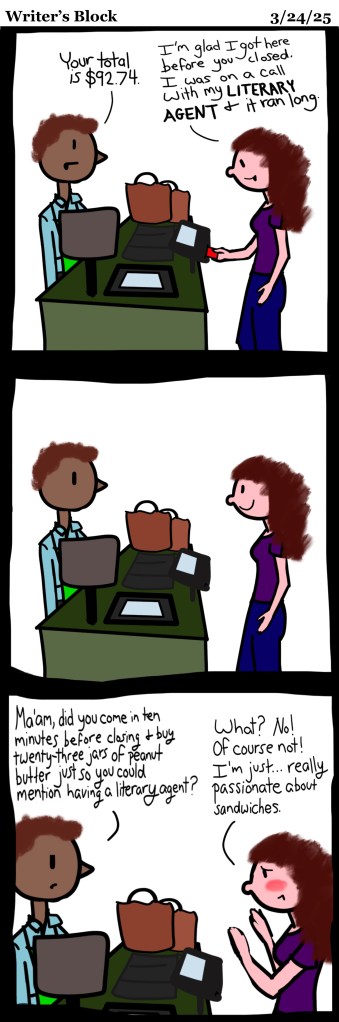
And, yes, I have been finding ways to work “I have an agent and/or editor” into everyday conversation as much as possible. I imagine I’ve become absolutely insufferable, but I just can’t help myself.
Leave a comment

Filed under books, publishing, writing

Not Special Enough

I wrote this book recently. It’s called Falling for the Protagonist. I had a great time writing it. The premise is that a woman gets transported into a romance novel and sends the male protagonist spiraling into an existential crisis when he realizes he’s a book character. It’s funny but emotional (Big ups to me for making myself cry at one point during a reread!), satirical of the romance genre but also an homage to it. I’m quite proud of it. I’ll copy and paste the first few paragraphs at the bottom of this post for those who are interested.

I’ve been querying this book. Got a couple rejections. No big. Except for this one that stuck out to me. Short but sweet, it said:

Hello Bex,

Thank you so much for sending your materials for our review. We really enjoyed this and can see the potential in your writing.

Unfortunately, however, despite all that we liked, we didn’t quite fall in love with this as we had hoped, so we will not be offering representation at this time.

Now, don’t get me wrong. A response–any response–from an agency is a good thing. There are many who say that you just have to wait six to eight weeks and if you don’t hear from them, that’s a rejection. The ambiguity and the… I suppose anticlimax of it… can be frustrating. Not that I blame them one bit. Can you imagine taking the time to send out what must be hundreds of rejection emails every week? No thank you. I’m just saying, when I get a negative response, I appreciate it.

But being me, I started to close-read this thing a little. What it boils down to is: Your writing is great. We don’t like it anyway. (Yes, I’m putting words in their mouth. My writing might have come across to them as merely good or adequate, but allow me the paraphrase here for the sake of my ego.)

I’ve contended with this frustration for many years. I’m not saying I think they should have accepted my book. Quite the opposite, actually. There are some people who write back or get angry or try to argue with these agents (I know; I used to intern for one). And all I want to ask them is: Do you really want someone representing your work who feels anything less than enthusiastic about it? How are they going to sell it to others if they can’t even sell it to themselves?

This also ties into the age-old question that agents and editors get asked time and time again: What do you look for in a book? I understand why people ask this question as they’re hoping to get an edge on how to find representation, but it’s unfortunately just not possible to answer as this industry is entirely subjective. The usual answer is something along the lines of, “I need a really strong voice.” This translates to what I see as a universal truth:

Sometimes I pick up a book and I like it. Sometimes I pick up a book and I don’t like it.

Happens to me all the time. I’ll start reading something and the writing will be perfectly sound, but it doesn’t “grab me” as they say. And I can’t always put my finger on why. The truth is, an agent (or editor) has to pick up your book and feel the click. No click, no contract. They can’t say “I didn’t like your book, but I don’t know why” because writers would riot. But that’s the gist.

This all brings me back to the aforementioned frustration I’ve been contending with. I think my writing is good. Some of my books are better than others, and I always have room for growth, but I’ve crafted some solid stories. I believe my writing is special and unique. The problem is, and I’ve just started to wrap my head around this, everyone is special and unique. It’s true! You are unique! But in a world that celebrates only a select few special people, that only works if everyone else fails to be recognized for their specialness. There would be no Many to worship the Few otherwise. There are thousands of good writers out there who will never get a publishing contract, actors worthy of every award in the book who will never see a stage or the front end of a camera, singers with voices like angels who won’t get a recording contract. You get it.

I know there is a very good chance that I will never see my work published (the traditional way). It’s just the way it goes. I’m special. I believe that. But I’m not special enough. LEST YOU THINK I AM GOING TO END THIS POST ON A MAJOR DOWNER…

It’s not my job to be the motivational poster on your wall. I’d suck at it anyway. Although… I did make this one.

But only because I thought it was funny!

The point is, I see no harm in trying again and again. If I lost track of Why (with a capital W) I write (i.e. because I enjoy it), that would be the real downer. As long as I’m writing, and I don’t see myself stopping, why not query? Why not put myself out there? A thousand rejections hurt, but I firmly believe you miss 100% of the shots you don’t take. So go for it. If you don’t believe in your own specialness, how can anyone else?

Huh. I guess I became a motivation poster anyway.

Here’s a teaser of Falling for the Protagonist:

Chapter One

The back corner of the bar known as Bonne Nuit echoed with the jovial, slightly manic, titters and squeals that could only belong to a group of women who were two hours into a bachelorette party. Emmy Miura kept smiling as the feminine chaos surrounded her and tried to tamp down on the deep, heartfelt longing she felt for her comfy pants. They were at home all alone, probably missing her. She couldn’t remember the last time she’d left them for so long on a Saturday night. Trying not to sulk, she shifted around until the strapless cocktail dress she’d bought for the occasion—at her sister’s subtle insistence—settled a little more comfortably around her.

“Deep breaths,” her best friend of a million years, Sarah, murmured to her.

“I am a bad person for wanting to leave.”

“You are a good sister for staying.”

That was one way to look at it, and Emmy did enjoy seeing May’s happiness, which was flowing more readily than the happy hour specials. Her sister, adorned with a sparkling headband that was coated in curlicues of metallic ribbon, was leaning over to listen to one of her friends. Whatever the friend said lit up May’s face.

“Yes!” she cried. “Yes, absolutely. I have to tell the story. I don’t even care if everyone’s already heard it a million times. Emmy, cover your ears.”

Emmy immediately went on alert. “Why?”

“Because I’m going to tell—shh seriously, guys, this is good—I’m going to tell the story of how me and Luis met. Emmy hates this because she is a cynic and a nonbeliever, but I’m telling it anyway because it is my party!”

“Oh Jesus.”

“How did they meet?” Sarah asked.

“She went to a sex psychic,” Emmy muttered under her breath.

“Sorry. Run that by me one more time?”

Emmy gestured to her sister, indicating Sarah should listen to May, and repeated, “She went to a sex psychic.”

1 Comment

Filed under writing

Some Things to Keep in Mind BEFORE Querying an Agent (Part 3)

We’ve come to the end of a long journey, my friends.  Thank you for sticking with me this far.  I’ve got some last points to make, and then I’ll let you be on your merry way.  So let’s get to it!  The finale!

#8 – When we tell you we’re swamped – we mean it!

This is basically a reiteration of what I said in my previous post, but with more focus on the rejection letters you will inevitably receive.  Most rejection letters will include an apology that goes something like, “While your book is no doubt wonderful, we have decided to pass as this time.  Please understand that we receive a great deal of submissions each day, yadda yadda.”  Just wanted to let you know…we mean it when we say that.  When we reject you, it really doesn’t mean that your book is bad and that you should stop trying.  That being said, there are some things you should keep in mind…

#9 – Do YOU like your book?

How do I say this?  Of course you have to like your book if you believe in it enough to send it out to agents, but…have you read similar titles?  Have you compared your book to other books you like and seen if it holds up to the already published books’ high standards?  They say you are your own worst critic.  I think that’s good.  It’s when you’re your own biggest fan that you run into trouble.  If you’re unable to cast a critical eye on your own work, play devil’s advocate and anticipate the criticisms that agents are going to give, then your book probably isn’t quite ready to be unleashed on the world.

When I talked about doing your research in my last post, and having other people read your work, I really, really meant it.  Because we are busy, and we don’t want to have our time wasted by the first 100 pages of literary nonsense that fell out of your brain.  It’s harsh, but it’s true.  A lot of people think agents are there to do your critiquing and revising for you, but that’s just not right.  We can’t take on a book unless it’s as close to finished as it can possibly get without the help of a professional editor.  Our jobs are on the line if your book doesn’t sell, so we can’t take on a project that only has the potential for being good.  Because there’s no guarantee that the author will be receptive to our criticism, and, even if they are, they still might not be able to make the changes we want to see.

And finally…

#10 – How is your book different from the hundreds of thousands that are already out there?

When agents like a book, they have to go through the same process that authors do – querying.  Only agents query the publishers, and the publishers aren’t keen on taking on every project that gets sent their way.  So we have to know why this book is unique and different and guaranteed to sell a million copies.  Which means you have to know all that, and you have to tell us!  When you do your research and find other similar titles, you have to tell us that you’ve looked at them, and that yours is different because it has/does/includes____________________, which none of those other books have done.  Now, this doesn’t necessarily have to be included in the query, though it wouldn’t hurt, but you should be prepared to answer those questions in case they’re asked.  Especially if you know that your book is really, really similar to, say, the Sherlock Holmes series.  We’re going to want to know how you’re different from a Sir Arthur Conan Doyle wannabe, and you’d better be prepared with a better answer than, “My book takes place in present day.”

That’s it!  We’re done!  Hooray!  I hope I was somewhat helpful.

Word of the Day: Finale (n) – The last piece, division, or movement of a concert, opera, or composition.

1 Comment

Filed under books, Humor, writing